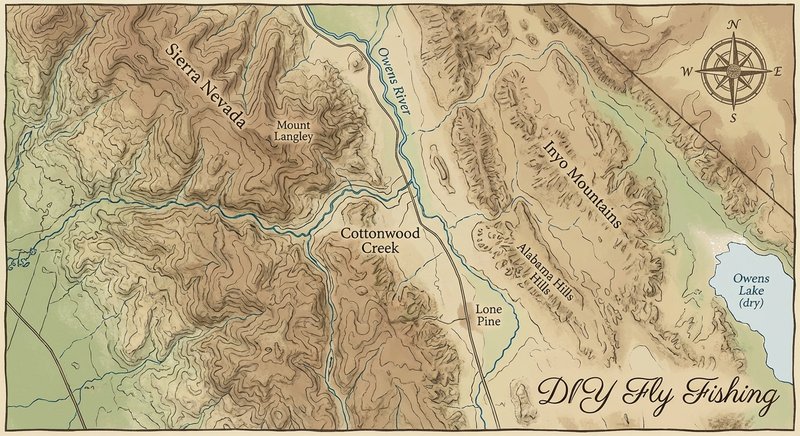
Cottonwood Creek (Inyo)
Fly fishing in California · Advanced · Best seasons: Summer, Fall
Target Species
Golden Trout, Rainbow Trout
About This Water
Southern Eastern Sierra stream with wild golden and rainbow trout. High altitude fishing.
Fishing Recommendations
Welcome to the high country. As your guide, I’m excited to walk you through one of the most storied fisheries in the Eastern Sierra. Cottonwood Creek, located in the Golden Trout Wilderness of Inyo National Forest, isn't just a place to catch fish; it is a pilgrimage for those seeking the rarest and most beautiful trout in the world.
This is the ancestral home of the California Golden Trout (Oncorhynchus mykiss aguabonita). The fish from this specific drainage were used to seed populations across the American West.
🎣 Location Overview
Cottonwood Creek is a high-altitude alpine stream located south of Mt. Whitney. It winds through vast meadows (like Horseshoe Meadow) and steep, rocky canyons at elevations between 9,000 and 10,000 feet.
What makes it special is the sheer purity of the environment. The water is crystal clear, cold, and relatively small. It offers classic "meadow-style" fishing where the creek meanders in tight "S" curves, undercut banks, and deep pools. Anglers love it because it provides a rare opportunity to catch a genetically pure Golden Trout in its native range, set against the backdrop of ancient Foxtail Pines and granite peaks.
🐟 Target Species & Behavior
- California Golden Trout: The primary draw. These fish are remarkably vibrant with crimson bellies and gold flanks. In these high-altitude environments, they are opportunistic but wary.
- Rainbow Trout: Found primarily in the lower reaches or where the creek leaves the wilderness boundary. Some hybridization occurs, though efforts are made to keep the upper reaches pure Golden.
Behavior: Due to the short growing season, these fish are aggressive feeders. They hold in the deepest parts of small pools, under log jams, and right against undercut banks. They are extremely sensitive to shadows and ground vibrations—if they see you, the fishing is over for that pool.
📅 Best Times to Fish
- Optimal Seasons: Late June through September.
- Summer (July - August): This is the prime window. The snow has melted, the meadows are accessible, and the terrestrial insect activity is at its peak.
- Fall (September - October): The air gets crisp, and the fish feed heavily to prepare for the long winter. The colors of the Golden Trout become even more intense during the fall.
- Best Times of Day: 10:00 AM to 4:00 PM. Unlike lower elevation streams, the high country stays cold. You don't need to be there at dawn; wait for the sun to hit the water and activate the bugs.
- Prime Windows: The "Golden Hour" here is mid-afternoon when the grasshoppers and ants are most active in the meadows.
🪰 Recommended Flies & Techniques
Top Fly Patterns
Because these fish have a high metabolism and a short summer, they aren't usually "picky" about hatch matching, but they are "size sensitive." Keep everything between size 14 and 18.
- Dry Flies:
- Parachute Adams (Size 16-18): The gold standard.
- Elk Hair Caddis (Size 14-16): Great for the riffles.
- Royal Wulff: High visibility and attracts aggressive strikes.
- Ants & Beetles (Size 16): Essential for meadow sections.
- Joe's Hopper (Size 14): Perfect for August breezes.
- Nymphs:
- Gold-Ribbed Hare’s Ear: Imitates almost anything.
- Pheasant Tail: Best for the deeper pools.
- Zebra Midge (Black or Red): Use when the water is glass-calm.
Techniques & Presentation
- The "Stealth" Approach: Stay 10 feet back from the bank. Kneel if you have to. If you can see the fish, they have likely already seen you.
- Dry-Dropper: This is the most effective rig. Run a buoyant dry fly (like a Humpy) with a small Pheasant Tail nymph tied 12-18 inches below it.
- Short Casts: You rarely need to cast more than 15-20 feet. Accuracy and a delicate landing are more important than distance.
💡 Pro Tips & Local Knowledge
- Watch the Shadows: In the treeless meadows, your shadow is a giant warning sign. Always fish with the sun in your face or at an angle that keeps your shadow off the water.
- Target the "Undercuts": The biggest Goldens hide under the grassy banks. If you drop a terrestrial fly (like an ant) right against the sod, be prepared for a lightning-fast strike.
- Keep Moving: Cottonwood Creek is small. If you catch one or two fish in a hole, move on to the next one to avoid spooking the entire stretch.
- Dull Your Gear: Use matte-finish reels and rods if possible. The high-altitude sun reflecting off a shiny rod can spook fish from a distance. Use 5X or 6X fluorocarbon tippet for the best results.
⚠️ Important Information
Access
Access is via Horseshoe Meadow Road out of Lone Pine, CA. It is a steep, winding road that climbs to 10,000 feet. The road is typically closed in winter and opens in late May or June depending on snowpack.
Regulations & Permits
- Barbless Hooks: Highly recommended to protect these fragile native fish.
- Catch and Release: While some areas allow keeping fish, most serious anglers practice 100% catch and release here to preserve the Golden Trout lineage.
- License: A valid California Fishing License is required for everyone 16 and older.
- Wilderness Permits: If you plan to backpack/overnight in the Golden Trout Wilderness, you must obtain a wilderness permit via Recreation.gov. Day hiking does not require a permit.
Special Considerations
- Altitude: You are fishing at 10,000 feet. Hydrate aggressively and watch for signs of altitude sickness.
- Weather: Thunderstorms can roll in rapidly in the afternoon. Always carry a light rain shell.
- Bear Country: This is Black Bear territory. If you are camping, use the provided bear lockers at the trailhead or a bear canister in the backcountry.
Tight lines, and enjoy the pursuit of the "Fish from Heaven!"
Bug Hatches & Matching Flies
| Hatch | Type | Peak months | Time of day | Hook sizes | Matching flies |
|---|---|---|---|---|---|
| Blue-Winged Olive (BWO) Baetis tricaudatus | mayfly | May, September, October | Late Morning/Afternoon | #18-22 | Parachute Adams #18-22, Pheasant Tail Nymph #18-20, RS2 #20-22 |
| Pale Morning Dun (PMD) Ephemerella excrucians | mayfly | July, August | Late Morning/Afternoon | #16-18 | PMD Sparkle Dun #16-18, Mercer's Trigger Case PMD #16-18, Quill Gordon #16 |
| Little Brown Stonefly Zapada sp. | stonefly | June, July | Morning/Evening | #14-16 | Stimulator (Brown) #14-16, Pats Rubber Legs (Small) #14-16 |
| Spotted Sedge Hydropsyche | caddis | July, August | Evening | #14-18 | Elk Hair Caddis (Tan) #14-18, LaFontaine's Deep Sparkle Pupa #16, Goddard Caddis #14-16 |
| High Sierra Midges Chironomidae | midge | June, July, August | All Day | #20-24 | Zebra Midge (Black/Silver) #20-22, Griffith's Gnat #20-24, Morgan's Midge #22 |
| Carpenter Ants Camponotus | terrestrial | July, August | All Day | #12-16 | Black Foam Ant #14-16, Chernobyl Ant #12-14 |
| High Sierra Grasshoppers Melanoplus | terrestrial | August, September | Mid-day/Afternoon | #10-14 | Dave's Hopper #12-14, Hopper Juan #12 |
| Golden Stonefly Hesperoperla pacifica | stonefly | July | Morning/Evening | #8-12 | Golden Stone Nymph #10-12, Rogue River Stone #8-10 |