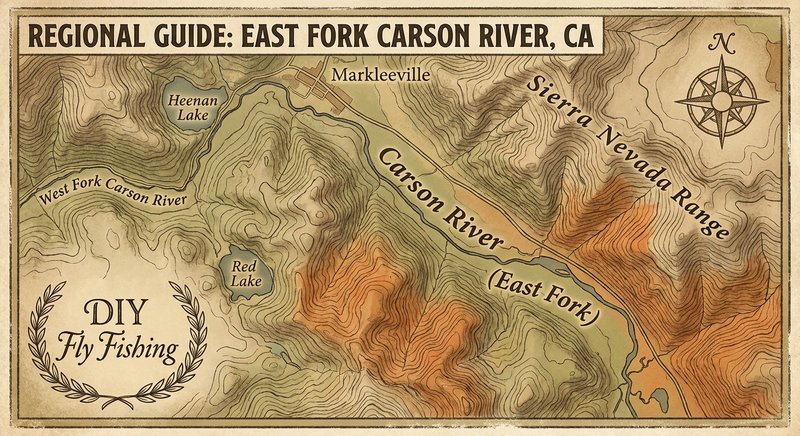
Carson River (East Fork)
Fly fishing in California · Intermediate · Best seasons: Summer, Fall
Target Species
Rainbow Trout, Brown Trout
About This Water
Eastern Sierra freestone with wild trout. Scenic canyon fishing near Markleeville.
Fishing Recommendations
The East Fork of the Carson River is one of California’s most scenic and accessible "wild and scenic" designated rivers. Stretching from the high peaks of the Sierra Nevada down into the high desert of Nevada, it offers a dramatic transition in landscape and a quintessential Western fly fishing experience.
🎣 Location Overview
The East Fork Carson (specifically the California side near Markleeville) is a classic freestone river. It is characterized by boulder-strewn pocket water, deep runs, and large, languid pools. What makes it special is the diversity of the terrain—you can fish high-alpine meadows near the headwaters or the rugged, steep canyons below Hangman's Bridge.
Anglers love it because it feels remote despite being easily accessible from Lake Tahoe or Reno. The water is generally clear and cold, and because it is a freestone river (un-dammed in its upper reaches), the fishing is dictated by the natural rhythms of snowmelt and insect hatches.
🐟 Target Species & Behavior
- Rainbow Trout: These are the primary residents. You will find a mix of wild "bows" and some holdover stocked fish. They are typically found in the faster oxygenated water—heads of riffles and along the "seams" where fast and slow water meet.
- Brown Trout: The East Fork is famous for some truly large, cannibalistic Brown Trout, especially in the deeper pools and undercut banks. Browns here are wary; they tend to hold in the shadows or under structure during the day and move into the shallows to hunt at dawn and dusk.
- Mountain Whitefish: You will likely hook into these as well. They congregate in the deep, slow tailouts of pools and are great indicators that you are getting your flies deep enough.
📅 Best Times to Fish
Optimal Seasons
- Summer (Late June – August): This is prime time once the spring runoff subsides. The water drops to a manageable level, and the dry fly action begins in earnest.
- Fall (September – November): My personal favorite. The crowds thin out, the Brown Trout become aggressive as they prepare to spawn, and the cottonwoods turn a brilliant gold. Water temps are perfect.
Best Times of Day
- Summer: Early morning (sunrise to 10:00 AM) and "the magic hour" (the last two hours of light). Mid-day can be slow due to high sun.
- Fall: The window shifts to mid-day. As the water cools, the fish wait for the afternoon sun to activate the bugs.
🪰 Recommended Flies & Techniques
Top Fly Patterns
- Dry Flies:
- Hopper patterns (Dave’s Hopper, Morrish Hopper) in size 8-12.
- Stimulators (Orange or Yellow) size 10-14.
- Parachute Adams (size 14-18) for general hatches.
- Elk Hair Caddis (Tan or Olive) size 14-16.
- Nymphs:
- Pats Rubber Legs (Stonefly imitation) in Coffee/Black.
- Prince Nymph (size 12-16).
- Pheasant Tail or Hare’s Ear (size 16-18).
- Streamers:
- Sculpzilla or Wooly Buggers (Olive, Black, or White) for those big Browns.
Techniques
- Dry-Dropper: This is the "bread and butter" technique for the East Fork in summer. Use a buoyant Hopper or Stimulator as your "indicator" and hang a Beadhead Pheasant Tail 2-3 feet below it.
- High-Sticking/Euro Nymphing: In the heavy pocket water near the bridge, keeping your line off the water is crucial to avoid drag.
- Streamer Stripping: In the fall, swing streamers through deep pools or strip them aggressively through undercut banks.
💡 Pro Tips & Local Knowledge
- Focus on the Pocket Water: Many anglers walk right past the small pockets behind boulders to get to the "big pools." In the heat of summer, the biggest fish are often in those small, oxygen-rich pockets.
- Hangman’s Bridge to the Nevada Line: This is the most famous stretch. Below the bridge, the river enters a canyon. If you are willing to hike a mile or two downstream, the fishing pressure drops significantly and the fish become much less "educated."
- The "Carson Twitch": When fishing hoppers in the summer, don't be afraid to give the fly a tiny twitch. It mimics a grasshopper struggling and can trigger a violent strike from a large Brown.
- Watch the Flows: Because it’s a freestone, check the USGS gauges. If flows are above 500 cfs, wading can be dangerous. The "sweet spot" for wading is usually between 150 and 300 cfs.
⚠️ Important Information
- Access: Most anglers access the river via Highway 4 (Ebbetts Pass) or Highway 89. Hangman’s Bridge (where Hwy 89 crosses the river) is the primary hub.
- Regulations:
- The section from Hangman's Bridge downstream to the Nevada State Line is a designated Wild Trout Water.
- Regulations: Minimum size 14 inches, limit 2 fish, and you must use artificial lures with barbless hooks.
- Always check the current California Department of Fish and Wildlife (CDFW) regulations before heading out, as rules can change seasonally.
- Permits: A valid California Fishing License is required. If you cross into Nevada, you need a Nevada license.
- Safety: This is rattlesnake country in the summer. Watch your step when bushwhacking through sagebrush and willows. Also, be mindful of afternoon thunderstorms in the high Sierra.
Bug Hatches & Matching Flies
| Hatch | Type | Peak months | Time of day | Hook sizes | Matching flies |
|---|---|---|---|---|---|
| Golden Stonefly Hesperoperla pacifica | stonefly | June, July | Morning/Evening | #8-12 | Chubby Chernobyl (Gold) #8-12, Pats Rubber Legs #8-12, Golden Stone Nymph #10-12 |
| Blue Winged Olive (BWO) Baetis | mayfly | March, April, October, November | Mid-day/Afternoon | #18-22 | Parachute Adams #18-22, RS2 #20-22, Pheasant Tail #18-20 |
| Pale Morning Dun (PMD) Ephemerella excrucians | mayfly | June, July | Mid-morning/Afternoon | #14-18 | PMD Sparkle Dun #16-18, Quigley Cripple #14-16, Military Mayfly #16-18 |
| Spotted Sedge Hydropsyche | caddis | June, July, August | Evening | #14-18 | Elk Hair Caddis #14-18, LaFontaine's Deep Sparkle Pupa #14-16, Peeping Caddis #14-16 |
| Little Yellow Sally Isoperla | stonefly | July, August | Afternoon/Evening | #14-16 | Yellow Stimulator #14-16, Iron Lotus #16, Yellow Sally Nymph #14-16 |
| Grasshoppers and Ants Orthoptera/Formicidae | terrestrial | August, September | All day | #10-16 | Dave's Hopper #10-12, Carpenter Ant #14-16, Morrish Hopper #10-14 |
| October Caddis Dicosmoecus gilvipes | caddis | September, October | Afternoon/Evening | #8-12 | Orange Stimulator #8-12, October Caddis Pupa #10-12, Bird's Nest (Orange) #10-12 |
| Midges Chironomidae | midge | January, February, March, December | Morning/Afternoon | #18-24 | Zebra Midge (Black/Silver) #18-22, Griffith's Gnat #20-22, Top Secret Midge #20-24 |