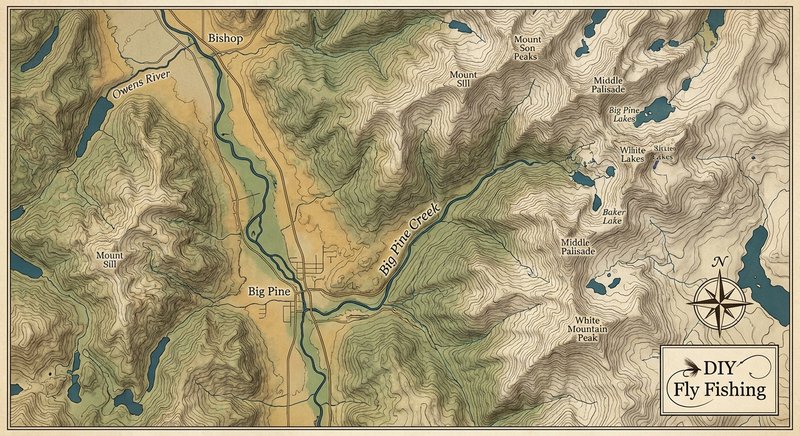
Big Pine Creek
Fly fishing in California · Intermediate · Best seasons: Summer, Fall
Target Species
Rainbow Trout, Brook Trout
About This Water
Near Big Pine with wild trout below glaciers. High Sierra adventure fishing.
Fishing Recommendations
Welcome to the Eastern Sierra. As a guide in this region, I can tell you that Big Pine Creek offers one of the most visually stunning fly fishing experiences in California. Located west of the town of Big Pine, this drainage is famous for the "Big Pine Lakes" and the towering Palisades—the southernmost glaciers in North America.
Fishing here is a tale of two waters: the high-gradient, pocket-filled creek and the turquoise, glacial-fed alpine lakes.
🎣 Location Overview
Big Pine Creek is a classic Eastern Sierra freestone system. It is divided into the North Fork (the most popular for hikers and anglers) and the South Fork.
What makes this water special is the Glacial Flour. The upper lakes (Lakes 1, 2, and 3) are fed by the Palisade Glacier, giving them a surreal, milky turquoise color. The water is cold, oxygenated, and holds a mix of wild and stocked fish. Anglers love it because it combines "small stream" technical fishing in the canyon with "stillwater" tactics in the high-altitude basins, all under the shadow of Temple Crag.
🐟 Target Species & Behavior
- Rainbow Trout: These are the primary residents of the lower creek (near the campgrounds) and Lakes 1 and 2. In the creek, they are opportunistic, sitting in "cushions" in front of boulders or in the tail-outs of pools.
- Brook Trout: You will find Brookies in high concentrations in the upper lakes (Lake 4, 5, and the Black Lake loop) and the smaller feeder streams. They are aggressive, especially in the fall, and will often strike at anything that moves near the shore.
- Brown Trout: While less common, some wild Browns hide in the deeper, brush-choked holes of the lower creek section near Glacier Lodge.
Behavior: Because the growing season is short at 9,000+ feet, these fish are not typically "selective." They are calorie-starved and will move several feet to smash a well-presented dry fly.
📅 Best Times to Fish
- Summer (July – August): This is the prime window. The snowpack has usually receded enough to make the trails accessible. The fish are most active during the heat of the day when the high-altitude sun triggers insect hatches (caddis and midges).
- Fall (September – October): My personal favorite. The crowds vanish, the mosquitoes die off, and the Brook Trout enter their spawning phase, turning brilliant shades of orange and red. The "October Caddis" hatch can provide explosive dry fly action.
- Time of Day: Unlike lower elevation rivers, you don't need to be on the water at dawn. At 10,000 feet, the water is frigid. Fishing usually picks up around 10:00 AM once the sun hits the water and peaks in the late afternoon.
🪰 Recommended Flies & Techniques
Top Fly Patterns
- Dry Flies:
- Elk Hair Caddis (Size 14-16) in tan or olive.
- Parachute Adams (Size 16-18) – the ultimate searcher pattern.
- Royal Wulff or Humpy (Size 14) – high visibility for fast water.
- Terrestrials: Foam Ants and Beetles are deadly in late August.
- Nymphs:
- Bead-head Pheasant Tail (Size 16-18).
- Zebra Midge (Size 18-20) in black/silver (essential for the lakes).
- Streamers:
- Woolly Bugger (Size 10-12) in Olive or Black. Strip these along the drop-offs in the lakes.
Techniques
- The Dry-Dropper: This is the "bread and butter" for the creek. Run a buoyant Stimulator or Elk Hair Caddis on top and hang a Pheasant Tail nymph 18 inches below it.
- Short Line Nymphing: In the steep sections of the creek, don't worry about long casts. Use a short line to "dap" your flies into the pockets behind rocks.
- Stillwater Stripping: In the lakes, find where a stream enters the lake. Cast a small Woolly Bugger into the current and use erratic, short strips.
💡 Pro Tips & Local Knowledge
- The Glacial Flour Factor: In Lakes 1, 2, and 3, the water can be cloudy. Fish can't see as far as they can in "clear" lakes. Use slightly larger flies with a bit of flash (like a Flashback Pheasant Tail) to help the fish track the fly.
- Go Higher for Brookies: If you want high-volume Brook Trout action, hike past the turquoise lakes to Lakes 4 and 5. These are clearer, less crowded, and the Brookie population is very healthy.
- The "South Fork" Secret: Most people take the North Fork trail. If you want solitude and small-stream wild trout, fish the South Fork. It's brushy and requires "bow-and-arrow" casts, but you won't see another soul.
- Inlet Strategy: Always focus your energy on the Inlets (where water flows into a lake). These spots bring in cold, oxygenated water and a steady conveyor belt of food.
⚠️ Important Information
- Access: Access is via Glacier Lodge Road out of Big Pine. The trailhead for the lakes is at the end of the road.
- The Hike: Be prepared. Reaching First Lake requires a 4.8-mile hike with 2,000 feet of elevation gain. This is "hike-to-fish" territory. Pack light and bring plenty of water.
- Permits: A standard California fishing license is required. If you plan to stay overnight, you must obtain a wilderness permit from the Inyo National Forest (these are popular and should be reserved via Recreation.gov).
- Regulations: Big Pine Creek generally falls under the Sierra District general regulations (5 fish limit), but I strongly recommend Catch and Release, especially for the wild fish in the upper basins, to preserve this fragile fishery.
- Bears & Safety: This is active Black Bear country. Use bear-proof canisters for food if camping. Also, watch the weather—afternoon thunderstorms are common and dangerous above the treeline.
Guide’s Final Word: Bring a camera. Even if the fish are being stubborn, the view of Temple Crag reflecting in the turquoise water of Second Lake is worth the hike alone.
Bug Hatches & Matching Flies
| Hatch | Type | Peak months | Time of day | Hook sizes | Matching flies |
|---|---|---|---|---|---|
| Blue-Winged Olive (BWO) Baetis | mayfly | March, April, September, October | Midday | #18-22 | Parachute Adams #18-22, RS2 #20-22, Pheasant Tail #18-20 |
| Pale Morning Dun (PMD) Ephemerella | mayfly | June, July, August | Late Morning/Afternoon | #14-18 | PMD Sparkle Dun #16-18, Quill Gordon #14-16, Split Case PMD #16-18 |
| Spotted Sedge Hydropsyche | caddis | July, August | Evening | #14-16 | Elk Hair Caddis #14-16, LaFontaine's Deep Sparkle Pupa #14-16, Hydropsyche Larva #14-16 |
| Little Yellow Sallie Isoperla | stonefly | June, July | Afternoon/Evening | #14-16 | Yellow Stimulator #14-16, Little Yellow Sloan #16, Iron Lotus #16 |
| Golden Stonefly Hesperoperla pacifica | stonefly | June, July | Morning/Evening | #8-12 | Golden Rogue Stone #8-10, Pat's Rubber Legs #8-12, Kaufmann's Stone #8-10 |
| Midges Chironomidae | midge | January, February, March, November, December | All Day | #18-24 | Zebra Midge #18-22, Griffith's Gnat #20-22, Top Secret Midge #20-24 |
| Terrestrials (Ants/Beetles) Formicidae / Coleoptera | terrestrial | July, August, September | All Day | #12-18 | Cinnamon Ant #14-18, Foam Beetle #12-16, Hopper Juan #12-14 |
| Western March Brown Rhithrogena morrisoni | mayfly | April, May | Afternoon | #12-14 | March Brown Western Red #12-14, Hare's Ear #12-14, Soft Hackle March Brown #14 |