Bishop Creek
Fly fishing in California · Beginner · Best seasons: Summer, Fall
Target Species
Rainbow Trout, Brown Trout, Brook Trout
About This Water
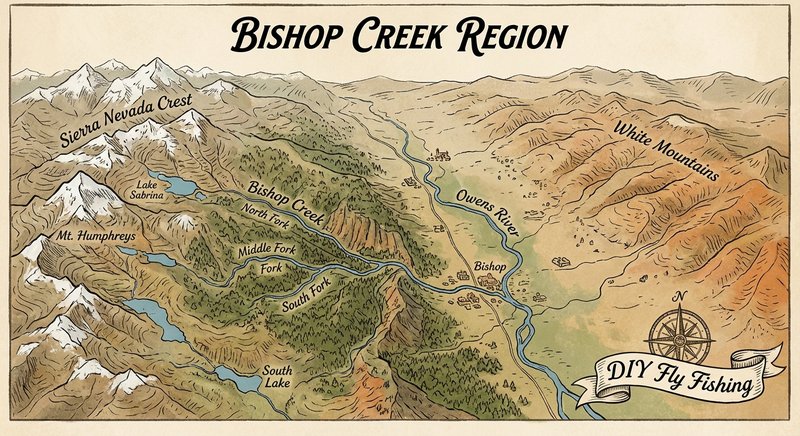
Eastern Sierra stream near Bishop. Multiple forks with wild trout fishing.
Fishing Recommendations
Welcome to the Eastern Sierra! As your guide, I’m excited to walk you through one of the crown jewels of California fly fishing: Bishop Creek.
Rising from the high granite peaks of the Sierra Nevada and dropping precipitously into the Owens Valley, Bishop Creek offers some of the most scenic and productive small-stream trout fishing in the Western United States. Whether you are fishing the South Fork, the Middle Fork, or the North Fork, you are in for a classic "mountain creek" experience.
🎣 Location Overview
Bishop Creek is a high-altitude drainage located just west of the town of Bishop, CA. It is unique because it splits into three distinct forks—North, Middle, and South—each offering a different character.
The creek is a quintessential "pocket water" fishery. You’ll find tumbling cascades, deep plunge pools, crystal-clear runs, and occasional meadow sections. What makes it special is the sheer diversity: you can fish for trophy-sized "Alpers-style" stocked Rainbows in the morning and hike into the backcountry for wild, vibrant Brookies in the afternoon. The backdrop of 13,000-foot peaks and golden aspen groves makes this a bucket-list destination.
🐟 Target Species & Behavior
- Rainbow Trout: These are the most common. The creek is heavily stocked by the CA Department of Fish and Wildlife and local landings. They tend to hold in the slower moving "buckets" behind large boulders and near road-accessible bridges.
- Brown Trout: You’ll find wild Browns primarily in the lower sections of the canyon and in the deeper, undercut banks of the meadow stretches. They are stealthier and more aggressive, especially during the fall.
- Brook Trout: Primarily found in the higher elevations, the North Fork, and the small tributaries. They are opportunistic feeders but very spooky. Look for them in the "skinny" water and headwaters.
Behavior Note: Because the water is cold and nutrient-poor compared to valley rivers, these fish are generally opportunistic. If a bug looks natural and the drift is drag-free, they will usually strike.
📅 Best Times to Fish
Optimal Seasons
- Summer (Late June – August): This is the prime season once the spring runoff subsides. All forks are accessible. The fish are active, and the dry fly fishing is at its peak.
- Fall (September – October): This is arguably the best time for experienced anglers. The crowds vanish, the Aspens turn brilliant gold, and the Brown trout become aggressive as they prepare for the spawn.
Best Times of Day
- Summer: Early morning (6 AM – 10 AM) and "the magic hour" before sunset. Mid-day can be slow due to the high overhead sun making fish retreat to deep cover.
- Fall: Mid-day is actually better as the water temperature rises. Look for 11 AM to 4 PM to be the "heat" of the action.
🪰 Recommended Flies & Techniques
Top Fly Patterns
- Dry Flies:
- Elk Hair Caddis (Size 14-18) – The gold standard here.
- Parachute Adams (Size 16-20) – Perfect for the slicker meadow runs.
- Stimulators (Size 12-14) – Great for high-visibility in turbulent pocket water.
- Ants and Beetles (Size 16) – Deadly in late summer.
- Nymphs:
- Bead-head Pheasant Tail (Size 16-18)
- Zebra Midge (Black or Red, Size 18-20)
- Prince Nymph (Size 14-16) for the deeper plunge pools.
- Streamers:
- Woolly Buggers (Olive or Black, Size 10-12) – Effective at the inlets of Sabrina or South Lake.
Effective Techniques
- Dry-Dropper: This is the most effective way to fish Bishop Creek. Use a high-floating Stimulator or Elk Hair Caddis as your "indicator" and hang a small Zebra Midge or Pheasant Tail 18 inches below it.
- High-Sticking (Short-Line Nymphing): In the steep cascades, keep as much fly line off the water as possible to avoid drag. Fish the "seams" where fast water meets slow water.
- Stealth Approach: The water is gin-clear. Always fish upstream (approach from behind the fish) and stay low to the ground to avoid casting a shadow over the pools.
💡 Pro Tips & Local Knowledge
- The "In-Between" Water: Most anglers fish right next to the campgrounds and bridges. If you walk just 15 minutes away from the road on the South Fork, you will find pressured-free fish that are much more willing to take a fly.
- North Lake Meadow: For a technical challenge, fish the small meandering creek just below North Lake. It requires a very soft touch and long leaders, but it holds beautiful wild trout.
- Check the Inlets: Where the creek enters Lake Sabrina or South Lake, there is often a concentration of larger fish waiting for food to wash down. This is a prime spot for a small Woolly Bugger.
- Attractor Patterns: These fish don't see massive hatches like the Delaware or the Henry's Fork. Often, a "flashy" fly like a Royal Wulff will trigger a strike simply out of curiosity.
⚠️ Important Information
- Access: Bishop Creek is accessed via Highway 168 west out of Bishop. The road forks: one way leads to South Lake, the other to Lake Sabrina and North Lake.
- Regulations: Most of Bishop Creek falls under general California trout regulations (5 fish limit), but always check the current CA Department of Fish and Wildlife (CDFW) handbook, as some specific sections or tributary lakes may have barbless/catch-and-release rules.
- Altitude: You will be fishing between 8,000 and 10,000 feet. Hydrate aggressively and be aware of altitude sickness.
- Bears: This is active Black Bear country. If you are camping or keeping fish, use the provided bear lockers. Never leave food or trash in your vehicle.
- Gear: A 3wt to 5wt rod (7.5 to 9 feet) is perfect. Use 5x or 6x tippet for the best presentation.
Tight lines, and enjoy the crisp mountain air of the Eastern Sierra!
Bug Hatches & Matching Flies
| Hatch | Type | Peak months | Time of day | Hook sizes | Matching flies |
|---|---|---|---|---|---|
| Blue Winged Olive (BWO) Baetis | mayfly | April, May, September, October | Afternoon | #18-22 | Parachute Adams #18-22, RS2 #20-22, Pheasant Tail #18-20 |
| Spotted Sedge Hydropsyche | caddis | June, July, August | Evening | #14-18 | Elk Hair Caddis #14-18, LaFontaine's Deep Sparkle Pupa #16, Soft Hackle Hare's Ear #14-16 |
| Pale Morning Dun (PMD) Ephemerella excrucians | mayfly | June, July | Late Morning | #16-18 | PMD Sparkle Dun #16-18, Mercer's Trigger Murphy #16-18, Split Case PMD #16 |
| Yellow Sally Isoperla | stonefly | June, July | Afternoon/Evening | #14-16 | Yellow Sally Stone #14-16, Kaufmann's Mini Stone #14 |
| Chironomids (Midges) Chironomidae | midge | March, April, May, October | Morning | #18-24 | Zebra Midge #18-22, Griffith's Gnat #20-22, Ice Midge #20 |
| Golden Stonefly Hesperoperla pacifica | stonefly | June, July | Morning/Afternoon | #8-12 | Stimulator (Orange/Yellow) #8-12, Golden Stone Nymph #10-12, Pat's Rubber Leg #8-12 |
| Callibaetis Callibaetis | mayfly | July, August, September | Morning | #14-16 | Callibaetis Spinner #14-16, Hares Ear Nymph #14-16, Wiggle Tail Callibaetis #16 |
| Terrestrials (Ants & Beetles) Formicidae / Coleoptera | terrestrial | July, August, September | Afternoon | #12-18 | Carpenter Ant #14-16, Foam Beetle #14-18, Chernobyl Ant #10-12 |