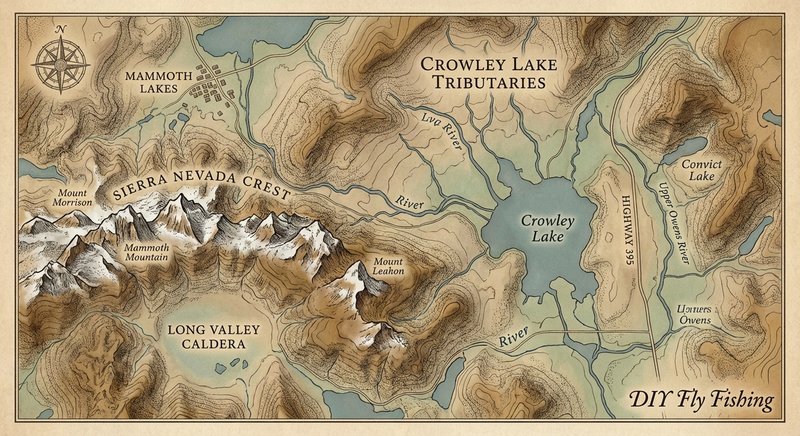
Crowley Lake Tributaries
Fly fishing in California · Intermediate · Best seasons: Spring, Fall
Target Species
Brown Trout, Rainbow Trout
About This Water
Multiple streams feeding Crowley Lake. Trophy trout during spawning runs.
Fishing Recommendations
As your guide to the Eastern Sierra, let me take you to some of the most storied moving waters in California: the Crowley Lake Tributaries.
Primarily consisting of the Upper Owens River and McGee Creek, these tributaries are famous not just for their resident fish, but for the massive, lake-run monsters that migrate out of Crowley Lake. This is "big game" fly fishing in a high-desert spring creek setting.
🎣 Location Overview
The Crowley tributaries are the lifeblood of the Mono Basin. The Upper Owens River is a classic meandering meadow stream characterized by deep undercut banks, oxbow bends, and glassy glides. McGee Creek is smaller, more rugged, and offers a more intimate small-stream experience before it empties into the lake.
What makes this area special is the "Crowley Migration." Because Crowley Lake is incredibly productive (essentially an underwater forest of midges and perch fry), the trout grow to staggering sizes. When these fish move into the shallow, clear tributaries to spawn or follow food sources, anglers have the chance to hook 20-plus-inch fish in water you could almost jump across.
🐟 Target Species & Behavior
- Rainbow Trout: These are the stars of the Spring run (February–May). These "Steelhead of the Sierra" move up from the lake to spawn. They are powerful, silver, and often congregate in the deeper pools and gravel runs.
- Brown Trout: The Fall run (September–November) belongs to the Browns. These fish move up to spawn and are notoriously aggressive and territorial. Look for the "V-wake" in shallow tailouts.
- Resident Fish: Year-round, you’ll find smaller (8–14 inch) wild Browns and Rainbows that live in the river full-time. They are opportunistic feeders but can be spooky in the clear water.
Behavior: During the runs, fish hold in the "buckets" (deep depressions in the bends) or right on the transition zones between deep pools and shallow riffles.
📅 Best Times to Fish
Spring (February – May)
This is peak season for lake-run Rainbows. The weather can be brutal (snow and wind), but the fishing is legendary.
- Conditions: Look for "slush" to clear in the mornings; the fishing usually warms up by 10:00 AM.
Fall (Late September – November)
The Brown trout migration. The cottonwoods turn gold, the air is crisp, and the big Browns become aggressive.
- Conditions: Overcast days are "magic" here—it brings the big Browns out from under the banks and makes them less wary of shadows.
Best Time of Day
- Mid-morning to Late Afternoon: Unlike many rivers, you don't need to be there at dawn. The water needs to warm up a few degrees to activate the fish and the bugs.
🪰 Recommended Flies & Techniques
Nymphing (The Bread & Butter)
90% of the big fish are caught on sub-surface patterns. Use a 9ft 5wt or 6wt rod with a long leader.
- Attractor Nymphs: San Juan Worms (red/pink), Egg patterns (peach, Oregon cheese), and Flashback Pheasant Tails.
- Midges: Zebra Midges (black/silver, red/gold) in sizes 18-22.
- The "Crowley Special": Small perch fry imitations or larger stonefly nymphs to get their attention.
Streamer Stripping
In the Fall, stripping streamers can trigger "revenge strikes" from territorial Browns.
- Patterns: Woolly Buggers (olive/black), Spruce Flies, or Sculpin patterns.
- Technique: Cast across to the opposite undercut bank and strip erratically back.
Dry Fly (Summer/Early Fall)
- Patterns: Hoppers (sizes 10-12), Elk Hair Caddis, or Griffiths Gnat.
- Technique: High-floating terrestrials tight to the grassy banks.
💡 Pro Tips & Local Knowledge
- The "Deep Bucket" Theory: On the Upper Owens, the fish aren't everywhere. You can walk past a mile of beautiful water that holds nothing, only to find 20 fish stacked in one deep, dark bend. Don't be afraid to keep moving until you find the "holding water."
- Stealth is Mandatory: The water is crystal clear and the banks are high. If you stand on the edge of the bank, the fish will see your silhouette against the sky and spook. Kneel or stay 10 feet back from the water's edge.
- Mind the Redd: During the spawn, you will see fish sitting on bright, clean gravel patches (redds). Do not fish for these trout. It is unethical and damages the future of the fishery. Target the fish in the deeper pools behind or below the spawning beds.
⚠️ Important Information
- Access:
- Upper Owens: Access via Benton Crossing Road. There are several dirt turnouts (monitored by the LADWP). High clearance vehicles are recommended if it’s been raining or snowing.
- McGee Creek: Access via the McGee Creek exit off Hwy 395; fish the section between the highway and the lake.
- Regulations: This is a Barbless Hook / Catch and Release fishery for much of the year, but regulations change seasonally. Always check the California Department of Fish and Wildlife (CDFW) handbook for the specific "District" rules (Sierra District).
- Weather: The wind in Long Valley can be ferocious. Bring a windbreaker and a heavy-duty wading jacket even if the sun is out.
- License: A valid California Fishing License is required for everyone 16 years and older.
Guide’s Final Word: Bring a big net and your patience. You’re hunting for the fish of a lifetime in one of the most beautiful high-altitude meadows on Earth. Respect the land, respect the fish, and they’ll reward you.
Bug Hatches & Matching Flies
| Hatch | Type | Peak months | Time of day | Hook sizes | Matching flies |
|---|---|---|---|---|---|
| Midges Chironomidae | midge | March, April, May, September, October | All Day | #18-24 | Zebra Midge #18-22, Brooks Sprout Midge #20-24, Griffith's Gnat #18-22 |
| Blue Winged Olive (BWO) Baetis | mayfly | March, April, October, November | Late Morning/Afternoon | #16-22 | RS2 #18-22, JujuBaetis #18-20, Parachute Adams #16-20 |
| Trico Tricorythodes | mayfly | August, September | Early Morning | #20-24 | Trico Spinner #20-24, Sunken Trico #22 |
| Spotted Sedge Hydropsyche | caddis | June, July, August | Evening | #14-18 | Elk Hair Caddis #14-18, LaFontaine's Deep Sparkle Pupa #16-18 |
| Little Yellow Stonefly Isoperla (Yellow Sallies) | stonefly | June, July | Afternoon/Evening | #14-16 | Yellow Sally Dry #14-16, Iron Lotus #16 |
| Grasshoppers Acrididae | terrestrial | August, September | Mid-day/Afternoon | #8-12 | Morrish Hopper #8-12, Charlie Boy Hopper #10-12 |
| Scuds Gammarus | crustacean | April, May, June | All Day | #14-18 | Ray Charles #14-18, Scud (Olive or Orange) #14-16 |
| Damselfly Enallagma | odonata | June, July | Late Morning/Afternoon | #10-14 | Marabou Damsel #12-14, Adult Damsel #10-12 |
| Cranefly Tipulidae | other | August, September | Morning/Evening | #10-14 | Crane Fly Larva #10-12, Daddy Long Legs #10-14 |