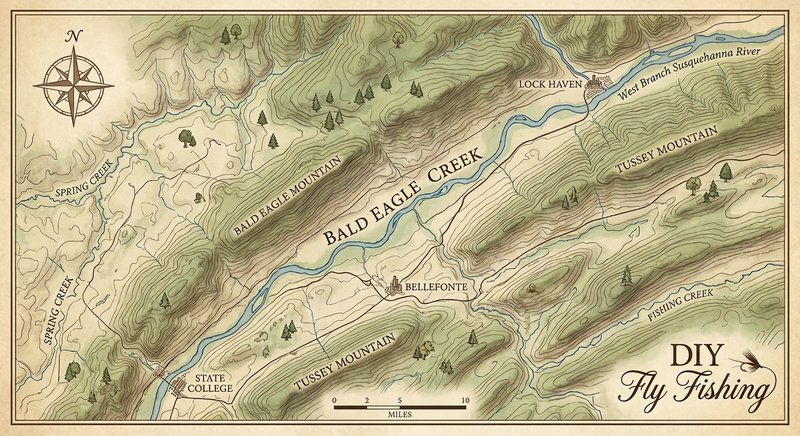
Bald Eagle Creek
Fly fishing in Pennsylvania · Intermediate · Best seasons: Spring, Summer, Fall
Target Species
Brown Trout, Rainbow Trout
About This Water
Central PA limestone influenced stream. Wild brown trout with good hatches.
Fishing Recommendations
Bald Eagle Creek, located in Centre County, Pennsylvania, is one of the Commonwealth’s most storied and unique trout fisheries. While it is often overshadowed by its famous tributaries—Spring Creek and Penns Creek—"The Baldy" offers a diverse and often more productive experience for anglers who prefer a larger river feel with classic limestone characteristics.
Here is your comprehensive guide to fly fishing Bald Eagle Creek.
🎣 Location Overview
Bald Eagle Creek is a tale of two rivers. It begins as a small mountain stream, but by the time it reaches the Milesburg area, it has transformed into a broad, powerful valley floor river. What makes it special is its limestone influence. It receives massive injections of cold, nutrient-rich water from world-class tributaries like Spring Creek and Fishing Creek.
The water is characterized by long, deep pools, heavy riffles, and extensive runs. Unlike the tight, technical casting of Spring Creek, Bald Eagle allows for long casts and big-water tactics. It is a "working man's" trout stream—rugged, beautiful, and home to some of the largest brown trout in the state.
🐟 Target Species & Behavior
- Brown Trout: The crown jewel of the creek. You will find both heavy-bodied stocked fish and a significant population of wild browns. The wild fish are notorious for hiding under the undercut banks and in the deep woody debris. They are predatory and will aggressively move for large streamers or heavy hatches.
- Rainbow Trout: Primarily stocked, particularly in the Keystone Select (Delayed Harvest) areas. These fish tend to congregate in the faster, oxygenated riffles and at the heads of the deep pools.
- Behavior: Due to the limestone influence, these fish are "well-fed." They aren't always looking for a meal; they are looking for a specific hatch. However, the larger browns are highly nocturnal and light-sensitive, often becoming most active during low-light transitions or during high-water events.
📅 Best Times to Fish
- Spring (April – June): The Prime Window. This is when the legendary hatches occur. If you want dry fly action, this is your time.
- Summer (July – August): Focus on the section below the confluence with Spring Creek in Milesburg. The cold water from Spring Creek acts as a thermal refuge, keeping Bald Eagle fishable even when other freestones have warmed up. Fish early mornings or late evenings with terrestrials.
- Fall (September – November): This is streamer season. As the brown trout prepare to spawn, they become highly territorial and aggressive. The Isonychia and Blue-Winged Olive hatches also provide excellent afternoon dry fly windows.
- Optimal Conditions: Look for a falling barometer or slightly stained water after a light rain. "Baldy" fish are less "spooky" when the water has a green tint.
🪰 Recommended Flies & Techniques
Dry Flies (Match the Hatch)
- Sulphurs (Size 14-18): The most famous hatch on the creek, occurring from mid-May through June.
- Grannom Sedge (Size 14-16): Late April. Look for the "dancing" caddis above the riffles.
- Isonychia (Size 10-12): Late summer and fall. A great "prospecting" fly.
- Terrestrials: Foam Beetles, Ants, and Dave’s Hoppers (July–Sept).
Nymphs
- The Waltz’s Worm (Size 14-16): A local Pennsylvania staple that mimics crane flies and scuds.
- Frenchie / Pheasant Tail (Size 14-18): Effective year-round.
- Girdle Bugs (Pat’s Rubber Legs): Essential in the heavier water and deep runs.
Streamers
- Sculpin Patterns: Bald Eagle is loaded with sculpins. Use olive or black weighted patterns (Size 4-8).
- Wooly Buggers: Black or White.
- Technique: "Pounding the banks." Cast toward the shore or fallen logs and strip aggressively back toward the middle of the river.
💡 Pro Tips & Local Knowledge
- The "Milesburg Confluence": The stretch where Spring Creek enters Bald Eagle is legendary. The influx of cold water and nutrients makes this a year-round hotspot. If the water is warm elsewhere, go here.
- The Keystone Select Section: Focus on the Delayed Harvest Artificial Lures Only (DHALO) stretch near Julian. The PFBC stocks this with a higher density of "trophy" sized fish (14-20+ inches).
- Check the Gauges: Bald Eagle can get muddy quickly after a storm. Check the USGS gauge at Milesburg. If it's spiking, the water will be chocolate milk. If it's on the "drop," it's time to fish streamers.
- Swing a Wet Fly: During the Grannom or Sulphur hatches, many anglers miss out by only fishing the surface. "Swinging" a soft hackle or a wet fly through the riffles can be devastatingly effective.
⚠️ Important Information
- Access: Much of the creek parallels Route 150 and Route 220. There are numerous pull-offs and bridges with public access. Always look for PFBC "Public Fishing" signs.
- Regulations:
- DHALO Sections: These have specific rules—no bait, and "catch and release" during certain times of the year.
- Licensing: A valid Pennsylvania Fishing License and a Trout Stamp are required.
- Wading Safety: The bottom of Bald Eagle Creek is famously "greasy." The rocks are covered in slick microfilm. Studded wading boots and a wading staff are highly recommended, especially in the swifter sections near Milesburg.
- Private Property: While access is good, some stretches are private. Respect all "Posted" signs to ensure future access for the angling community.
Guide’s Final Word: Bald Eagle Creek is a reward for the observant angler. It’s a big river that requires you to read the water carefully, but the reward is often the heaviest trout of your season. Tight lines!
Bug Hatches & Matching Flies
| Hatch | Type | Peak months | Time of day | Hook sizes | Matching flies |
|---|---|---|---|---|---|
| Blue-Winged Olive (BWO) Baetis / Pseudocloeon | mayfly | April, May, September, October | Afternoon | #18-22 | RS2 #18-22, Blue-Winged Olive Sparkle Dun #18-20, Pheasant Tail #18-20 |
| Grannom Caddis Brachycentrus | caddis | April, May | Morning/Afternoon | #14-16 | LaFontaine's Deep Sparkle Pupa #14-16, Henryville Special #14-16, Peacock Caddis #14-16 |
| Hendrickson Ephemerella subvaria | mayfly | April, May | Afternoon | #12-14 | Red Quill #12-14, Hendrickson Comparadun #12-14, Hare's Ear Nymph #12-14 |
| Sulphur Ephemerella invaria / dorothea | mayfly | May, June | Evening | #14-18 | Sulphur Parachute #16-18, Snowshoe Rabbit Foot Emerger #14-18, Sulphur Spinner #14-18 |
| Slate Drake Isonychia bicolor | mayfly | June, September | Afternoon/Evening | #10-14 | Isonychia Parachute #12-14, Zug Bug #10-12, Isolator Nymph #12-14 |
| Light Cahill Stenacron interpunctatum | mayfly | June, July | Evening | #12-14 | Light Cahill Dry #12-14, Cream Usual #12-16 |
| Trico Tricorythodes | mayfly | July, August, September | Morning | #22-26 | Trico Spinner #22-26, Sunray Trico #24-26, Griffith's Gnat #20-24 |
| Terrestrials (Ants/Beetles) Formicidae / Coleoptera | terrestrial | July, August, September | All Day | #12-20 | Black Foam Ant #16-20, Crowe Beetle #14-18, Letort Hopper #12-14 |