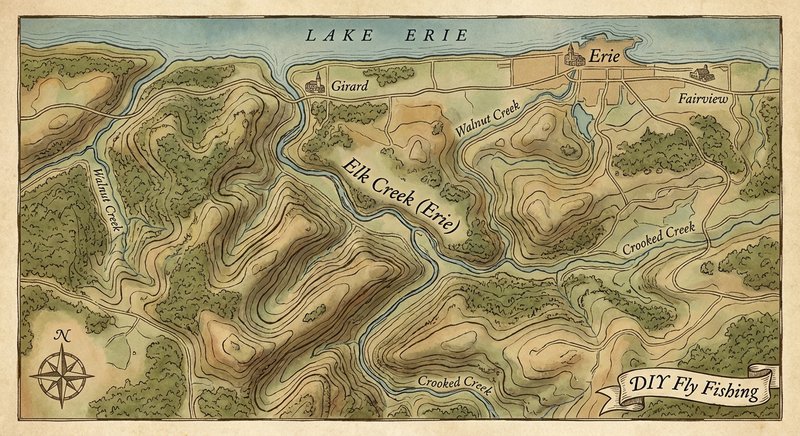
Elk Creek (Erie)
Fly fishing in Pennsylvania · Intermediate · Best seasons: Fall, Winter, Spring
Target Species
Steelhead, Brown Trout
About This Water
Lake Erie tributary famous for steelhead runs. Excellent fall through spring fishing.
Fishing Recommendations
Welcome to the "Steelhead Alley." As your guide to Elk Creek, the largest and most iconic tributary in Pennsylvania’s Lake Erie system, I’m here to tell you that this is some of the finest tributary fly fishing in the United States. Elk Creek is famous for its high fish counts and beautiful shale-lined gorges.
Here is your comprehensive guide to mastering Elk Creek.
🎣 Location Overview
Elk Creek is the "crown jewel" of Pennsylvania’s steelhead waters. It flows through Erie County, entering Lake Erie west of the city of Erie.
What makes it special: Unlike the smaller tributaries, Elk Creek is large enough to offer a variety of water types: deep shale pools, long riffles, and technical pocket water. The stream cuts through scenic shale cliffs, providing a dramatic backdrop. Because of its size, it holds fish longer than other creeks, even during lower water periods, though it is "flashy"—meaning it rises quickly after rain and turns a distinct "chocolate milk" color before settling into a fishable emerald green.
🐟 Target Species & Behavior
Steelhead (Lake Erie Rainbow Trout)
The primary draw. These are "Adfluvial" fish, meaning they live in the lake and run up the streams to spawn.
- Behavior: They are not actively feeding to grow, but they retain their predatory instincts and a "memory" of aquatic insects. They are highly sensitive to water temperature and clarity.
- Holding Water: In high, murky water, look for them in the soft "inside" edges of bends. In clear, low water, they hide in the deepest parts of pools or under "shelf" rock ledges.
Brown Trout
While less common than steelhead, large Lake Erie Brown Trout enter the creek in the fall to spawn. They are elusive, often nocturnal, and highly prized by locals.
📅 Best Times to Fish
Optimal Seasons
- Fall (Late Sept – November): The "Run" begins. As water temperatures drop into the 50s and 40s, the first pushes of silver fish enter after a good rain. This is prime time for aggressive fish.
- Winter (December – February): Fishing becomes technical. Fish congregate in deep, slow pools. On sunny winter days, snowmelt can trigger a mid-day bite.
- Spring (March – April): The "Dropback" season. Fish are finishing their spawn. They are hungry and aggressive as they head back to the lake.
Prime Conditions
- Water Clarity: The "Magic Window" is when the water is receding after a rain and has 12 to 24 inches of visibility (the "emerald green" stage).
- Time of Day: In clear water, low-light conditions (dawn/dusk) are essential. On overcast days, the bite can stay strong all day.
🪰 Recommended Flies & Techniques
Top Fly Patterns
- Egg Patterns: Sucker Spawn (peach, cream, orange), Crystal Meth (estaz eggs), and Glow Bugs.
- Nymphs: Size 12-16 Black Stoneflies, Pheasant Tails, and Prince Nymphs.
- Streamers: Wooly Buggers (Black, Olive, White) and White Death (a local minnow imitation).
- The "Pink Worm": Small squirmy wormies or San Juan worms can be deadly in slightly turbid water.
Effective Techniques
- Indicator Nymphing: The most common method. Use a floating line, a long leader (9-12ft), and enough split shot to get the fly to the "zone" (just off the bottom). Your drift must be dead-drifted.
- Swinging (Spey/Switch): Elk Creek is large enough for trout Spey. Swinging streamers or large wet flies through the tail-outs of pools is an exhilarating way to get a violent "grab."
- Centerpinning (Non-Fly): While you are fly fishing, be aware that many locals use Centerpin rods for incredibly long, natural drifts.
💡 Pro Tips & Local Knowledge
- The "Elk Creek Shuffle": Avoid it. This refers to wading through a pool and kicking up silt/eggs to attract fish. It’s considered poor etiquette. Stay on the bank or wade quietly.
- Stealth is Key: In the clear shale pools, steelhead can see you from a distance. Wear earthy tones, stay low, and try to avoid splashing.
- Follow the Rain: Watch the USGS stream gauges. If Elk Creek is blown out (too high), the smaller "East Side" creeks (like 20-Mile) might be clear. If Elk is at 200-300 cfs, it's game on.
- Spotting Fish: Wear high-quality polarized glasses. Look for "ghosts"—shadows that move against the current—rather than the whole fish.
⚠️ Important Information
Access Information
- Public Access: There are several key spots: The Mouth (access via Lake Erie Community Park), the "Chutes" area, and Girard Borough Park.
- Folly’s End Campground: A famous local hub that offers paid parking, a fly shop, and great stream access.
Regulations & Permits
- License: You need a Pennsylvania Fishing License PLUS a Lake Erie Permit (or a Combo Trout/Lake Erie permit).
- Limits: Check the current PA Fish & Boat Commission "Special Regulations" for Lake Erie Tributaries, as creel limits and tackle restrictions can change seasonally.
Special Considerations
- Private Property: Much of Elk Creek flows through private land. PA has specific laws about Navigability. Always respect "Posted" signs to ensure future access for all anglers.
- Safety: The shale bottom is incredibly slick—it’s like walking on wet ice. Studded wading boots are mandatory. A wading staff is highly recommended.
Guide’s Final Word: Elk Creek is a world-class fishery, but it demands patience. If a pool is crowded, keep walking. There are miles of water, and often the best fishing is found by the angler willing to hike a half-mile away from the bridges.
Bug Hatches & Matching Flies
| Hatch | Type | Peak months | Time of day | Hook sizes | Matching flies |
|---|---|---|---|---|---|
| Chironomids (Midges) Chironomidae | midge | January, February, March, November, December | All Day | #18-24 | Zebra Midge #18-22, Griffith's Gnat #20-24, Palomino Midge #20-22 |
| Blue Winged Olive Baetis | mayfly | April, May, September, October | Late Morning/Afternoon | #18-22 | RS2 #20-22, Pheasant Tail Nymph #18-20, Parachute BWO #18-22 |
| Grannom Caddis Brachycentrus | caddis | April, May | Morning/Afternoon | #14-16 | Deep Sparkle Pupa #14-16, Elk Hair Caddis (Dark) #14-16, Peacock Caddis #14-16 |
| Tan Caddis Hydropsyche | caddis | May, June | Evening | #14-18 | Hydropsyche Larva #14-16, LaFontaine's Emergent Pupa #14-18, Tan Elk Hair Caddis #14-18 |
| Golden Stonefly Acroneuria | stonefly | May, June, July | Evening | #8-12 | Pat's Rubber Legs #8-12, Golden Stone Nymph #10-12, Stimulator (Yellow) #8-12 |
| White Fly Ephoron leukon | mayfly | August | Dusk/Night | #12-14 | White Wulff #12-14, Ephoron Spinner #12-14 |
| Black Ants Formicidae | terrestrial | July, August, September | Afternoon | #16-22 | Black Foam Ant #16-20, Flying Ant #18-22 |
| Crane Fly Tipulidae | other | August, September, October | Morning/Evening | #10-14 | Crane Fly Larva #10-12, Daddy Long Legs #12-14 |