Delaware River (Upper)
Fly fishing in Pennsylvania · Intermediate · Best seasons: Spring, Summer, Fall
Target Species
Rainbow Trout, Brown Trout
About This Water
Border water with New York featuring wild rainbow and brown trout. Excellent hatches.
Fishing Recommendations
🎣 Location Overview
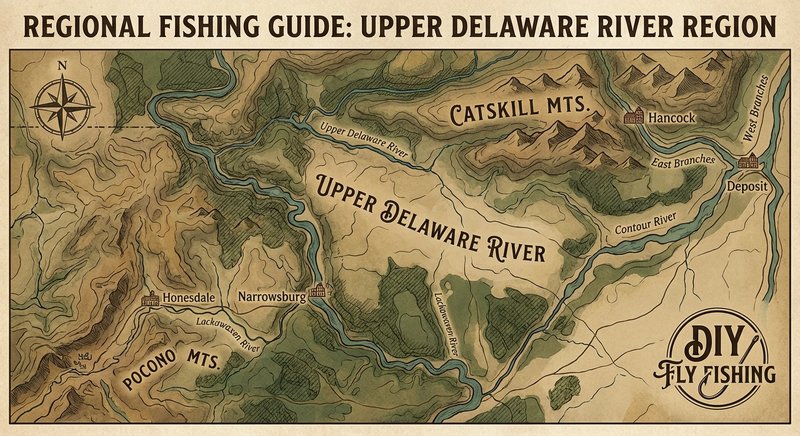
The Upper Delaware River, forming the border between Pennsylvania and New York, is widely considered the "holy grail" of dry fly fishing in the Eastern United States. This is a massive, complex tailwater system fed by the cold bottom-releases of the Cannonsville (West Branch) and Pepacton (East Branch) reservoirs.
What makes it special is the combination of wild, river-born fish and its technical difficulty. These are not stocked fish; they are sophisticated, powerful, and notoriously "PhD-level" trout. The water is cold year-round, nutrient-rich, and characterized by long, glassy pools, technical riffles, and heavy hatches. Anglers love it because it offers a true "Western" big-river feel just a few hours from New York City and Philadelphia.
🐟 Target Species & Behavior
Wild Brown Trout
The Upper Delaware is famous for its butter-colored wild Browns. They are highly predatory but also extremely selective surface feeders. They tend to hold in the "seams" and "bubbles lines" of the long pools. Big browns here are known to sit in surprisingly shallow water—sometimes just inches deep—during a heavy spinner fall.
Wild Rainbow Trout
Particularly prevalent on the Main Stem (below the confluence of the West and East branches), these rainbows are legendary for their strength. Unlike the browns, they prefer faster water—the "heads" of pools and heavy riffles. When hooked, they are acrobatic and will frequently take you into your backing.
Feeding Behavior: These fish are "surface-oriented" from April through September. They are highly attuned to the specific stage of an insect's life cycle (nymph, emerger, dun, or spinner). If you aren't matching the exact stage, they will ignore your fly.
📅 Best Times to Fish
Spring (April – June)
- The Prime Window: This is the peak. May and June host the legendary "Mayfly Madness."
- Conditions: High water is common in April (Hendricksons). By June, the water levels stabilize, and the Blue-Winged Olives, March Browns, and Green Drakes appear.
Summer (July – August)
- The Tailwater Advantage: While other PA rivers get too warm, the West Branch stays cold.
- Times: Focus on early morning or late evening. Trico hatches in the morning and Sulphurs in the evening are the main events.
- Warning: The Main Stem can get too warm for ethical fishing in late July; stick to the West Branch during heatwaves.
Fall (September – October)
- The "Second Season": The crowds thin out. You'll see Isonychia and late Blue-Winged Olives.
- Behavior: Browns become aggressive as they prepare for the spawn. This is the best time for streamer fishing.
🪰 Recommended Flies & Techniques
Top Fly Patterns
- Dry Flies:
- Hendrickson (Size 12-14) in April.
- Sulphur Parachutes and Snowshoe Emergers (Size 16-20) - The staple of the river.
- Apple-Green Bug (Size 12-14) for the Cornuta hatch.
- Tricos (Size 22-26) for summer mornings.
- Rusty Spinner (Size 14-18) – Essential for evening falls.
- Nymphs:
- Pheasant Tails (Size 16-20).
- Zebra Midges (Size 18-22).
- Frenchies or jig-style nymphs for the faster riffles.
- Streamers:
- Articulated Gold/Olive streamers or Black Wooly Buggers during high water or overcast fall days.
Techniques & Presentation
- The Reach Cast: This is mandatory. You must be able to place your fly upstream of the fish with the line already "mended" to ensure a drag-free drift.
- Long Leaders: Use 12 to 15-foot leaders tapering down to 5X or 6X fluorocarbon. These fish are extremely leader-shy.
- Down-and-Across: For emergers, a down-and-across swing can be more effective than a dead drift.
💡 Pro Tips & Local Knowledge
- The "Main Stem" vs. West Branch: The West Branch (Hancock to Deposit) is colder and more consistent but crowded. The Main Stem (Hancock down to Callicoon) is bigger water, holds the hardest-fighting rainbows, and is best fished from a drift boat.
- Bank Stealth: Because the fish hold in the "micro-eddies" right against the bank, avoid wading too deep. You will often be standing right where the fish want to eat.
- Watch the Rise: Don't cast at every splash. Observe. Is the fish taking a dun (on top) or an emerger (just below the surface)? If you see a dorsal fin or tail, it's likely an emerger.
- Micro-Drag: Even if your fly looks like it's drifting perfectly to you, the complex currents often create "micro-drag." If you’re getting refused, change your casting angle before changing your fly.
⚠️ Important Information
Access
- Pennsylvania Side: Public access is available at several Fish and Boat Commission (PFBC) launches (e.g., Buckingham, Ball’s Eddy, Lordville).
- Drift Boats: This is a big river. While wading is possible at low flows, a drift boat or professional guide is highly recommended to cover the most productive water.
Regulations & Permits
- Reciprocity: A Pennsylvania fishing license is valid for fishing from a boat or from either bank on the border stretches. However, if you step foot on the NY shore to wade, you technically need a NY license (and vice versa). Check the specific boundary markers.
- Catch & Release: While some areas allow harvest, the culture of the Upper Delaware is strictly Catch and Release to protect the wild trout populations.
Special Considerations
- Water Release: Check the USGS Water Gauges for "West Branch at Hancock" and "Stilesville." Sudden release changes from the dams can make wading dangerous very quickly.
- Temperature: Carry a thermometer. If the water hits 70°F, stop fishing to protect the trout from stress-induced mortality.
Bug Hatches & Matching Flies
| Hatch | Type | Peak months | Time of day | Hook sizes | Matching flies |
|---|---|---|---|---|---|
| Hendrickson Ephemerella subvaria | mayfly | April, May | Afternoon | #12-14 | Red Quill #12-14, Hendrickson Emerger #14, Pheasant Tail #12-14 |
| Blue-Winged Olive Baetis / Drunella | mayfly | April, May, September, October | Late Morning/Afternoon | #18-22 | RS2 #18-22, BWO Sparkle Dun #18-20, Parachute Adams #18-22 |
| Apple Caddis (Grannom) Brachycentrus | caddis | April, May | Morning/Evening | #14-16 | LaFontaine's Deep Sparkle Pupa #14-16, Elk Hair Caddis (Green body) #14-16, Peacock Caddis #16 |
| March Brown Maccaffertium vicarium | mayfly | May | Afternoon | #10-12 | March Brown Parachute #10-12, Hare's Ear Nymph #10-12, March Brown Wet Fly #12 |
| Sulfur Ephemerella invaria / dorothea | mayfly | May, June, July | Late Afternoon/Evening | #14-20 | Sulfur Parachute #14-18, Snowshoe Rabbit Foot Emerger #16-20, Sulfur Spinner #14-20 |
| Green Drake Ephemera guttulata | mayfly | June | Evening | #8-10 | Coffin Fly #8-10, Green Drake Cripple #8-10, Green Drake Nymph #8-10 |
| Isonychia (Slate Drake) Isonychia bicolor | mayfly | June, July, August, September | Afternoon/Evening | #10-14 | Iso Parachute #12-14, Zug Bug #10-12, Isonychia Wet Fly #12 |
| Trico Tricorythodes | mayfly | July, August, September | Early Morning | #22-26 | Trico Spinner #22-26, Trico Drowned Spinner #24, Griffith's Gnat #22-24 |