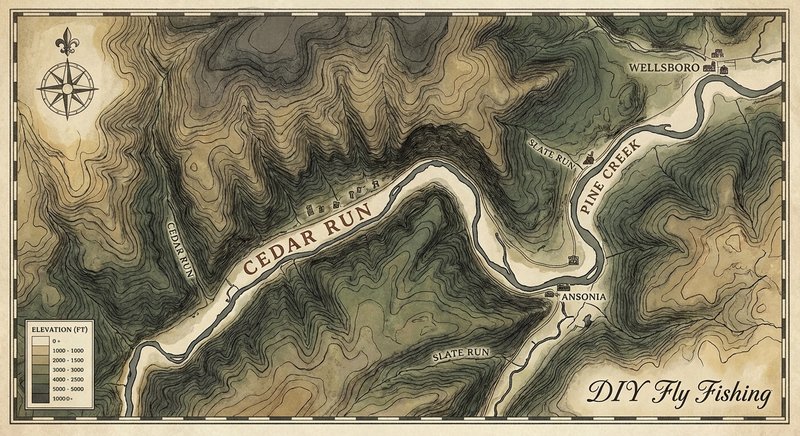
Cedar Run
Fly fishing in Pennsylvania · Intermediate · Best seasons: Spring, Summer, Fall
Target Species
Brook Trout, Brown Trout
About This Water
Small tributary of Pine Creek with wild brook trout. Remote backcountry fishing experience.
Fishing Recommendations
Welcome to one of the crown jewels of North-Central Pennsylvania’s “Grand Canyon” region. As a guide who has spent decades roaming the freestone streams of the Appalachians, I can tell you that Cedar Run is a special piece of water. It is a rugged, cold-water tributary to Pine Creek that offers a classic mountain fly fishing experience with a sophisticated edge.
🎣 Location Overview
Cedar Run is a premier freestone stream located in Lycoming and Tioga Counties. It flows through a steep, heavily forested canyon before emptying into Pine Creek at the village of Cedar Run.
What makes this water special is its wild trout biomass. Unlike many mountain streams that are acidic and sterile, Cedar Run has a slightly higher alkalinity due to localized limestone influences, which leads to better bug life and larger fish. The water is gin-clear, characterized by "stair-step" pools, large boulders, and deep plunge pools. It is a physical stream to fish, requiring a bit of rock-scrambling, but the reward is some of the most beautiful wild trout in the Eastern U.S.
🐟 Target Species & Behavior
- Wild Brown Trout: These are the primary residents of the lower and middle sections. They are buttery-gold, street-smart, and highly territorial. In Cedar Run, they hold tight to "undercut" banks and beneath the shadows of large boulders.
- Native Brook Trout: As you move higher up the drainage or into its tiny feeder streams, the population shifts toward Pennsylvania’s state fish. These are opportunistic but wary, often holding in the faster "bubbles" at the head of pools.
Behavior: Because the water is so clear, these fish have high "spook factor." They are masters of vibration and shadow detection. If they see you, they won't eat for an hour. They feed heavily on the surface during hatches but move into deep "sanctuary" water during the heat of the day.
📅 Best Times to Fish
- Spring (Mid-April to June): This is the "Golden Era." The major hatches (Hendricksons, March Browns, and Sulphurs) bring the larger wild browns to the surface. Water levels are usually perfect.
- Summer (July to August): While many PA streams get too warm, Cedar Run’s canopy and springs keep it cooler. However, focus on early mornings and late evenings. This is prime Terrestrial Season.
- Fall (September to October): My favorite time. The Brookies are in their spawning colors, and the Brown Trout become aggressive before their late-fall spawn. The low, clear water requires 6x or 7x tippet and long casts.
🪰 Recommended Flies & Techniques
Top Fly Patterns
- Dry Flies:
- Adams Variant or Purple Haze (Size 14-18) – The best general searchers.
- Slate Drake (Isonychia) (Size 12-14) – A staple on Cedar Run.
- Elk Hair Caddis (Tan/Olive, Size 14-16).
- Terrestrials: Black Foam Ants and Green Beetles (Size 14-18) are mandatory in summer.
- Nymphs:
- Pheasant Tail (Size 16-20) – Mimics almost everything here.
- Prince Nymph (Size 14-16) – Great for the faster, oxygenated riffles.
- Streamers:
- Woolly Bugger (Olive or Black, Size 10-12) – Fish these deep in the plunge pools on a rainy day.
Effective Techniques
- Dry-Dropper: This is the "bread and butter" here. Use a buoyant dry fly (like a Stimulator) and hang a small Pheasant Tail nymph 18-24 inches below it.
- High-Sticking/Euro Nymphing: In the pocket water and "boulder gardens," keeping your fly line off the water is crucial to avoid drag caused by complex currents.
- The "Stealth" Approach: Always fish from the tail of the pool upward. Stay low—sometimes I'm on my knees—and use the boulders for cover.
💡 Pro Tips & Local Knowledge
- The "Trophy Trout" Section: Focus on the 7-mile stretch from the mouth at Pine Creek upstream to the confluence with Buck Run. This is managed under Trophy Trout / Artificial Lures Only regulations, ensuring a high density of wild fish.
- Mind the Temperature: Even though it stays cooler than Pine Creek, if the water hits 68°F, stop fishing. It’s better for the trout's survival.
- The "Shadow" Rule: On Cedar Run, the sun hits the canyon floor at odd angles. If your shadow falls across a pool, you might as well keep walking to the next one; the fish are already gone.
- Wading Safety: The rocks in Cedar Run are notorious for being slippery "bowling balls." Studded wading boots and a wading staff are highly recommended.
⚠️ Important Information
- Regulations: Most of the prime water is Trophy Trout - Artificial Lures Only. This means no bait, and strict size/creel limits (usually 2 fish over 14 inches, but most locals practice 100% Catch & Release here). Always check the current PFBC Summary of Regulations.
- Access: Cedar Run Road follows the stream for much of its length. There are several small pull-offs. Much of it is within the Tioga State Forest, providing excellent public access.
- Cell Service: Expect zero cell service in the canyon. Download your maps for offline use and let someone know when you expect to be back.
- Respect Private Property: While much is public, there are cabins along the lower stretch. Respect "Posted" signs and stay in the stream bed where necessary.
Guide’s Final Word: Cedar Run isn't about high numbers or trophy-room trophies; it’s about the purity of the pursuit. Use a light rod (3wt or 4wt), take your time, and enjoy one of the most scenic trout streams in the Eastern United States. Tight lines!
Bug Hatches & Matching Flies
| Hatch | Type | Peak months | Time of day | Hook sizes | Matching flies |
|---|---|---|---|---|---|
| Blue-Winged Olive Baetis | mayfly | April, October | Mid-day/Afternoon | #18-22 | RS2 #20-22, BWO Sparkle Dun #18-20, Pheasant Tail #18-22 |
| Hendrickson Ephemerella subvaria | mayfly | April | Afternoon | #12-14 | Red Quill #12-14, Hendrickson Nymph #12-14, Hendrickson Emerger #12-14 |
| Grannom Caddis Brachycentrus | caddis | April | Morning/Afternoon | #14-16 | Grannom Pupa #14-16, Elk Hair Caddis (Dark) #14-16, Peeking Caddis #14-16 |
| March Brown Maccaffertium vicarium | mayfly | May | Afternoon | #10-14 | March Brown Wet #10-12, Hare's Ear Nymph #10-14, March Brown Paradun #10-12 |
| Sulfur Ephemerella invaria/dorothea | mayfly | May, June | Evening | #14-18 | Sulfur Parachute #14-18, Sulfur Spinner #14-18, Sulfur CDC Emerger #14-18 |
| Eastern Green Drake Ephemera guttulata | mayfly | May, June | Evening | #8-12 | Coffin Fly #8-10, Green Drake Cripple #8-10, Green Drake Nymph #8-12 |
| Slate Drake Isonychia bicolor | mayfly | June, September | Afternoon/Evening | #10-14 | Isonychia Parachute #12-14, Zug Bug #10-14, Isonychia Nymph #10-12 |
| Trico Tricorythodes | mayfly | July, August, September | Morning | #22-26 | Trico Spinner #22-26, Trico Dun #24-26, Trico Nymph #22-24 |
| Terrestrials Formicidae/Gryllidae | terrestrial | July, August, September | All Day | #12-18 | Black Foam Ant #14-18, Crowe Beetle #12-16, Letort Hopper #10-14 |