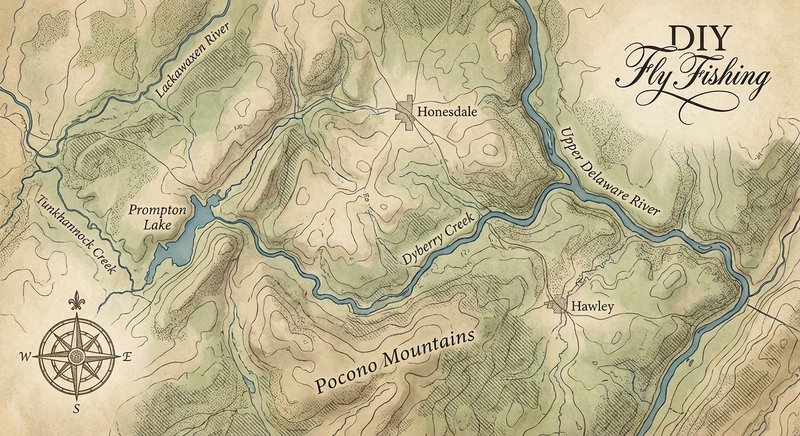
Dyberry Creek
Fly fishing in Pennsylvania · Beginner · Best seasons: Spring, Summer, Fall
Target Species
Brown Trout, Brook Trout
About This Water
Wayne County freestone with wild brown and brook trout. Less crowded NE PA stream.
Fishing Recommendations
Welcome to one of the gems of Northeastern Pennsylvania. As an expert guide, I’ve spent plenty of time on the freestone waters of the Poconos, and Dyberry Creek in Wayne County is a quintessential PA trout stream. It offers a perfect blend of stocked "trophy" water and rugged, mountain-style fishing for wild fish.
Here is your comprehensive guide to fly fishing Dyberry Creek.
🎣 Location Overview
Dyberry Creek is a primary tributary to the Lackawaxen River, located near Honesdale, PA. It is a classic freestone stream, meaning its flow and temperature are dictated by rainfall and snowmelt.
What makes the Dyberry special is its character. It is divided primarily into the West Branch, the East Branch, and the Main Stem. The upper reaches are intimate, shrouded in hemlocks and mountain laurel, while the lower sections open up into larger pools and broad riffles. It feels wilder than many other PA streams, offering a sense of solitude despite its proximity to town.
🐟 Target Species & Behavior
- Brown Trout: These are the kings of the Dyberry. You’ll find a mix of stocked fish (especially in the DHALO section) and holdover/wild browns. In the lower main stem, these fish become very "stream smart" and will hold in the deep undercut banks and the tails of long pools during low light.
- Brook Trout: The "Jewels of the East." Wild Brookies are found primarily in the West Branch and the smaller feeder tributaries. They are smaller (4–8 inches) but exceptionally vibrant and aggressive.
- Behavior: During the day, fish hold in the oxygenated "bubble curtains" at the heads of pools. As the evening hatch begins, they move into the flat water at the tail-outs to sip emergers.
📅 Best Times to Fish
- Spring (Mid-April to June): This is the "Golden Era" on the Dyberry. Water levels are usually prime, and the insect activity is at its peak. This is when you’ll see the best dry fly action.
- Summer (July to August): The main stem can get warm and low. During this time, focus on the West Branch or head upstream where the canopy provides shade. Fish early morning (dawn till 10 AM) or late evening.
- Fall (September to October): My personal favorite. The Brown trout become aggressive as they prepare to spawn. The colors in the Wayne County hills are world-class, and the crowds are gone.
- Prime Conditions: Look for a falling barometer or 2–3 days after a rain event when the water has a "tea-colored" tint but is clearing.
🪰 Recommended Flies & Techniques
Top Fly Patterns
- Dry Flies:
- Spring: Hendrickson (Red Quill) #12-14, Elk Hair Caddis (Tan) #14-16, Blue Winged Olives #18-20.
- Summer: Sulfurs #16-18, Light Cahills #14.
- Terrestrials: Black Foam Ants and Cricket patterns (August is prime for this).
- Nymphs:
- Pheasant Tail (Flashback) #14-18, Gold-Ribbed Hare’s Ear #14, and Zebra Midges #18-22 for picky fish in the pools.
- Streamers:
- Woolly Buggers (Black or Olive) #6-10. Work these through deep holes or during high water.
Effective Techniques
- Tight-Line Nymphing: The Dyberry has many "pocket water" sections. A high-stick nymphing approach without a bobber is incredibly effective here to avoid drag.
- Match the Hatch: If you see fish rising but they won't take your dry, they are likely eating emergers just below the surface. Swing a soft-hackle wet fly through the riffle.
- The "Stealth" Approach: Because the water can be crystal clear, stay low. Don't wade into a pool until you've fished the edges first.
💡 Pro Tips & Local Knowledge
- The DHALO Section: There is a 0.9-mile Delayed Harvest Artificial Lures Only (DHALO) section on the Dyberry that runs from the Widmer Road bridge downstream to the mouth of Big Brook. This area is heavily stocked and holds fish year-round. It is the most reliable spot for a beginner or someone looking for consistent action.
- The "Widmer" Hole: Just below the bridge at Widmer Road is a legendary deep pool. It holds some of the largest browns in the creek, but they are highly pressured. Use 6X or 7X fluorocarbon tippet here.
- Look for Cold Springs: In the heat of July, look for where small, icy feeder streams enter the main creek. Trout will congregate there for the oxygen and cooler temps.
- The West Branch: If you want a "Blue Ribbon" experience, hike the West Branch. It’s tight casting—bring a 7-foot or 7.5-foot 3-weight rod. You won’t catch monsters, but the wild Brookies are spectacular.
⚠️ Important Information
- Regulations: PA Fish & Boat Commission (PFBC) rules apply. In the DHALO section, it is strictly catch-and-release from Labor Day until June 15th, and you may only use artificial lures or flies (no bait/scented lures).
- Permits: You must have a valid Pennsylvania Fishing License and a Trout Stamp. These can be purchased online or at local shops in Honesdale.
- Access: Much of the Dyberry flows through private land where owners have graciously allowed access. Respect "No Parking" signs and always pack out your trash. If a landowner is out, a friendly wave goes a long way in keeping these waters open.
- Wading Safety: The rocks can be slippery. Felt soles (where legal) or studded rubber soles are highly recommended.
Guide’s Final Thought: The Dyberry isn't a river where you just "show up and haul 'em in." It rewards the observant angler who watches the water for five minutes before making the first cast. Tight lines!
Bug Hatches & Matching Flies
| Hatch | Type | Peak months | Time of day | Hook sizes | Matching flies |
|---|---|---|---|---|---|
| Blue Winged Olive Baetis / Pseudocloeon | mayfly | March, April, September, October | Midday | #18-22 | RS2 #18-22, BWO Parachute #18-22, Pheasant Tail #18-22 |
| Hendrickson Ephemerella subvaria | mayfly | April, May | Afternoon | #12-14 | Hendrickson Pink Lady #12-14, Red Quill #14, Hendrickson Wet Fly #12-14 |
| Grannom Caddis Brachycentrus | caddis | April, May | Morning/Afternoon | #14-16 | Grannom Pupa #14-16, Elk Hair Caddis (Olive/Grey) #14-16, LaFontaine's Deep Pupa #14-16 |
| March Brown Maccaffertium vicarium | mayfly | May, June | Afternoon | #10-12 | March Brown Western #10-12, Gold Ribbed Hare's Ear #10-12, March Brown Wet #10-12 |
| Sulphur Ephemerella invaria / dorothea | mayfly | May, June, July | Evening | #14-18 | Sulphur Parachute #14-18, Sulphur Snowshoe Emerger #16-18, Pheelans Sulphur #16 |
| Slate Drake Isonychia bicolor | mayfly | June, September | Late Afternoon/Evening | #10-14 | Iso Parachute #12-14, Isonychia Nymph #10-14, Prince Nymph #12-14 |
| Tan Caddis Hydropsyche | caddis | June, July, August | Evening | #14-18 | Tan Elk Hair Caddis #14-18, Holy Grail #14-16, Iris Caddis #16-18 |
| Golden Stonefly Acroneuria | stonefly | June, July | Evening/Night | #8-12 | Pat's Rubber Legs (Yellow/Brown) #8-12, Stimulator (Yellow) #10-12, Golden Stone Nymph #10 |
| Terrestrials (Ants and Beetles) Formicidae / Coleoptera | terrestrial | July, August, September | All Day | #12-20 | Cinnamon Ant #16-18, Black Foam Beetle #14-16, Chernobyl Ant #12 |