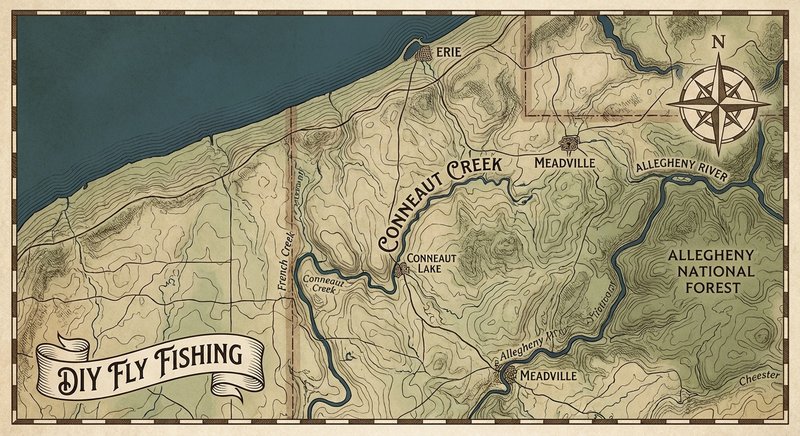
Conneaut Creek
Fly fishing in Pennsylvania · Intermediate · Best seasons: Fall, Winter, Spring
Target Species
Steelhead, Brown Trout
About This Water
Erie County steelhead fishery with excellent public access. Large fish possible.
Fishing Recommendations
Welcome to the "Steelhead Alley." As a guide who has spent countless hours on the tributaries of Lake Erie, I can tell you that Conneaut Creek is a crown jewel for those who prefer a more wild, scenic, and technically diverse experience than the more crowded "ditch fishing" found elsewhere.
While much of Conneaut Creek flows through Ohio, the Pennsylvania section offers some of the best spawning gravel and deep holding water in the entire system.
🎣 Location Overview
Conneaut Creek is unique among Pennsylvania’s Lake Erie tributaries. Unlike the short, high-gradient streams like Walnut or Elk Creeks, Conneaut is a long, meandering, and low-gradient waterway. It flows through deep woodlots and shale canyons, offering an aesthetic that feels more like the Pacific Northwest than the Rust Belt.
Water Characteristics:
- The "Slow Drain": Because it has a lower gradient and more clay in its banks, Conneaut stays turbid (muddy) longer than other streams. However, it also stays "in fishable shape" longer after a rain once it hits that perfect "steelhead green" clarity.
- Structure: Expect plenty of woody debris, fallen logs, and deep shale pools. This isn't just ledge-and-pool fishing; it’s a "river" environment.
🐟 Target Species & Behavior
Steelhead (Lake Erie Strain)
These are the primary draw. These fish are "adventurous" and will push far upstream into the Pennsylvania headwaters.
- Behavior: They enter the creek in waves following rain events (blowouts).
- Holding Water: In the fall, they hold in the deeper pools and "frothy" water near the heads of runs. In the winter, they move to the "slow and deep" guts of the pools to conserve energy.
Brown Trout
While less common than steelhead, Conneaut holds a decent population of resident brown trout in its upper reaches, and you will occasionally encounter "Lake-run" Browns—massive, silver-colored brutes that enter the system in late October.
📅 Best Times to Fish
Fall (October – November)
This is the prime "push." As water temperatures drop into the 50s and 40s, the first large Chrome fish enter. This is the best time for aggressive strikes on swung flies.
Winter (December – February)
The "Ice Man" season. The fishing slows down, but the fish are concentrated. Look for windows where the air temperature hits 35°F+; even a slight warming of the water can trigger a mid-day bite.
Spring (March – April)
The "Drop-back" season. After spawning, fish are hungry and aggressive as they head back to the lake. This is often the most productive time for high numbers of fish.
The Golden Rule: Watch the USGS gauges. You want to see the water level dropping after a spike. If it’s rising, stay home. If it’s "falling and clearing," get to the water immediately.
🪰 Recommended Flies & Techniques
1. Indicator Nymphing (The "Bread and Butter")
The most productive method on Conneaut. Use a 9ft to 10ft 7-weight rod.
- Egg Patterns: Sucker Spawn (peach, pink, cream), Glow Bugs, and the "Blood Dot" egg.
- Nymphs: Size 12-16 Pheasant Tails, Hare’s Ears, and Prince Nymphs.
- The "Conneaut Special": Black or Olive Stonefly patterns (Size 8-12). Steelhead here see a lot of natural stones.
2. Swinging Streamers (Spey or Single-Hand)
Because Conneaut is wider than most PA tribs, it is one of the few places you can effectively swing a fly.
- Patterns: Wooly Buggers (Olive, Black, White), Egg-Hucking Leeches, and small Intruder-style flies.
- Tip: Use a sink tip to get the fly into the "zone" (the bottom 12 inches of the water column).
3. The "Dead Drift" Streamer
In cold water, nymphing a small white or olive streamer under an indicator can be deadly for lethargic fish.
💡 Pro Tips & Local Knowledge
- The "Green" Window: Because Conneaut is muddy, don't be afraid to fish when there is only 6–10 inches of visibility. In these conditions, use larger, darker flies (Black Stoneflies) or ultra-bright fluorescent eggs to help the fish find the fly.
- Stealth Matters: In the PA sections, the water can get very clear between storms. Use long 10–12 foot leaders and fluorocarbon tippet down to 4X or 5X.
- Upper vs. Lower: If the lower river (Ohio side) is chocolate milk, drive upstream into the Pennsylvania headwaters. The water clears from the top down.
- Wood is Good: Unlike Elk Creek, which is mostly shale ledges, Conneaut has a lot of "sweepers" (fallen trees). Steelhead love the overhead cover. If you aren't losing a few flies to the wood, you aren't fishing where the big fish are.
⚠️ Important Information
Access
- Much of the Pennsylvania side flows through private property. Always look for PFBC "Fishing Permitted" signs.
- Key access points include the area around Cherry Hill and the bridges near the State Line.
Regulations & Permits
- License: You need a valid Pennsylvania Fishing License.
- Permits: You must have the Lake Erie Permit and the Trout/Salmon Stamp.
- Limits: Check the current PFBC summary for creel limits, as they change between the regular season and the winter season.
Safety
- Shale is Slick: The bottom of Conneaut Creek is like greased glass. Studded wading boots are non-negotiable. A wading staff is highly recommended, especially when the water is turbid and you cannot see the bottom.
- Cold Water: In winter, the water is 33-35°F. If you take a dunk, hypothermia is an immediate threat. Always fish with a buddy and keep a dry change of clothes in your vehicle.
Guide’s Final Word: Conneaut Creek rewards the patient angler who is willing to walk a half-mile away from the bridge pools. Find the wood, watch the gauges, and keep your fly on the bottom!
Bug Hatches & Matching Flies
| Hatch | Type | Peak months | Time of day | Hook sizes | Matching flies |
|---|---|---|---|---|---|
| Blue-Winged Olive Baetis spp. | mayfly | April, May, September, October | Midday | #18-22 | RS2 #18-22, Parachute BWO #18-20, Pheasant Tail #18-22 |
| Grannom Caddis Brachycentrus | caddis | April, May | Afternoon | #14-16 | Peacock Caddis #14-16, Deep Sparkle Pupa #14-16, Elk Hair Caddis (Olive) #14-16 |
| Hendrickson Ephemerella subvaria | mayfly | April, May | Afternoon | #12-14 | Red Quill #12-14, Hendrickson Nymph #12-14, Snowshoe Emerger #12-14 |
| Sulfur Ephemerella invaria/dorothea | mayfly | May, June | Evening | #14-18 | Sulfur Parachute #14-18, Pheasant Tail (Flashback) #14-18, Sulfur Spinner #14-16 |
| Slate Drake Isonychia bicolor | mayfly | June, September, October | Late Afternoon | #10-12 | Zug Bug #10-12, Iso Parachute #10-12, Prince Nymph #10-14 |
| Zebra Midge Chironomidae | midge | January, February, March, December | All Day | #18-24 | Zebra Midge (Red/Black) #18-22, Griffith's Gnat #20-24, Palomino Midge #20-22 |
| Light Cahill Stenacron interpunctatum | mayfly | June, July | Evening | #12-14 | Light Cahill #12-14, Gold Ribbed Hare's Ear #12-14 |
| Tan Caddis Hydropsyche | caddis | June, July, August | Evening | #14-18 | Elk Hair Caddis (Tan) #14-16, LaFontaine Sparkle Pupa #14-18, Holy Grail #14-16 |
| Trico Tricorythodes | mayfly | July, August, September | Early Morning | #22-26 | Trico Spinner #22-26, Trico Dun #22-24 |
| Cinnamon Ant Formicidae | terrestrial | July, August, September | All Day | #14-18 | Cinnamon Ant #14-18, Chernobyl Ant #10-14 |