Falling Spring Branch
Fly fishing in Pennsylvania · Advanced · Best seasons: Spring, Summer, Fall
Target Species
Brown Trout
About This Water
A small limestone spring creek with very selective trout. Technical fishing at its finest.
Fishing Recommendations
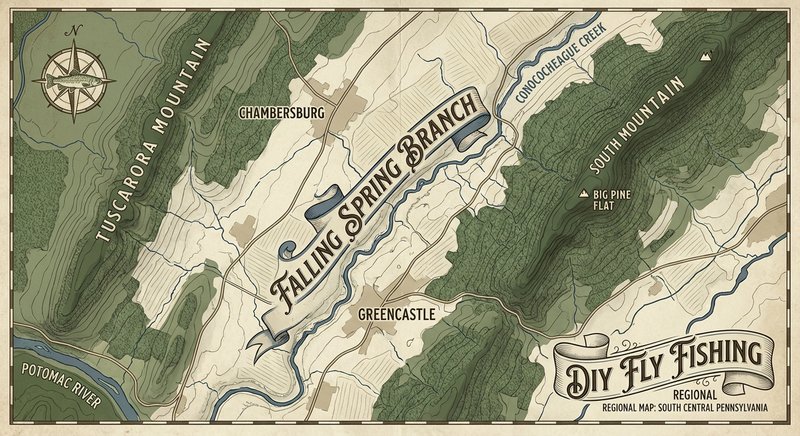
Falling Spring Branch (often simply called "Falling Springs") in Chambersburg, Pennsylvania, is hallowed ground in the fly fishing world. It is a classic limestone spring creek that looks and fishes much like the fabled chalk streams of England.
Here is a comprehensive guide to fishing this technical and rewarding water.
🎣 Location Overview
Falling Spring Branch is a small, meandering limestone stream located in Franklin County. What makes it special is its constancy. Because it is spring-fed, the water temperature remains remarkably stable (around 52–55°F) year-round. This creates a rich ecosystem of aquatic vegetation (like Elodea and Watercress) and a massive biomass of insects.
The stream is narrow, often no more than 15–20 feet wide, and flows through pastoral meadows and suburban pockets. It is the definition of "technical" fishing. The water is gin-clear, the currents are complex due to thick weed beds, and the trout are among the most sophisticated in the United States.
🐟 Target Species & Behavior
The Wild Brown Trout is the king of Falling Spring. While you may occasionally encounter a rainbow, the wild, buttery-yellow Browns are the primary target.
- Behavior: These fish are "PhD" trout. They are extremely spooky. A heavy footfall on the bank or a shadow casting over the water will send them darting for the weed beds.
- Holding Patterns: They don't just sit in the deep holes. Look for them in the "slots" between weed beds, tucked tightly under overhanging grass on the banks, or hovering just below the surface during a hatch.
- Feeding: They are highly selective. If a hatch is on, they will often "lock-in" on a specific stage of the insect (e.g., just the emerger or just the spent spinner).
📅 Best Times to Fish
Falling Spring is a true four-season fishery, but your experience will change drastically depending on the month.
- Spring (April – June): This is the prime time for classic aquatic hatches. The Sulphur hatch in May and June is legendary, bringing the largest fish to the surface in the evening.
- Summer (July – September): This is Trico and Terrestrial season.
- Tricos: Tiny white-winged mayflies hatch in the early morning (often 7:00 AM – 10:00 AM).
- Terrestrials: Mid-day fishing with ants and beetles is highly effective during the heat of summer.
- Fall (October – November): The crowds thin out. Brown trout become more aggressive as they prepare for the spawn. Blue-winged Olives (BWOs) provide excellent dry fly action on overcast days.
🪰 Recommended Flies & Techniques
Top Fly Patterns
- Tricos (Size 22–26): Female duns and spent-wing spinners. You must have these for summer mornings.
- Sulphurs (Size 16–18): Both duns and "snowshoe" emergers.
- Terrestrials: Crow Ants (16–20), Black Foam Beetles (16–18), and Letort Hoppers (14–16).
- Scuds and Sowbugs (Size 16–20): These are the bread and butter of the trout's diet. Grey or olive.
- Pheasant Tail Nymphs (Size 18–22): Slim profiles are key.
Techniques
- The Stealth Approach: Approach the bank on your knees. Wear dull colors (greens/browns) to blend into the meadow.
- Long Leaders: Use a 12-foot to 15-foot leader tapering down to 6X or 7X fluorocarbon tippet. The clear water demands it.
- The Reach Cast: You must master the reach cast to provide a drag-free drift over the complex micro-currents caused by the weed beds.
- Sight Fishing: Don't just blind cast. Spend 10 minutes watching a pool. Look for the "white wink" of a trout’s mouth opening or the subtle tip of a tail.
💡 Pro Tips & Local Knowledge
- The Heritage Section: Focus your efforts on the Heritage Trout Angling section (near Skelly Road). This is catch-and-release only and holds the best concentration of wild fish.
- The "Shadow" Trick: On bright summer days, fish the shadows cast by the long meadow grass. Even a 6-inch strip of shade along the bank can hold a 15-inch Brown.
- Downstream Dry Fly: If you can't get a drag-free drift from below, move above the fish and drift your fly straight down to them (the "downstream wiggle cast"). This ensures the fish sees the fly before the tippet.
- Don't ignore the Scuds: If there is no surface activity, fish a weighted scud deep along the edges of the weed beds. Give it a tiny "twitch" to mimic the natural movement of the crustacean.
⚠️ Important Information
- Regulations: The most popular stretch is designated as Catch and Release Fly-Fishing Only. Check the PA Fish & Boat Commission (PFBC) signs at access points.
- Permit: You need a valid Pennsylvania Fishing License and a Trout Permit.
- Etiquette: Because the stream is small, give other anglers plenty of space. If someone is working a rising fish, do not walk the bank behind them; loop wide through the meadow to avoid spooking the fish they are targeting.
- Private Property: Much of the stream flows through private land with public fishing easements. Stay within the mowed paths or near the stream banks to maintain good relationships with local landowners.
Bug Hatches & Matching Flies
| Hatch | Type | Peak months | Time of day | Hook sizes | Matching flies |
|---|---|---|---|---|---|
| Trico Tricorythodes spp. | mayfly | July, August, September | Morning | #22-26 | Trico Spinner #22-26, Trico Emerger #22-24 |
| Sulphur Ephemerella invaria/dorothea | mayfly | May, June | Evening | #14-18 | Sulphur Parachute #16-18, Pheasant Tail Nymph #14-18 |
| Blue Winged Olive Baetis spp. | mayfly | April, May, September, October | Afternoon | #18-24 | RS2 #20-22, BWO Sparkle Dun #18-22 |
| Cressbug Caecidotea communis | crustacean | Year-round | All Day | #14-18 | Cressbug #14-18, Ray Charles #16-18 |
| Scud Gammarus pseudolimnaeus | crustacean | Year-round | All Day | #14-20 | UV Scud #16-20, Flashback Scud #14-18 |
| Terrestrials (Ants and Beetles) Formicidae / Coleoptera | terrestrial | June, July, August, September | Mid-day | #14-22 | Black Foam Ant #18-22, Crowe Beetle #14-18 |
| White Miller Ephoron leukon | mayfly | August | Evening | #12-14 | White Wulff #12-14, Ephoron Spinner #12-14 |
| Midges Chironomidae | midge | Year-round | Morning/Afternoon | #20-28 | Zebra Midge #18-24, Griffith's Gnat #20-24 |
| Little Brown Caddis Glossosoma spp. | caddis | April, May, September | Afternoon/Evening | #16-20 | Elk Hair Caddis (Dark) #16-20, Pupa Larva #18 |
| Light Cahill Stenacron interpunctatum | mayfly | June, July | Evening | #12-14 | Light Cahill #12-14 |