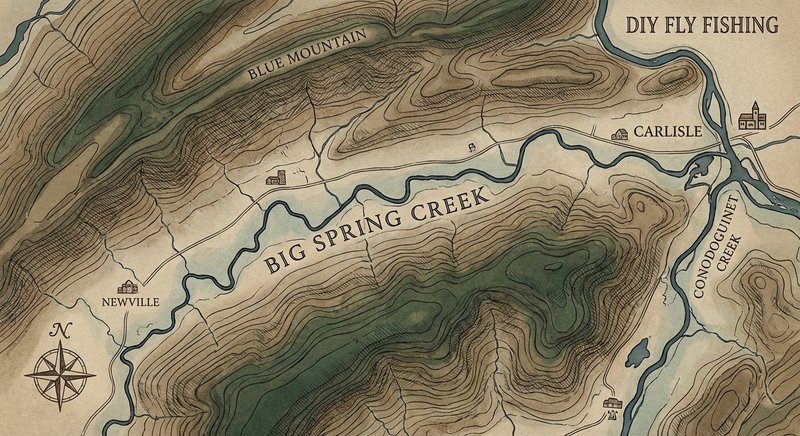
Big Spring Creek
Fly fishing in Pennsylvania · Advanced · Best seasons: Spring, Summer, Fall
Target Species
Brown Trout, Rainbow Trout
About This Water
Crystal-clear limestone creek with trophy brown trout. Technical dry fly fishing.
Fishing Recommendations
Welcome to the "holy water" of Pennsylvania limestone country. As your guide, I’m excited to walk you through one of the most storied and technical spring creeks in the United States: Big Spring Creek.
Located near Newville in Cumberland County, Big Spring is a classic limestone masterpiece. While it faced environmental challenges in the late 20th century due to a state fish hatchery, its removal and subsequent restoration have returned this creek to its status as a world-class trout fishery.
🎣 Location Overview
Big Spring Creek is a classic "limestone" stream. It emerges from a massive underground aquifer at a steady 52°F (11°C), meaning it never freezes in the winter and rarely gets too warm in the summer.
What makes it special: The water is gin-clear, nutrient-rich, and flows through lush beds of watercress and elodea. It is highly technical; the fish are wild, savvy, and have exceptional vision. Anglers love it because it offers a "British chalk stream" experience in the heart of Pennsylvania. It’s not a high-volume numbers game—it’s a game of chess played with a fly rod.
🐟 Target Species & Behavior
- Wild Brown Trout: The kings of the creek. These fish are buttery-yellow, often reaching impressive sizes (20"+). They are incredibly "spooky" and tend to hold under undercut banks, beneath overhanging brush, or deep within weed channels.
- Wild Rainbow Trout: Unlike most PA streams where rainbows are stocked, Big Spring has a self-sustaining population of wild rainbows. They are known for their vibrant colors and acrobatic fights. They often hold in the slightly faster "chutes" between weed beds.
- Behavior: These fish are opportunistic but highly selective. They sit in "lanes" in the weeds and will often only move an inch or two to take a fly. If they see your shadow or your fly line, the pool is "put down" for an hour.
📅 Best Times to Fish
Because of the stable water temperature, Big Spring is a 365-day fishery, but each season offers a different challenge:
- Spring (April – June): This is the prime window. The Sulphur hatch (late May/June) is legendary. You’ll also see Blue Quills and Hendricksons.
- Summer (July – August): While freestone streams are too hot to fish, Big Spring is perfect. This is Trico season. Tiny white-winged duns and spinners fall in the morning, creating some of the most challenging and rewarding dry-fly fishing in the world.
- Fall (September – November): The Brown Trout are aggressive as they prepare to spawn. Blue-Winged Olives (BWOs) hatch on overcast, drizzly days. Terrestrials (ants/beetles) remain effective until the first hard frost.
- Optimal Window: The first three hours of daylight (for Tricos) and the last two hours of daylight (for Sulphurs).
🪰 Recommended Flies & Techniques
Top Fly Patterns
- Nymphs/Crustaceans:
- Scuds and Sowbugs (Size 16–22): These are the bread and butter of the creek. Grey, tan, or olive.
- Pheasant Tail Nymphs (Size 18–22): Unweighted is often better to avoid snagging weeds.
- Dry Flies:
- Trico Spinners (Size 22–26): Essential for summer mornings.
- Sulphurs (Size 16–18): Both duns and emergers.
- Craneflies: Large, leggy dries that can trigger aggressive strikes.
- Terrestrials:
- Black Ants and Cinnamon Ants (Size 18–22).
- Japanese Beetles (Size 14–16).
Techniques
- Sight Nymphing: In the clear water, you often don't use an indicator. You watch the fish; when you see the white of its mouth or a sudden head turn, you set the hook.
- The "Ditch" Method: In the upper section (The Ditch), use a long leader (12–15 feet) and 6X or 7X fluorocarbon tippet.
- Downstream Dry Fly: To avoid showing the fish your leader, cast quartering downstream and "reach cast" to let the fly hit the fish’s nose before the line.
💡 Pro Tips & Local Knowledge
- The "Ditch" vs. The Meadows: The upper-most section (the Ditch) is deep and slow; this is where the monsters live. The lower sections (the Meadows) have more traditional riffle-and-pool character and are slightly easier to read.
- Dress for Stealth: Wear drab colors (camo, olive, or tan). Avoid bright hats.
- Kneel: If you are standing up on the bank, the trout can see you from 30 feet away. Experienced Big Spring anglers spend half their time on their knees.
- Watch the "Rise Forms": If you see a bubble, they are taking duns. If you see a dorsal fin or tail, they are taking emergers just under the surface. Adjust your fly accordingly.
⚠️ Important Information
Regulations
Big Spring is managed under Catch and Release / Fly Fishing Only regulations for the upper 1.1 miles (from the source to the Nealy Road bridge).
- Always check the latest PA Fish & Boat Commission (PFBC) summary book, as regulations can change.
- A valid Pennsylvania Fishing License and a Trout Permit are required.
Access
- The Source: There is a parking lot near the "Gump" (the headwaters). This is the most famous spot.
- The Big Spring Road: The road parallels the creek for much of its length, with several designated pull-offs and small parking lots.
Special Considerations
- Wading: Use caution. The bottom is often soft "muck" or silt. It is easy to get stuck or cloud up the water, which ruins the fishing for others downstream. Stay on the banks as much as possible.
- Etiquette: Because it is a small, technical stream, give other anglers plenty of space. If someone is working a rising fish, do not crowd them.
Guide’s Final Word: Big Spring Creek will humble you. You might spend four hours casting to one fish and never hook it—but when you finally land a 20-inch wild Big Spring Brown on a size 24 Trico, it’s a feeling you'll never forget. Tight lines!
Bug Hatches & Matching Flies
| Hatch | Type | Peak months | Time of day | Hook sizes | Matching flies |
|---|---|---|---|---|---|
| Blue-Winged Olive (BWO) Baetis | mayfly | March, April, September, October | Mid-day/Afternoon | #18-24 | RS2 #20-22, Parachute Adams #18-22, Pheasant Tail Nymph #18-24 |
| Sulphur Ephemerella invaria / dorothea | mayfly | May, June | Evening | #14-18 | Sulphur Parachute #14-18, CDC Sulphur Emerger #16-18, Sulphur Spinner #14-18 |
| Trico Tricorythodes | mayfly | July, August, September | Early Morning | #22-26 | Trico Spinner (Female) #22-26, Drowned Trico Spinner #22-24, Griffith's Gnat #22-24 |
| Scud Gammarus | terrestrial | January, April, October, December | All Day | #14-20 | Ray Charles #16-18, Pink Scud #14-18, Olive Scud #16-20 |
| Sowbug Asellus | terrestrial | March, May, September, November | All Day | #14-18 | Cress Bug #14-18, Soft Hackle Sowbug #16-18 |
| Grannom Caddis Brachycentrus | caddis | April | Afternoon/Evening | #14-16 | Grannom Pupa #14-16, Elk Hair Caddis (Olive) #14-16, LaFontaine's Deep Sparkle Pupa #16 |
| Crane Fly Tipulidae | other | August, September | Morning/Evening | #10-14 | Daddy Long Legs #10-12, Crane Fly Larva #10-14 |
| Cinnamon Sedge Hydropsyche | caddis | June, July, August | Evening | #16-18 | Cinnamon Caddis #16-18, Z-Caddis #16-18 |
| Terrestrials (Ants/Beetles) Formicidae / Coleoptera | terrestrial | July, August, September | Mid-day/Afternoon | #14-22 | Black Foam Beetle #14-18, Cinnamon Flying Ant #16-20, Crowe Beetle #16-18 |