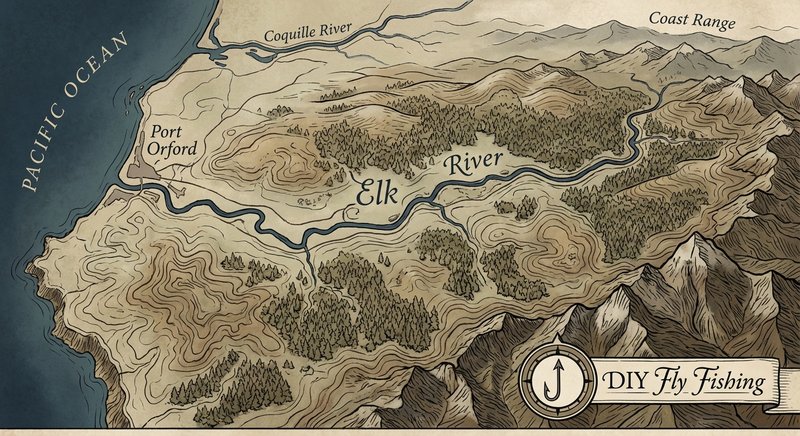
Elk River
Fly fishing in Oregon · Intermediate · Best seasons: Winter
Target Species
Steelhead, Cutthroat Trout
About This Water
Small southern Oregon stream with wild winter steelhead. Remote and scenic.
Fishing Recommendations
The Elk River is widely considered the "Gem of the South Coast." Flowing through the rugged Siskiyou National Forest and dumping into the Pacific Ocean just north of Port Orford, it is one of Oregon’s most pristine and visually stunning coastal rivers.
As an expert guide, here is your comprehensive breakdown for fly fishing the Elk River.
🎣 Location Overview
The Elk River is famous for its extraordinary clarity. Unlike many coastal rivers that turn into "chocolate milk" after a heavy rain, the Elk filters through a high-gradient, rocky canyon with very little silt. It is often the first river on the coast to "drop and clear" after a winter storm, making it the primary destination for anglers when other systems are blown out.
The river is characterized by dramatic boulders, deep emerald-green pools, and short, punchy riffles. It is a "wild and scenic" designated river, and the scenery—towering Douglas firs and moss-covered canyon walls—is as much of a draw as the fish.
🐟 Target Species & Behavior
Winter Steelhead
The Elk hosts both wild and hatchery winter steelhead. These are powerful, hard-fighting fish that enter the system from late November through March.
- Behavior: Because the water is so clear, these fish can be "spooky." They tend to hold in the deeper "buckets" or behind large submerged boulders.
- Holding Water: In the lower river, look for them in the tail-outs of long pools. In the upper canyon, they will hold in the depressions between large rocks.
Coastal Cutthroat Trout
While many anglers focus on the Fall "Sea-Run" Cutthroat, resident Cutthroats remain in the river through the winter.
- Behavior: They are opportunistic feeders. During the winter, they often hover behind spawning salmon or steelhead to gorge on loose eggs.
- Holding Water: Look for them in softer water, side channels, or the "seams" where fast water meets slow water.
📅 Best Times to Fish
- Optimal Months: Late December through early March. January and February are the "Prime Time" for fresh winter steelhead.
- The "Drop" Window: The best fishing occurs when the river is dropping after a rain event. Look for a flow between 3.0 and 5.0 feet on the USGS Elk River gauge. If it's below 3 feet, the water becomes gin-clear, and the fish become very wary.
- Time of Day: On clear days, the "low light" periods of early morning and late evening are best. On overcast or rainy days, fish can be active all day.
🪰 Recommended Flies & Techniques
Spey / Swinging (Traditional)
Swinging a fly is the most "soulful" way to fish the Elk. Because of the clarity, you don't always need massive, heavy flies.
- Patterns: Ho-Bo Spey, Signature Intruders, and Pick-Yer-Pocket leeches.
- Colors: In clear water, go with Black/Blue or Olive/White. In slightly tinted water, move to Pink/Orange or Chartreuse.
- Tip: Use a Skagit head with a variety of T-8 or T-11 sink tips to get the fly into the "zone" quickly.
Nymphing / Indicator Fishing
This is often the most productive method for both Steelhead and Cutthroat, especially in the deeper canyon holes.
- Patterns: Glo-Bugs (Egg patterns) in peach, Oregon cheese, or "clown" colors. For the Cutthroat, a #12-14 Bead-head Prince Nymph or Hare’s Ear is effective.
- Pro Technique: "Dead-drifting" a weighted egg pattern under an indicator. Ensure your shot is heavy enough to get the fly to the bottom quickly.
💡 Pro Tips & Local Knowledge
- The Stealth Factor: Because the water is so clear, wear muted colors (no bright red jackets). Approach pools quietly. If you can see the fish, they can likely see you. Long leaders (9–12 feet) are often necessary when nymphing.
- The "Hatchery Hole": There is a state fish hatchery about 10 miles upriver. This is a major collection point for fish. It gets crowded, but it is a "sure bet" for finding holding fish.
- Upper vs. Lower: The lower river (below the bridge) is mostly private land and is best fished from a drift boat. The upper river (National Forest land) offers excellent bank access for the wading angler.
- The "Elk/Sixes" Double: The Sixes River is just over the ridge. If the Elk is too low and clear, the Sixes might be just right. If the Sixes is blown out, the Elk is usually perfect.
⚠️ Important Information
- Access: Most bank access is found along Elk River Road, which parallels the river. There are several pull-outs and designated river access points within the Siskiyou National Forest.
- Regulations: Check the ODFW Southwest Zone regulations before heading out. The Elk has specific rules regarding the retention of wild steelhead (usually one per day and five per year, but this can change annually).
- Safety: The upper river canyon is steep. Be careful on the mossy rocks; felt soles or cleats are highly recommended.
- Shuttles: If you are floating, local shuttle services are available in Port Orford to move your rig from the "hatchery" or "Ironhead" drifts.
Guide’s Final Word: Bring your 7-weight Spey rod and a camera. Even if the fish aren't biting, the emerald water of the Elk is one of the most beautiful sights in the Pacific Northwest.
Bug Hatches & Matching Flies
| Hatch | Type | Peak months | Time of day | Hook sizes | Matching flies |
|---|---|---|---|---|---|
| March Brown Rhithrogena morrisoni | mayfly | March, April | Midday | #12-14 | Western March Brown #12-14, Pheasant Tail #12-14, March Brown Wet Fly #12 |
| Blue Winged Olive (BWO) Baetis | mayfly | February, March, October, November | Late Morning/Afternoon | #18-22 | Parachute Adams #18-22, RS2 #20, WD-40 #18-22 |
| Golden Stonefly Calineuria californica | stonefly | May, June, July | Morning/Evening | #6-10 | Kaufmanns Stimulator #8-10, Pat's Rubber Leg #6-8, Golden Stone Nymph #8 |
| Spotted Sedge Hydropsyche | caddis | June, July, August | Evening | #14-16 | Elk Hair Caddis #14-16, LaFontaine's Deep Sparkle Pupa #14-16, Peacock Soft Hackle #14-16 |
| October Caddis Dicosmoecus gilvipes | caddis | September, October | Afternoon | #8-10 | Orange Stimulator #8-10, Morrish October Caddis #8-10, Peaked Pupa #10 |
| Yellow Sally Isoperla | stonefly | June, July | Afternoon/Evening | #14-16 | Yellow Stimulator #14-16, Little Yellow Stone #16, Iron Lotus #16 |
| Carpenter Ants & Beetles Formicidae / Coleoptera | terrestrial | August, September | All Day | #12-16 | Black Foam Ant #14-16, Chernobyl Ant #12, Foam Beetle #14 |
| Midges Chironomidae | midge | December, January, February | Late Morning | #20-24 | Zebra Midge #20-22, Griffith's Gnat #20-22, Palomino Midge #20 |