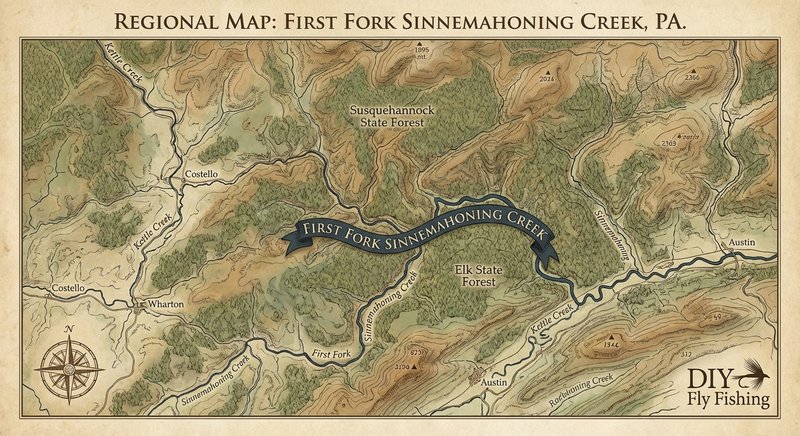
First Fork Sinnemahoning Creek
Fly fishing in Pennsylvania · Intermediate · Best seasons: Spring, Summer, Fall
Target Species
Brook Trout, Brown Trout
About This Water
Remote Potter County stream with wild brook trout. Excellent backcountry fishing.
Fishing Recommendations
Welcome to the "Wilds" of Pennsylvania. As your guide, I’m thrilled to introduce you to the First Fork of the Sinnemahoning Creek. Located primarily in Potter and Cameron Counties, this is one of the most storied and picturesque freestone streams in the Keystone State.
Here is your comprehensive guide to fly fishing the First Fork.
🎣 Location Overview
The First Fork Sinnemahoning Creek is a classic Appalachian freestone stream. It flows through a rugged, deeply forested valley known as the Pennsylvania Wilds. What makes this water special is its transition: the upper reaches near Wharton are intimate and cold, while the lower sections broaden into a majestic river-like setting.
Anglers love the First Fork because it offers a "big water" feel that is rare in the Eastern US, combined with the seclusion of the surrounding Susquehannock State Forest. It is a productive fishery that benefits from both natural reproduction in its tributaries and a robust stocking program by the state and local sportsman’s clubs.
🐟 Target Species & Behavior
- Brown Trout: These are the kings of the First Fork. You will find both hard-fighting stocked fish and "holdovers" that have survived multiple seasons. They tend to hold in the deeper pools, under undercut banks, and near large woody debris. During hatches, even the big browns will move into the glassy tails of pools to sip duns.
- Brook Trout: While the main stem holds some stocked Brookies, the real prize is the wild Brook Trout that drop down from the icy mountain tributaries (like Bailey Run or Berge Run). These fish are aggressive but spooky. Look for them in the upper reaches where the water remains coldest.
- Behavior: In the spring, fish are opportunistic and feed heavily on nymphs. As the water warms, they become very "hatch-oriented." By late summer, they shift to nocturnal feeding or holding in the deepest, oxygenated oxygen-rich riffles.
📅 Best Times to Fish
- Spring (Late April – June): This is the "Golden Age" of the First Fork. Water levels are usually ideal, and the major mayfly hatches occur. This is your best chance for a trophy on a dry fly.
- Summer (July – August): Focus on the early morning (dawn to 10:00 AM) and late evening. The water can get warm in the lower sections, so carry a thermometer. If the main stem hits 68°F+, move upstream to the cooler headwaters or the "Delayed Harvest" section.
- Fall (September – October): A spectacular time to be in the canyon. The Brown Trout become aggressive as they prepare to spawn. The crowds are gone, and the foliage is world-class.
- Prime Window: The "Green Drake" hatch in late May/early June is the stuff of local legend.
🪰 Recommended Flies & Techniques
Top Fly Patterns
- Dry Flies:
- Hendrickson (Dark & Light) - Late April.
- Sulphurs (Size 14-18) - May through June.
- Green Drake (Size 8-10) - Late May.
- Slate Drake (Isonychia) - Summer and Fall.
- Terrestrials: Foam beetles and ants are essential in July and August.
- Nymphs:
- Pheasant Tail (Size 12-18) - Imitates almost everything.
- Walts Worm - A local PA favorite.
- Golden Stonefly Nymphs - High water in Spring.
- Streamers:
- Black or Olive Wooly Buggers - Work these deep through the big pools.
Techniques
- The "Dry-Dropper": In the pocket water of the upper First Fork, a buoyant dry fly (like a Stimulator) with a small nymph tied 18" below it is deadly.
- Nymphing: Use a tactical European Nymphing setup or a small indicator. Focus on the "seams" where fast water meets slow water.
- Swing the Streamer: On the lower, wider sections, swinging a streamer across and down can trigger aggressive strikes from large Browns.
💡 Pro Tips & Local Knowledge
- The Delayed Harvest Area: Focus on the Delayed Harvest Artificial Lures Only (DHALO) section which runs for about 2.1 miles from the mouth of Bailey Run downstream. This area holds fish long after other sections have been fished out.
- Watch the Tributaries: If the First Fork is running high or muddy after a rain, hike up the small feeder streams. They clear faster and are full of wild Brookies.
- The "Wharton" Rule: Generally, the further upstream of the town of Wharton you go, the more "wild" the experience. The further downstream toward Sinnemahoning, the larger the pools and the fish.
- Stealth Matters: Despite the size of the water, the First Fork is very clear. Wear natural colors (greens/tans) and avoid wading deep into the pools where you might spook fish holding in the shallows.
⚠️ Important Information
- Access: Much of the First Fork is accessible via Route 872. There are numerous pull-offs and public parking areas within the State Forest and Sinnemahoning State Park.
- Regulations: Ensure you have a valid Pennsylvania Fishing License and a Trout Permit. Be sure to check the PA Fish & Boat Commission summary book for specific "Delayed Harvest" rules (no bait allowed, specific harvest dates).
- Special Considerations: This is "Elk Country." Keep your eyes peeled for Pennsylvania’s wild elk herd, which often frequents the river banks. Also, be aware that cell service is almost non-existent in the canyon—download your maps for offline use before you leave Sinnemahoning or Coudersport.
Tight lines, and enjoy one of Pennsylvania's finest freestones!
Bug Hatches & Matching Flies
| Hatch | Type | Peak months | Time of day | Hook sizes | Matching flies |
|---|---|---|---|---|---|
| Blue-Winged Olive (BWO) Baetis | mayfly | April, May, September, October | Afternoon | #18-22 | RS2 #18-22, Parachute Adams #18-22, Pheasant Tail Nymph #18-20 |
| Quill Gordon Epeorus pleuralis | mayfly | April | Afternoon | #12-14 | Quill Gordon Dry #12-14, Gold Ribbed Hare's Ear #12-14 |
| Hendrickson Ephemerella subvaria | mayfly | April, May | Afternoon | #12-14 | Red Quill #12-14, Hendrickson Nymph #12-14, Hendrickson Sparkle Dun #12-14 |
| Grannom Caddis Brachycentrus | caddis | April, May | Morning/Afternoon | #14-16 | Elk Hair Caddis (Dark) #14-16, LaFontaine's Deep Sparkle Pupa #14-16 |
| March Brown Maccaffertium vicarium | mayfly | May | Afternoon | #10-12 | March Brown Western #10-12, Hare's Ear Nymph #10-12 |
| Sulfur Ephemerella invaria/dorothea | mayfly | May, June | Evening | #14-18 | Sulfur Parachute #14-18, Sulfur CDC Emerger #16-18, Pheasant Tail #16-18 |
| Slate Drake Isonychia bicolor | mayfly | June, September | Afternoon/Evening | #10-12 | Iso Parachute #10-12, Isonychia Nymph (Zug Bug variation) #10-12 |
| Light Cahill Stenocron interpunctatum | mayfly | June, July | Evening | #12-14 | Light Cahill Dry #12-14, Gold Ribbed Hare's Ear #14 |
| Golden Stonefly Acroneuria | stonefly | June, July | Evening/Night | #6-10 | Kaufmann's Stone #6-10, Golden Stimulator #8-10 |
| Terrestrials (Ants/Beetles) Formicidae/Coleoptera | terrestrial | July, August, September | Midday | #12-18 | Black Foam Ant #14-18, Crowe Beetle #12-16 |