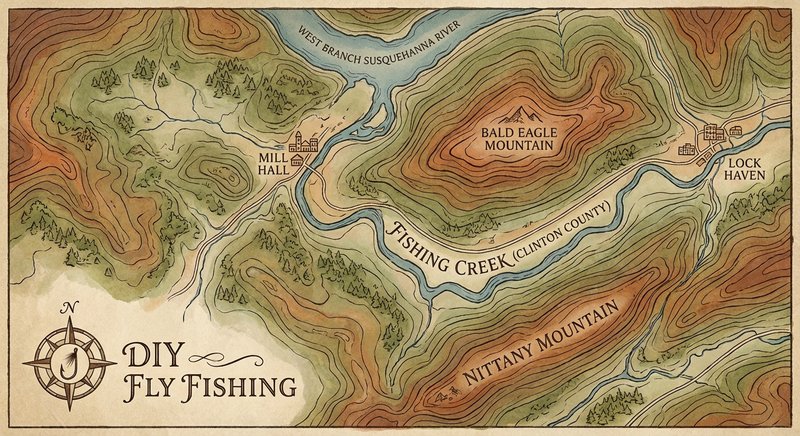
Fishing Creek (Clinton County)
Fly fishing in Pennsylvania · Intermediate · Best seasons: Spring, Summer, Fall
Target Species
Brown Trout, Brook Trout
About This Water
Premier central PA freestone with excellent hatches. Wild brown trout in scenic mountain setting.
Fishing Recommendations
Fishing Creek in Clinton County, Pennsylvania—often referred to as "Big Fishing Creek" to distinguish it from its namesakes—is legendary in the fly fishing world. It is arguably one of the most productive and challenging wild trout fisheries in the Eastern United States.
Here is your comprehensive guide to mastering this limestone gem.
🎣 Location Overview
Big Fishing Creek is a limestone-influenced freestone stream that flows through a dramatic, steep-walled gap known as "The Narrows." What makes this water special is the massive influx of cold, nutrient-rich spring water from the limestone aquifer, particularly near the Tylersville state fish hatchery.
This influx keeps the water temperatures stable and cold even in the heat of summer, creating a "biological factory" for aquatic insects. The stream is characterized by "pocket water"—a chaotic mix of boulders, plunges, and deep runs. It is physically demanding to wade and technically demanding to fish, attracting anglers who crave a challenge over an easy catch.
🐟 Target Species & Behavior
- Wild Brown Trout: These are the kings of the creek. They are 100% wild, buttery-gold, and incredibly wary. They hold in tight "pockets" behind boulders and deep in the undercut banks of the lower valley sections.
- Wild Brook Trout: Found primarily in the upper reaches above the Narrows and in the cold-water tributaries. They are opportunistic but small, requiring stealthy approaches in thin water.
- Behavior: Due to the high fishing pressure and crystal-clear water, these fish have a PhD in avoiding artificial flies. They have a narrow "feeding window" and will often reject a fly if the drift isn't perfect or the tippet is too thick.
📅 Best Times to Fish
- Spring (April – June): This is the prime window. The Grannom Caddis (mid-April) and Sulphurs (May/June) provide world-class dry fly action. The famous Green Drake hatch usually occurs in late May or early June.
- Summer (July – August): Unlike many PA streams, Fishing Creek remains fishable due to the cold springs. Focus on early mornings or late evenings. Terrestrials become the name of the game.
- Fall (September – October): The Brown Trout become aggressive as they prepare to spawn. This is the best time for streamer fishing and seeing Blue-Winged Olives (BWO) on drizzly afternoons.
- Conditions: Overcast days are your best friend here. The lack of shadows makes the fish significantly less "spooky."
🪰 Recommended Flies & Techniques
Top Fly Patterns
- Nymphs: Frenchie (size 14-18), Sexy Walt’s Worm (size 12-16), Pheasant Tail (size 16-20), and Zebra Midges.
- Dry Flies: Elk Hair Caddis (Tan/Olive), Sparkle Dun Sulphurs (size 14-18), Blue Winged Olive (size 18-22), and the Coffin Fly (for the Green Drake spinner fall).
- Terrestrials: Dave’s Hopper, Beetles, and Ants (size 16-20 with a hi-vis post).
- Streamers: Black or Olive Wooly Buggers, and small Sculpin patterns.
Effective Techniques
- Euro Nymphing (Tactical Nymphing): This is perhaps the most effective way to fish the Narrows. Because the current is complex, a tight-line approach allows you to get deep into the pockets without drag.
- Dry-Dropper: In the summer, a buoyant foam beetle with a small pheasant tail dropper is deadly in the riffles.
- The "Slow Swing": When the Grannom or Sulphur emergers are active, swinging a wet fly or soft hackle through the tail-outs can be more effective than a dead drift.
💡 Pro Tips & Local Knowledge
- The "Greased Bowling Ball" Warning: The rocks in Fishing Creek are notoriously slick and round. Studded wading boots and a wading staff are not optional—they are mandatory for safety.
- Focus on "The Narrows": The 5-mile stretch between Lamar and Tylersville is the "holy water." It has the highest concentration of wild fish and the coldest water.
- Downsize Your Tippet: For dry flies, you will frequently need to drop down to 6X or 7X fluorocarbon. These fish see hundreds of flies a week; any hint of "micro-drag" or heavy line will spook them.
- Stealth Matters: Don't just walk up to the bank. Kneel when approaching a pool. Keep a low profile and try to cast from behind boulders to stay out of the trout's line of sight.
⚠️ Important Information
- Regulations: Large sections of Fishing Creek are under "Catch and Release / All Tackle" regulations (especially in the Narrows). Always check the latest Pennsylvania Fish and Boat Commission (PFBC) summary before heading out.
- Access: Much of the Narrows is along Route 880. There are various pull-offs, but many are small. Be sure your vehicle is completely off the white line.
- Private Property: While there is significant public access, some stretches in the lower valley (near Mill Hall) are private. Look for the "Fishing Permitted" signs and always respect "Posted" signs.
- Permits: You must have a valid PA Fishing License and a Trout Permit. These can be purchased online via the HuntFishPA website or at local fly shops like Trout Run Fly Shop (a great place for up-to-the-minute hatch info).
Fishing Creek is a "graduate level" trout stream. Don't be discouraged if you get skunked your first time—landing even one wild brown here is a badge of honor for any fly fisher.
Bug Hatches & Matching Flies
| Hatch | Type | Peak months | Time of day | Hook sizes | Matching flies |
|---|---|---|---|---|---|
| Blue-Winged Olive Baetis / Drunella | mayfly | April, May, September, October | Late Morning/Afternoon | #18-22 | RS2 #20-22, BWO Sparkle Dun #18-20, Pheasant Tail #18-22 |
| Quill Gordon Epeorus pleuralis | mayfly | April | Midday | #12-14 | Quill Gordon Dry #12-14, Hare's Ear #12-14 |
| Grannom Caddis Brachycentrus | caddis | April, May | Afternoon/Evening | #14-16 | Henryville Special #14-16, LaFontaine's Deep Sparkle Pupa #14-16, Peacock Caddis #14-16 |
| Hendrickson Ephemerella subvaria | mayfly | April, May | Afternoon | #12-14 | Hendrickson Pink Lady #12-14, Red Quill #12-14, Hendrickson Nymph #12-14 |
| Sulphur Ephemerella invaria / dorothea | mayfly | May, June | Evening | #14-18 | Sulphur Parachute #14-18, Sulphur Emerger #14-18, Pheasant Tail #14-16 |
| Eastern Green Drake Ephemera guttulata | mayfly | May, June | Late Evening | #8-10 | Green Drake Paradox #8-10, Coffin Fly #8-10, Green Drake Nymph #8-10 |
| Slate Drake Isonychia bicolor | mayfly | June, September | Afternoon/Evening | #10-12 | Isonychia Parachute #10-12, Prince Nymph #10-14, Zug Bug #10-12 |
| Trico Tricorythodes | mayfly | July, August, September | Early Morning | #22-26 | Trico Spinner #22-26, Trico Parachute #22-24 |
| Tan Caddis Hydropsyche | caddis | June, July, August | Evening | #14-16 | Elk Hair Caddis #14-16, Frenchie #14-16 |