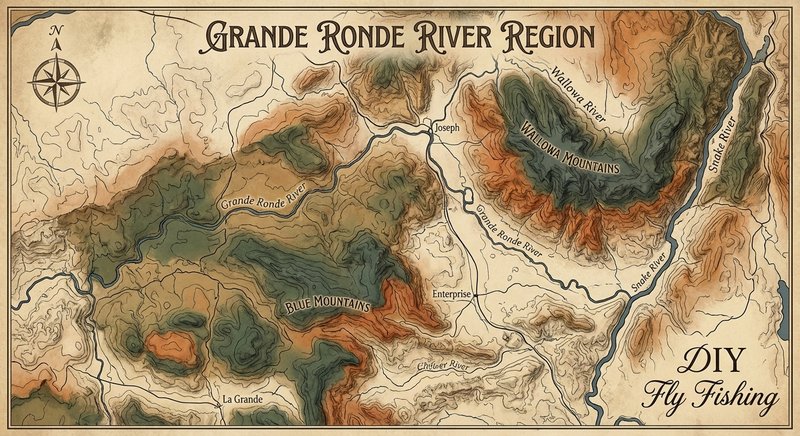
Grande Ronde River
Fly fishing in Oregon · Intermediate · Best seasons: Fall, Winter
Target Species
Steelhead, Rainbow Trout, Smallmouth Bass
About This Water
Northeast Oregon river with excellent steelhead. Beautiful canyon and wilderness fishing.
Fishing Recommendations
The Grande Ronde River, particularly the section flowing through the high desert canyons of Northeast Oregon and into Southeast Washington, is a hallowed destination for fly anglers. Often referred to as "The Ronde," it is a wild, scenic, and remote river characterized by stunning basalt cliffs, golden bunchgrass hills, and classic "riffle-run-pool" water that is arguably the finest "swinging" water for Steelhead in the Lower 48.
🎣 Location Overview
The Grande Ronde is a tributary of the Snake River. Its most famous reach for fly fishing lies between the town of Minam, Oregon, and the mouth at the Snake. What makes it special is its gradient and character. It is a relatively shallow, cobble-bottomed river with a moderate pace, making it approachable for wading and ideal for presenting a fly on a swung line.
Anglers love the Ronde for its solitude and the "Step-Cast-Swing" rhythm. Unlike the coastal rivers, the Grande Ronde offers a "high desert" experience where the air is crisp, the light is dramatic, and the Steelhead are known for being aggressive surface-takers.
🐟 Target Species & Behavior
Summer-Run Steelhead (The Main Event)
These fish are "B-Run" and "A-Run" Steelhead returning from the Pacific. They enter the river in late September and stay through the winter.
- Behavior: They are known for their willingness to move to a fly. In the early fall, they often hold in faster, oxygenated riffles. As the water cools, they move into the "gut" or "tail-outs" of long runs.
- Feeding: They aren't actively feeding to grow, but they retain an aggressive predatory strike response.
Rainbow Trout (Redbands)
The Grande Ronde holds a healthy population of native Columbia Basin Redband Trout.
- Behavior: They are opportunistic. In the fall, they often shadow spawning salmon to eat eggs or gorge on October Caddis.
- Holding: Look for them in "seams" behind boulders and in the slower bubbles lines.
Smallmouth Bass
While found primarily in the lower reaches (near the Snake River confluence), they are prolific in the warmer months and early fall.
- Behavior: They hold in the slower, rockier eddies and deeper pools. They are highly aggressive and will smash streamers and poppers.
📅 Best Times to Fish
The "Golden Window": October – November
This is the prime time for Steelhead. The water temperatures are usually between 40°F and 50°F—the "magic zone" where Steelhead are most likely to rise for a dry fly or chase a swung fly.
- Optimal Times: 10:00 AM to 4:00 PM. Unlike summer trout fishing, you don't need to be on the water at dawn. Steelhead activity often peaks as the sun warms the water slightly.
- Winter (December – February): Fishing becomes a game of endurance. The fish are there, but they are lethargic. You must fish deep and slow.
🪰 Recommended Flies & Techniques
Steelhead: The "Swing"
The Grande Ronde is a Spey casting paradise.
- Technique: Use a 6- or 7-weight Spey rod. Cast 45 degrees downstream, let the current pull the fly across the river (the swing), and wait for the "grab."
- Top Flies:
- Surface: Greaseliner, Waller Walker (Yes, they will take dries here!).
- Subsurface: Hobo Spey (Purple/Black), Green Butt Skunk, Blue Charm, and Intruders (in orange/pink for colder water).
Trout: Nymphing & Dries
- Technique: Indicator nymphing or "European Style" in the pocket water.
- Top Flies:
- October Caddis: Size 8-10 (Orange Stimulators).
- Nymphs: Prince Nymphs, Bead-head Pheasant Tails, and Glo-Bugs (egg patterns) in late fall.
Smallmouth Bass
- Top Flies: Woolly Buggers (Black/Olive), Clouser Minnows, and Poppers in the late evening.
💡 Pro Tips & Local Knowledge
- "The Pendulum" Swing: On the Ronde, the fish often sit closer to the bank than you think. Don't wade out to your chest immediately. Fish the "inside" water first.
- Color Progression: A local rule of thumb is "Bright day, bright fly; Dark day, dark fly." However, if the water is cold (under 40°F), almost everyone switches to Pink or Orange.
- The "Minam to Troy" Float: This is a multi-day wilderness trip (approx. 45 miles). It is the best way to access water that sees very little pressure. If you are day-tripping, focus on the Boggan’s Oasis area down to the mouth.
- Watch the USGS Gauge: The Grande Ronde is "flashy." If a heavy rain hits, the river turns to "chocolate milk" quickly. Check the gauges at Troy or Rondowa before driving.
⚠️ Important Information
- Access: Much of the river is bordered by private land, but there are significant stretches of BLM and State land. Use an app like onX Hunt to stay legal.
- Regulations:
- Barbless hooks only for Steelhead.
- You must have a valid Oregon Angling License and a Combined Angling Tag (Steelhead tag).
- Note: The river crosses the WA/OR border. If you cross the state line near Troy, you need a Washington license.
- Safety: Cell service is non-existent in the canyon. Carry a satellite communication device (like a Garmin inReach). In winter, the roads into the canyon (like the "Rattlesnake Grade") can be treacherous—4WD and snow tires are mandatory.
- Shuttles: If floating, contact local services like Boggan’s Oasis for vehicle shuttles.
Guide’s Final Word: The Grande Ronde isn't about high fish counts; it's about the quality of the take. There is no thrill in fly fishing quite like a wild Steelhead rising to a dry fly in a basalt canyon while the golden eagles soar overhead.
Bug Hatches & Matching Flies
| Hatch | Type | Peak months | Time of day | Hook sizes | Matching flies |
|---|---|---|---|---|---|
| Salmonfly Pteronarcys californica | stonefly | May, June | All day | #4-8 | Chubby Chernobyl #6-8, Rogue Foam Salmonfly #4-6, Pat's Rubber Leg Stone #4-8 |
| Golden Stonefly Hesperoperla pacifica | stonefly | June, July | Morning/Evening | #8-12 | Clark's Stone #8-10, Norm Wood Special #10-12, Golden Stone Nymph #8-12 |
| Blue-Winged Olive (BWO) Baetis | mayfly | March, April, September, October, November | Afternoon | #16-22 | Parachute Adams #16-20, RS2 #18-22, Pheasant Tail #16-20 |
| October Caddis Dicosmoecus gilvipes | caddis | September, October | Late Afternoon/Evening | #8-12 | Orange Stimulator #8-12, Morrish October Caddis #10, Peery's October Caddis Pupa #10-12 |
| Pale Morning Dun (PMD) Ephemerella hydri | mayfly | June, July | Late Morning/Afternoon | #14-18 | Sparkle Dun #16-18, Quigley's PMD Hackle Stacker #14-16, Split Case PMD #16-18 |
| Mother's Day Caddis Brachycentrus | caddis | May | Evening | #14-16 | Elk Hair Caddis (Peacock) #14-16, Iris Caddis #14-16, Hydropsyche Larva #14-16 |
| March Brown Rhithrogena morrisoni | mayfly | March, April | Afternoon | #12-14 | March Brown Western #12-14, Hare's Ear Nymph #12-14, March Brown Wet #12 |
| Grasshoppers | terrestrial | August, September | Late Morning through Afternoon | #8-12 | Morrish Hopper #8-12, Dave's Hopper #10-12, Yee's Carpet Hopper #10 |
| Tricos Tricorythodes | mayfly | August, September | Early Morning | #20-24 | Trico Spinner #20-24, Trico Dun #22, Zebra Midge #20-22 |