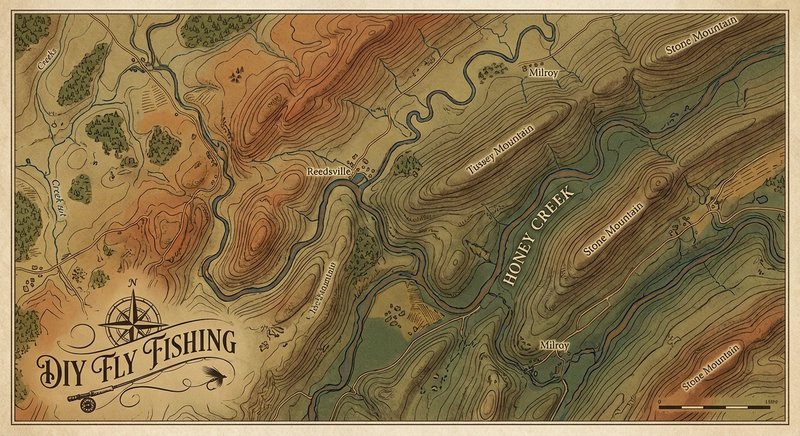
Honey Creek
Fly fishing in Pennsylvania · Advanced · Best seasons: Spring, Summer, Fall
Target Species
Brown Trout
About This Water
Small limestone tributary of Kishacoquillas. Trophy brown trout in intimate setting.
Fishing Recommendations
Honey Creek, located in Mifflin County near Reedsville, Pennsylvania, is one of the hidden gems of the "Cumberland Valley" style limestone region, though it technically sits in the Ridge and Valley province. It is a transition stream—part freestone, part limestone—offering a diverse environment that produces some of the most beautiful wild Brown Trout in the state.
Here is your comprehensive guide to fishing Honey Creek.
🎣 Location Overview
Honey Creek is a major tributary to the Kishacoquillas Creek ("The Kish"). What makes it special is its dual personality. The upper reaches, particularly above the village of Reeds Creek, behave more like a mountain freestone stream. As it flows through the valley toward the Narrows, it gains significant limestone influence from underground springs.
Anglers love Honey Creek because it offers a "technical but fair" challenge. It features classic pool-and-riffle sequences, undercut banks, and deep limestone pockets. Unlike the more famous Penns Creek or Spruce Creek nearby, Honey Creek often feels more intimate and less crowded, providing a serene PA fly fishing experience.
🐟 Target Species & Behavior
Primary Species: Wild Brown Trout. While there are some stocked fish in certain reaches, the draw here is the robust population of wild Browns.
- Behavior: These fish are wary. Because the water is often crystal clear, they have excellent vision. They are highly opportunistic during hatches but revert to being "structure-oriented" predators during non-hatch periods.
- Where they hold: Look for them at the "heads" of pools in the bubbles during oxygen-rich spring mornings. As the sun rises, they move under the overhanging hemlocks and undercut limestone ledges. In the "Narrows" section, they often hold behind large submerged boulders.
- Feeding: They are highly selective during Trico and Sulpher hatches. However, they are also known for "looking up" for terrestrials in late summer due to the lush farmland surrounding the creek.
📅 Best Times to Fish
Optimal Seasons
- Spring (April – June): This is the "Golden Era" on Honey Creek. Water levels are usually stable, and the major hatches occur.
- Summer (July – August): Fishing becomes technical. Focus on early mornings or late evenings. The limestone influence keeps the water cooler than pure freestone streams, but temperature monitoring is essential.
- Fall (September – November): A fantastic time as wild Browns become aggressive before the spawn. The foliage in the valley is world-class.
Prime Windows
- Morning: Best for Trico hatches in July and August (approx. 7:00 AM – 10:00 AM).
- Evening: Best for the "Sulpher Spinner" fall in May and June.
- Low Light: Overcast days are prime for streamer fishing for the larger resident Browns.
🪰 Recommended Flies & Techniques
Top Fly Patterns
- Dry Flies:
- Sulphurs (Sizes 14-18): A staple in May/June.
- Tricos (Sizes 22-26): Critical for summer mornings.
- Slate Drake (Iso) (Size 12-14): Great for the faster riffles in late summer/early fall.
- Terrestrials: Black foam beetles and Dave’s Hoppers (Sizes 10-16).
- Nymphs:
- Pheasant Tail (Sizes 16-20): Mimics almost everything here.
- Frenchie or Walt’s Worm: Highly effective for "Euro-style" nymphing in the deeper slots.
- Zebra Midge (Size 20-22): Essential for low-water summer conditions.
- Streamers:
- Black or Olive Wooly Buggers: Work these near the undercut banks.
- Sculpin Patterns: Honey Creek has a healthy sculpin population.
Presentation Tips
- The "Reach Cast": Essential here to manage drag across complex current seams.
- Light Leaders: 6X or 7X tippet is often mandatory during the Trico hatch or in the flat pools.
- Stealth: Approach the water from downstream and stay low. If you see the fish, they have likely already seen you.
💡 Pro Tips & Local Knowledge
- The "Narrows": The section of Honey Creek that flows through "The Narrows" (along Route 322) offers higher gradients and more oxygenated water. This is the place to be during the warmer weeks of June.
- After a Rain: Honey Creek can get a "milky" stain after a light rain. This is the best time to throw medium-sized streamers. The wild Browns lose their inhibitions in the slightly turbid water.
- The "Green Drake" Factor: While Penns Creek is the king of the Green Drake, Honey Creek gets a decent showing of these massive flies (late May). It’s less crowded than Penns, and the fish are just as eager to smash a Size 8 dry fly.
- Check the Gauges: Look at the USGS gauge for the Kishacoquillas Creek at Reedsville to get a sense of local flow trends.
⚠️ Important Information
Access
- Much of Honey Creek flows through private land, but many landowners allow fishing if you are respectful.
- Public access is available in several spots near Reedsville and throughout the Honey Creek Meadows area.
- Always look for "Posted" signs and respect "No Trespassing" zones. The continued access to this creek depends on angler behavior.
Regulations
- A significant portion of Honey Creek is managed under Catch and Release / Artificial Lures Only regulations (specifically the 1.75-mile stretch from the bridge on T-483 downstream to the SR 4003 bridge).
- Always check the Pennsylvania Fish and Boat Commission (PFBC) summary book for the most current boundary markers and seasonal rules.
Special Considerations
- Wading: The rocks in Honey Creek can be incredibly slick due to the limestone mineral deposits and algae. Studded wading boots and a staff are highly recommended.
- Temperature: If the water temperature hits 68°F (20°C), stop fishing to protect the wild trout population. In mid-summer, the lower reaches can occasionally reach these limits.
Bug Hatches & Matching Flies
| Hatch | Type | Peak months | Time of day | Hook sizes | Matching flies |
|---|---|---|---|---|---|
| Blue-Winged Olive Baetis | mayfly | April, October, November | Mid-day | #18-22 | RS2 #20-22, Parachute Adams #18-22, BWO Sparkle Dun #18-20 |
| Grannom Caddis Brachycentrus | caddis | April | Morning/Afternoon | #14-16 | Deep Sparkle Pupa #14-16, Elk Hair Caddis (Dark) #14-16, Peacock Caddis #16 |
| Hendrickson Ephemerella subvaria | mayfly | April, May | Afternoon | #12-14 | Pheasant Tail Nymph #12-14, Red Quill #14, Hendrickson Spinner #12-14 |
| Sulphur Ephemerella invaria/dorothea | mayfly | May, June | Evening | #14-18 | Sulphur Parachute #14-18, Split Case Sulphur #16, Sulphur Spinner #14-18 |
| Slate Drake Isonychia bicolor | mayfly | June, September | Afternoon/Evening | #10-14 | Zug Bug #10-12, Iso Parachute #10-12, Prince Nymph #12-14 |
| Trico Tricorythodes | mayfly | July, August, September | Early Morning | #22-26 | Trico Spinner (Poly Wing) #22-24, Griffith's Gnat #20-24, Trico Dun #24 |
| White Fly Ephoron leukon | mayfly | August | Evening (Dusk) | #12-14 | White Wulff #12-14, White Sparkle Dun #12-14, Ephoron Nymph #12-14 |
| Tan Caddis Hydropsyche | caddis | May, June, July | Evening | #14-18 | Holy Grail Caddis Pupa #14-16, Elk Hair Caddis (Tan) #14-18, Frenchie #14-18 |
| Terrestrials Formicidae / Coleoptera | terrestrial | July, August, September | All Day | #12-20 | Cinnamon Ant #16-20, Black Foam Beetle #14-18, Dave's Hopper #10-12 |