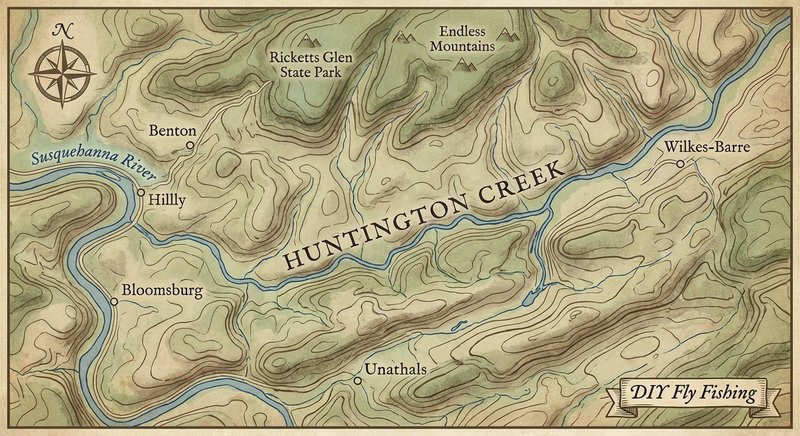
Huntington Creek
Fly fishing in Pennsylvania · Beginner · Best seasons: Spring, Summer, Fall
Target Species
Brown Trout, Brook Trout
About This Water
Columbia County stream with wild brown trout. Scenic valley fishing.
Fishing Recommendations
As an expert guide with years of experience navigating the limestone and freestone waters of the Keystone State, I can tell you that Huntington Creek is one of Pennsylvania’s most rewarding "under the radar" fisheries. While the nearby Big Fishing Creek gets a lot of the glory, Huntington offers a more intimate, technical, and often more peaceful experience for the discerning angler.
Here is your comprehensive guide to fly fishing Huntington Creek.
🎣 Location Overview
Huntington Creek is a beautiful freestone stream flowing through Luzerne and Columbia counties in Northeastern Pennsylvania. It eventually joins the main stem of Fishing Creek near Bloomsburg.
What makes Huntington special is its wild character. While some sections are stocked, the creek boasts a robust population of wild Brown Trout and, in its upper reaches and feeder tributaries, native Brook Trout. The water is characterized by a classic "pool-and-drop" structure—you’ll find deep, shaded pools separated by bubbly riffles and technical pocket water. It is a medium-sized stream, manageable for wading, but dense riparian cover makes casting a test of skill.
🐟 Target Species & Behavior
- Wild Brown Trout: The stars of the show. These fish are wary and highly attuned to overhead movement. They tend to hold tight to undercut banks, submerged logs, and the "seams" where fast water meets slow water. Large, predatory browns often move into the tailouts of pools during low light.
- Native Brook Trout: Found primarily in the headwaters (above the town of Shickshinny/Huntington Mills area) and in the small, cold-water feeder runs. They are opportunistic but fragile; they prefer the coldest, most oxygenated water available.
- Behavior: During the day, fish stay deep in the "buckets." As the sun hits the water, they become very light-sensitive. In the evening, they move into the shallower riffles to intercept hatching insects.
📅 Best Times to Fish
- Spring (April – June): This is the prime window. The water temperatures are ideal (55–62°F), and the major hatches occur. Late May is legendary for its Sulphur emergence.
- Summer (July – August): Fishing becomes technical. Focus on early mornings (dawn to 10 AM) or the "magic hour" at dusk. Look for cooler water near tributary mouths. Terrestrial fishing (ants/beetles) is at its peak.
- Fall (September – November): A favorite for guides. The Brown Trout become aggressive as they prepare to spawn. The colors of the foliage matching the colors of the trout make this a visually stunning time to be on the water.
- Optimal Conditions: Overcast days are your best friend here. It cuts the glare and makes the wild browns much less "spooky."
🪰 Recommended Flies & Techniques
Top Fly Patterns
- Dry Flies:
- Sulphur Parachute (#14-18) - Essential for May/June.
- Slate Drake (Isonychia) (#10-12) - Great for the faster riffles.
- Blue Winged Olive (BWO) (#18-22) - Vital for rainy spring or fall days.
- Elk Hair Caddis (#14-16) - Tan or Olive; a great searcher pattern.
- Nymphs:
- Pheasant Tail (#14-18) - The gold standard here.
- Hare’s Ear (#14-16) - Effective in the deeper pools.
- Perdigons (#16-18) - In silver or copper, to get down fast in pocket water.
- Streamers:
- Woolly Bugger (Black or Olive, #8-10).
- Muddler Minnow - Excellent for imitating sculpins in the riffles.
Presentation & Techniques
- The "Reach Cast": Because of the varying current speeds, a reach cast is essential to get a drag-free drift before the line gets caught in the faster center-current.
- European Nymphing: This is highly effective in Huntington’s riffles. A long rod (10ft 3wt) allows you to probe the pockets without your fly line ever touching the complex currents.
- Stealth Approach: This is not a "grandstand" river. Stay low, wear drab colors, and wade slowly. If you splash, you’ve already lost the pool.
💡 Pro Tips & Local Knowledge
- Focus on the "Hidden" Pockets: Many anglers walk right past the small, knee-deep pockets between the major pools. In Huntington, a wild brown will often sit in water barely deep enough to cover its back if there is a good bubble-line nearby.
- The Terrestrial Secret: From July through September, don’t overlook the Japanese Beetle or a Black Foam Ant. PA trout are "tree-feeders" in the summer. If you see overhanging branches, drop a beetle right under them with a slight "splat."
- Follow the Cold: If the main stem of Huntington feels too warm (above 68°F), move upstream. The temperature can drop significantly as you gain elevation toward the headwaters.
⚠️ Important Information
- Access: Much of Huntington Creek flows through private land, though many landowners are gracious to anglers. Always look for "Posted" signs. Public access can be found near bridge crossings and specific state-managed areas. The State Game Lands #57 region offers some of the most pristine, rugged access for those willing to hike.
- Regulations: Huntington Creek is subject to Pennsylvania Fish & Boat Commission (PFBC) regulations. There are "Delayed Harvest Artificial Lures Only" (DHALO) sections on nearby streams, but much of Huntington is under general regulations. Check the current PFBC summary book for specific reach designations.
- Wading Safety: The rocks can be "greasy" with algae. Felt soles (where legal) or studded rubber boots are highly recommended.
- Permits: A valid Pennsylvania Fishing License and a Trout/Salmon Permit are required for all anglers 16 and older.
Guide’s Final Word: Huntington Creek rewards the patient angler. Don't try to cover five miles of water; instead, pick a half-mile stretch and fish it thoroughly and quietly. You’ll be surprised at how many wild trout are watching you from the shadows.
Tight lines!
Bug Hatches & Matching Flies
| Hatch | Type | Peak months | Time of day | Hook sizes | Matching flies |
|---|---|---|---|---|---|
| Blue-Winged Olive Baetis spp. | mayfly | March, April, September, October | Mid-day/Afternoon | #18-22 | RS2 #18-22, BWO Sparkle Dun #18-22, Pheasant Tail #18-20 |
| Hendrickson Ephemerella subvaria | mayfly | April, May | Afternoon | #12-14 | Red Quill #12-14, Hendrickson Emerger #12-14, Hare's Ear Nymph #12-14 |
| Grannom Caddis Brachycentrus | caddis | April, May | Morning/Evening | #14-16 | LaFontaine's Deep Pupa #14-16, Elk Hair Caddis (Olive) #14-16, Peacock Caddis #14-16 |
| Sulfur Ephemerella invaria/dorothea | mayfly | May, June | Evening | #14-18 | Sulfur Parachute #14-18, Pheasant Tail (Flashback) #14-18, Sulfur Spinner #14-18 |
| Slate Drake Isonychia bicolor | mayfly | June, September | Afternoon/Evening | #10-12 | Isonychia Nymph #10-12, Slate Drake Parachute #10-12, Zug Bug #10-12 |
| Light Cahill Stenacron interpunctatum | mayfly | June, July | Evening | #12-14 | Light Cahill Dry #12-14, Cream Usual #12-16 |
| Trico Tricorythodes | mayfly | July, August, September | Morning | #22-26 | Trico Spinner #22-26, Trico Drown Spinner #22-24 |
| Tan Caddis Hydropsyche | caddis | May, June, July | Evening | #14-18 | Tan Elk Hair Caddis #14-18, Hydropsyche Larva #14-16, Holy Grail Caddis #14-18 |
| Terrestrials Formicidae / Coleoptera | terrestrial | July, August, September | All Day | #12-20 | Black Foam Ant #16-20, Crowe Beetle #14-16, Dave's Hopper #10-12 |