Illinois River
Fly fishing in Oregon · Advanced · Best seasons: Winter, Spring
Target Species
Steelhead, Chinook Salmon
About This Water
Wild and scenic Rogue tributary. Remote wilderness steelhead fishing.
Fishing Recommendations
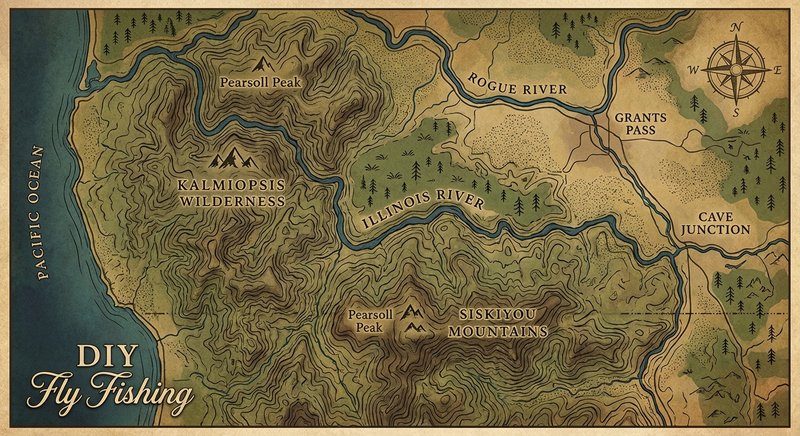
The Illinois River in Southwest Oregon is a crown jewel of the Wild and Scenic River system. Flowing through the rugged Kalmiopsis Wilderness before joining the Rogue River, it is often referred to as "The Little Colorado of the West." For the fly angler, it represents one of the most demanding, beautiful, and rewarding steelhead and salmon fisheries in the Pacific Northwest.
🎣 Location Overview
The Illinois River is defined by its ultra-clear, emerald-green water and its violent, boulder-strewn canyons. Unlike the wider, more pastoral rivers of the region, the Illinois is a high-gradient mountain stream. It is famous for its "Illinois Green" color—a result of the serpentine rock through which it flows.
Anglers love the Illinois because it offers a true wilderness experience. This isn’t "combat fishing" next to a highway; it’s a place of steep canyon walls, old-growth forests, and some of the hardest-fighting wild fish on the coast. However, it is also temperamental—it rises and falls faster than almost any river in Oregon, making timing the "window" of fishable water an art form in itself.
🐟 Target Species & Behavior
Winter Steelhead
The Illinois is legendary for its wild winter steelhead. These fish are known for their size (often reaching the 12–15 lb range) and their aggressive nature.
- Behavior: They are "sprinters." They move quickly through the lower canyon to reach spawning tributaries.
- Holding: Look for them in classic tailouts, but on the Illinois, they often hold in "pockets" behind massive boulders to escape the heavy current.
Spring Chinook (Springers)
Spring Chinook are the most prized table fare in the NW, and the Illinois gets a dedicated run of these powerful fish.
- Behavior: They enter the river in late spring as the snow melts. They are notoriously fickle and prefer deep, cool "guts" of pools.
- Feeding: While they aren't actively feeding to grow, they strike out of aggression or instinct. They hold deep and require heavy tips to reach.
📅 Best Times to Fish
- Winter Steelhead (January – March): The peak is typically February. You are looking for the "drop"—the moment after a heavy rain when the river turns from "blown out" to a translucent emerald green.
- Spring Chinook (May – June): This is high-water season. As the spring freshet begins to subside and the water warms slightly, the Springers move in.
- Best Time of Day: During the winter, the water is cold, so the "midday bite" (10 AM to 2 PM) is real as the sun warms the water a degree or two. For Springers, first light is almost always the best window.
🪰 Recommended Flies & Techniques
Steelhead Techniques
- Spey Casting/Swinging: This is the preferred method on the Illinois. Use a Skagit head with a variety of T-series sink tips (T-11 to T-14) depending on flow.
- Patterns:
- Intruders: Pink/Orange or Black/Blue.
- Prom Dress: Flashy and large for colored water.
- Hobo Spey: In black or purple for clearer water.
Chinook Techniques
- Dredging: You must get deep. Use heavy sink tips and "low and slow" swings.
- Patterns:
- Comets: Orange or Pink with plenty of flash.
- Bunny Leech: Large, 4-inch leeches in Chartreuse or Pink.
Nymphing
If the swing isn't working, a 10ft 7wt or 8wt single-handed rod with a strike indicator and a "bead" (10mm or 12mm in mottled orange) or a Rubber-Legged Stonefly can be incredibly effective in the pocket water.
💡 Pro Tips & Local Knowledge
- The "Serpentine Slide": The rocks on the Illinois are notoriously slippery due to the serpentine geology. Studded felt boots and a wading staff are non-negotiable. Do not attempt to wade this river without them.
- The Eight Dollar Mountain Area: For those without a raft, the area around Eight Dollar Mountain provides some of the best bank access. There are several pull-offs with trails leading down to the river.
- Stealth is Key: Because the water is so clear, these fish can see you from a distance. Avoid "high-holing" a run. Keep a low profile and use longer fluorocarbon leaders (up to 4-5 feet off your sink tip) when the water is low and clear.
- Watch the Gauge: Use the USGS Kerby Gauge. If the river is over 3,000 cfs, it is generally too dangerous/high to fish from the bank. The "magic" zone is usually between 1,000 and 2,000 cfs.
⚠️ Important Information
- Access: Access is limited. Much of the river is in a deep canyon. The Illinois River Road (out of Selma) provides the primary access points. Be prepared for narrow, gravel roads that can be treacherous in winter.
- Regulations: The Illinois is primarily a Wild Fish river.
- Check the ODFW Southwest Zone Regulations before heading out.
- Most of the Illinois is catch-and-release for wild steelhead (only adipose fin-clipped hatchery fish may be kept, though they are rare here).
- Barbless hooks are highly recommended (and required for certain species/seasons).
- Safety: This is remote country. There is no cell service in the canyon. Carry a satellite messenger (like a Garmin inReach) and tell someone exactly where you are going. Bears and cougars are present; keep a clean camp.
Guide’s Final Word: The Illinois is a "quality over quantity" river. You may go two days without a grab, but the fish you eventually hook will likely be the most memorable fish of your life.
Bug Hatches & Matching Flies
| Hatch | Type | Peak months | Time of day | Hook sizes | Matching flies |
|---|---|---|---|---|---|
| Salmonfly Pteronarcys californica | stonefly | May, June | All day | #4-8 | Chubby Chernobyl #6-8, Pat's Rubber Leg Stone #4-8, Rogue River Stone #4-6 |
| Golden Stonefly Calineuria californica | stonefly | May, June, July | Late Afternoon/Evening | #8-12 | Golden Celebrity #8-10, Twenty Incher #10-12, Norm Wood Special #8-12 |
| March Brown Rhithrogena morrisoni | mayfly | March, April | Afternoon | #12-14 | March Brown Dry #12-14, Hare's Ear Nymph #12-14, March Brown Emerger #14 |
| Pale Morning Dun Ephemerella excrucians | mayfly | June, July | Late Morning/Afternoon | #14-18 | Sparkle Dun #16-18, Pheasant Tail Nymph #14-18, PMD Cripple #16 |
| October Caddis Dicosmoecus atripes | caddis | September, October | Afternoon/Evening | #8-12 | Orange Stimulator #8-12, Morrish October Caddis Pupa #10-12, Bucktail Caddis #10 |
| Blue Winged Olive Baetis spp. | mayfly | March, April, October, November | Late Morning | #18-22 | Parachute Adams #18-22, RS2 #20-22, Baetis Nymph #18-20 |
| Yellow Sally Isoperla spp. | stonefly | June, July, August | Evening | #14-16 | Yellow Sally Stone #14-16, Iron Lotus #16, Little Yellow Stone #14 |
| Spotted Sedge Hydropsyche spp. | caddis | May, June, July, August | Evening | #14-16 | Elk Hair Caddis #14-16, LaFontaine's Deep Sparkle Pupa #14-16, Z-Wing Caddis #14-16 |