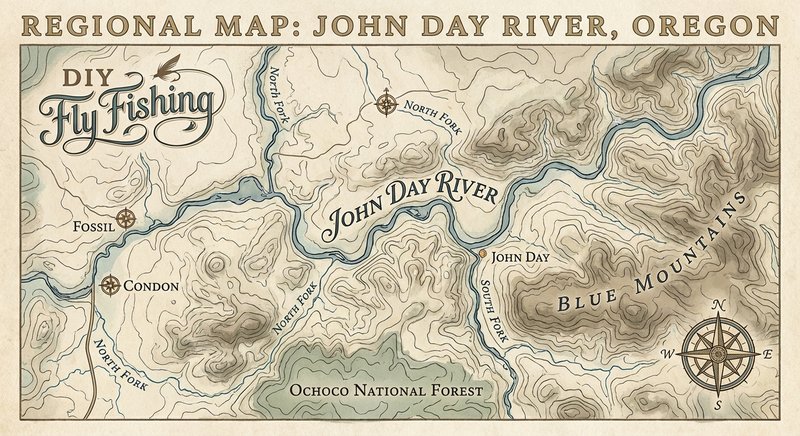
John Day River
Fly fishing in Oregon · Intermediate · Best seasons: Spring, Summer, Fall
Target Species
Smallmouth Bass, Steelhead, Rainbow Trout
About This Water
Longest free-flowing river in Oregon. Excellent smallmouth bass and some steelhead.
Fishing Recommendations
The John Day River is one of the crown jewels of the American West. As the longest undammed river in the Oregon interior, it offers a "step back in time" experience. Flowing through massive basalt canyons and high-desert rimrock, it is a place of solitude, ancient geology, and world-class fishing.
🎣 Location Overview
The John Day is a "Wild and Scenic" river, characterized by its lack of dams, which creates a natural, pulse-driven ecosystem. Because there are no dams to regulate temperature or flow, the river is dynamic.
Anglers love the John Day for its remote multi-day float trips. You aren't just fishing; you are embarking on a wilderness expedition. The water ranges from shallow, riffle-filled runs in the upper reaches to deep, slow-moving pools in the lower canyons. The scenery is breathtaking—expect to see bighorn sheep, golden eagles, and ancient petroglyphs while you cast.
🐟 Target Species & Behavior
Smallmouth Bass
The John Day is arguably one of the best Smallmouth Bass fisheries in the world by sheer volume.
- Behavior: They are extremely aggressive here. They hold in "froggy" slack water, behind boulders, and along the shade lines of canyon walls.
- Feeding: They focus on crayfish (the river is crawling with them), sculpins, and during mid-summer, an incredible damselfly hatch.
Steelhead (Summer-run)
These are "A-run" fish returning from the ocean. They are known for being smaller but incredibly feisty.
- Behavior: They use the John Day as a corridor to reach spawning grounds. They hold in traditional "swing" water—walking-speed riffles and the heads of deep pools.
- Feeding: While they don't "feed" in freshwater, they strike out of aggression or instinct.
Rainbow Trout (Redband)
In the upper reaches (Main Stem above Service Creek and the North Fork), you’ll find native Interior Redband Trout.
- Behavior: These are hardy fish that love fast, oxygenated water. They hold in pocket water and under overhanging willow banks.
📅 Best Times to Fish
- Spring (Late April – June): This is the prime window for Smallmouth Bass. As the water warms to 55°F, the bass become hyper-active. This is also when the water levels are high enough for drift boats and rafts to clear the rock gardens.
- Summer (July – August): Excellent for bass, but it gets hot (often 100°F+). Fishing is best at dawn and dusk. The river drops significantly; this is the time for kayaks and packrafts.
- Fall (September – November): The "Magic Season." The Steelhead begin to arrive in the lower river. The bass are still active but moving to deeper holes. The weather becomes crisp and the canyon colors turn gold.
🪰 Recommended Flies & Techniques
For Smallmouth Bass
- Topwater: Boogle Bugs, Foam Poppers, and Murdich Minnows. Technique: Cast tight to the rocky banks and "chug" them back.
- Sub-surface: Bass Turds, Near Nuff Crayfish, and Clouser Minnows (Chartreuse/White).
- The "Damselfly Hatch": In July, use blue adult Damsel patterns. The bass will actually jump out of the water to grab them.
For Steelhead
- Swinging: Traditional patterns like the Green Butt Skunk or Purple Haze.
- Skagit/Scandi: Use Sink tips (T-8 or T-11) in the fall to get intruders down in the deeper slots.
For Rainbow Trout
- Dries: Chubby Chernobyls, Stimulators, and Elk Hair Caddis.
- Nymphs: Prince Nymphs and Pheasant Tails (size 14-16).
💡 Pro Tips & Local Knowledge
- The "John Day Twitch": When fishing crayfish patterns for bass, don't just strip. Let the fly bounce off the bottom rocks, then give it a sharp 2-inch twitch. This mimics a fleeing crawdad and triggers an instinctual strike.
- Focus on the Shade: In the heat of the summer, bass will hug the "cliff shade." If one side of the canyon is shaded, that is where 90% of the fish will be.
- Flow Management: Because the river is undammed, flows can drop rapidly. Check the Service Creek gauge. For most drift boats, 500-800 CFS is the bare minimum for the lower stretches.
- The "Big Three" Floats:
- Service Creek to Twickenham: Great for a day trip or overnight; good trout/bass mix.
- Twickenham to Clarno: Stunning scenery, heavy bass numbers.
- Clarno to Cottonwood: The "Wilderness" stretch. 70 miles of remote canyon. Requires 5+ days.
⚠️ Important Information
- Permits: A BLM permit is required for boating the Wild and Scenic sections (Service Creek to Tumwater Falls). These are issued via a lottery on Recreation.gov.
- Barbless Hooks: Highly recommended (and required for Steelhead). The John Day is a fragile ecosystem; handle all fish with care.
- Shuttles: This is a remote area. Arrange your vehicle shuttle in advance through local services in Service Creek or Fossil.
- Heat & Hydration: Rattlesnakes are common on the banks, and the sun is intense. Bring more water than you think you need and high-quality sun hoodies.
- Regulations: Always check the ODFW Recreation Report before heading out, as Steelhead seasons can close overnight based on return numbers.
Bug Hatches & Matching Flies
| Hatch | Type | Peak months | Time of day | Hook sizes | Matching flies |
|---|---|---|---|---|---|
| Salmonfly Pteronarcys californica | stonefly | May, June | All Day | #4-8 | Chubby Chernobyl #6-8, Pats Rubber Legs #4-8, Clark's Stone #6-10 |
| Golden Stonefly Hesperoperla pacifica | stonefly | June, July | Morning/Evening | #8-12 | Norm Wood Special #8-10, Golden Stone Nymph #8-12, Yuriko's Golden Stone #10-12 |
| Pale Morning Dun (PMD) Ephemerella excrucians | mayfly | June, July | Late Morning/Afternoon | #14-18 | Sparkle Dun #14-16, Pheasant Tail Nymph #14-18, RS2 #16-18 |
| Blue Winged Olive (BWO) Baetis | mayfly | March, April, October, November | Afternoon | #18-22 | Parachute Adams #18-22, WD-40 #20-22, BWO CDC Emerger #18-20 |
| Spotted Sedge / Caddis Hydropsyche | caddis | May, June, July, August | Evening | #12-16 | Elk Hair Caddis #14-16, LaFontaine's Deep Sparkle Pupa #14-16, Goddard Caddis #12-14 |
| Grasshopper Caelifera | terrestrial | July, August, September | Late Morning/Afternoon | #6-12 | Morrish Hopper #8-12, Dave's Hopper #10-12, Rainy's Grand Hopper #6-10 |
| Yellow Sally Isoperla | stonefly | June, July | Afternoon/Evening | #14-16 | Yellow Stimulator #14-16, Little Yellow Sloan #14-16, Yellow Sally Hammer #16 |
| Trico Tricorythodes | mayfly | August, September | Early Morning | #20-24 | Trico Spinner #20-24, Sunken Trico Spinner #22, Trico Dun #20-22 |