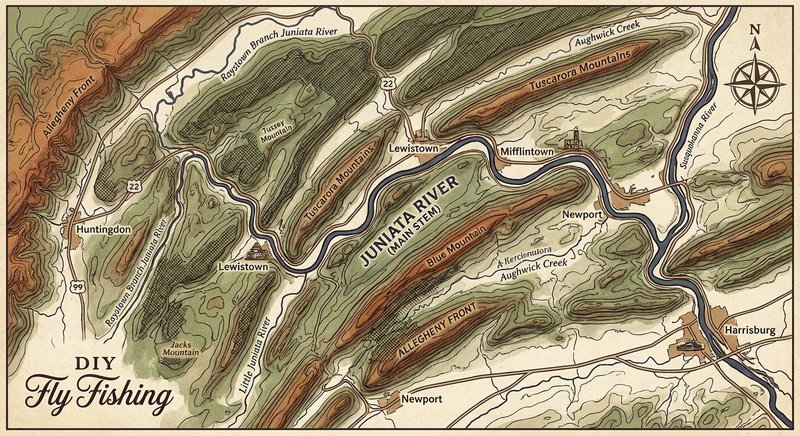
Juniata River (Main Stem)
Fly fishing in Pennsylvania · Beginner · Best seasons: Spring, Summer, Fall
Target Species
Smallmouth Bass, Brown Trout
About This Water
Large central PA river with smallmouth bass and some trout. Float fishing opportunities.
Fishing Recommendations
The Juniata River, particularly the "Main Stem" (formed by the confluence of the Little Juniata and the Frankstown Branch near Petersburg), is one of the premier warm-water fly fishing destinations in the Mid-Atlantic. While the "Little J" is famous for its wild trout, the Main Stem is the kingdom of the Smallmouth Bass. It is a river characterized by its ancient rock ledges, expansive views of the Appalachian ridges, and a "big water" feel that remains accessible to those who know how to read it.
🎣 Location Overview
The Main Stem of the Juniata flows roughly 100 miles before joining the Susquehanna River at Duncannon. It is often referred to as a "river of rocks" because of its unique geological formations. Unlike many silt-bottomed rivers, the Juniata features a series of parallel shale and sandstone ledges that run across the current.
These ledges act as natural weirs, creating deep troughs, oxygenated riffles, and slow-moving pools. The water is generally clear but takes on a tea-colored stain after rains. It is a scenic, pastoral river that feels much wilder than its proximity to Central Pennsylvania towns would suggest. While largely a warm-water fishery, the upper sections near Huntingdon maintain cooler temperatures longer, allowing for unique "overlap" fishing where you might hook a trophy Brown Trout and a Smallmouth on back-to-back casts.
🐟 Target Species & Behavior
Smallmouth Bass (The Primary Target)
The Juniata Smallmouth is a hard-fighting, acrobatic fish.
- Behavior: They are highly structure-oriented. In the Juniata, they live in the "shadows" of the ledges. They use the rock ribs to break the current and ambush prey.
- Feeding: Their diet is heavy on Crayfish and Hellgrammites (dobsonfly larvae). During summer, they focus heavily on baitfish (shiners and dace) and topwater terrestrial insects or emerging damsel flies.
Brown Trout
While the Main Stem is not a "trout stream" in the traditional sense, the first 5–10 miles below the confluence of the Little Juniata hold a surprising number of wild Brown Trout.
- Behavior: These are "transient" trout. They move into the Main Stem during the spring and fall when water temperatures are below 65°F. They are often much larger than average, feeding on the high protein sources (crayfish and large nymphs) that the Main Stem provides.
- Holding: Look for them in the deepest, fastest oxygenated water or near cold-water tributary mouths.
📅 Best Times to Fish
- Spring (April – June): This is the window for the biggest fish. As water warms into the 50s, Smallmouth become aggressive. This is also the prime time for Brown Trout in the upper Main Stem. Look for the Grannom Sedge and Light Cahill hatches in May.
- Summer (July – August): The "Topwater Glory Days." As the water clears and levels drop, the bass look upward. Low light (dawn and dusk) is essential. During the day, fish move into the deeper ledge troughs.
- Fall (September – October): The "Feeding Frenzy." As water temperatures drop, bass gorge themselves for winter. This is the best time for streamer fishing. The colors of the Juniata valley are spectacular during this window.
- Prime Window: A falling, clearing river 2–3 days after a rain event is the "gold standard" for Juniata fishing.
🪰 Recommended Flies & Techniques
Subsurface (The High-Volume Approach)
- Hellgrammite Patterns: Murray’s Hellgrammite (Black, size 4–8). This is perhaps the most famous local fly. Fish it deep and slow through the ledges.
- Crayfish Patterns: Near-Nuff Crayfish or Clouser Crayfish (Olive/Orange). Must be fished on the bottom.
- Streamers: The Clouser Minnow (Chartreuse/White or Olive/White) was practically invented for rivers like this. Swing them through riffles or strip them across ledges.
Topwater (The Most Exciting)
- Hard-Body Poppers: BoogleBugs in "Panther Martin" or "Yellow" colors.
- Sneaky Petes: For a more subtle presentation when the water is glassy and low.
- Murdich Minnow: A great neutral-buoyancy fly that works just under the surface.
Techniques
- The "Ledge Hop": Cast upstream at a 45-degree angle, let your fly sink into a ledge trough, and "hop" it over the rock ribs as the current carries it down.
- Swing and Strip: Especially effective with streamers. Swing the fly like you are trout fishing, but add erratic strips at the end of the swing.
💡 Pro Tips & Local Knowledge
- Read the "V's": On the Juniata, look for breaks in the ledges. Where a rock ledge is broken, it creates a "V" of faster water. Bass sit right at the base of that "V" waiting for food to be funneled to them.
- The "Big J" Wade: The river is wide and can be intimidating. Always wear studded wading boots. The shale ledges are slanted and incredibly slippery. A wading staff is highly recommended.
- Grass Lines: In mid-summer, the river develops thick beds of aquatic vegetation (Stargrass). Smallmouth love to hide on the edges of these grass lines. A weedless popper thrown right into the pockets of the grass is a local secret.
- The "Trout Transition": If you want the "Juniata Slam" (Trout and Bass), focus on the stretch between Petersburg and Huntingdon.
⚠️ Important Information
- Access: There are excellent PFBC (PA Fish & Boat Commission) access points. Notable ones include:
- Point Access (near Huntingdon)
- Mount Union
- Newton Hamilton
- Lewistown
- Muskrat Springs
- Regulations: A Pennsylvania Fishing License and Trout/Salmon permit (if targeting trout or fishing the upper reaches) are required. Follow all PFBC seasons; bass are typically "Catch and Immediate Release" during the spring spawning season (check current PA Summary of Fishing Laws for exact dates).
- Safety: The Juniata is a "powerful" slow river. It can rise quickly after storms in the mountains. Always check the USGS gauge at Huntingdon or Lewistown before heading out. A flow of 1,000–2,000 cfs at Huntingdon is generally ideal for wading; anything over 3,500 cfs is strictly boat-only territory.
Bug Hatches & Matching Flies
| Hatch | Type | Peak months | Time of day | Hook sizes | Matching flies |
|---|---|---|---|---|---|
| White Mayfly Ephoron leukon | mayfly | August, September | Evening/Dusk | #10-14 | White Wulff #12-14, Ephoron Spinner #12-14, White Chalk Stream Emerger #12-14 |
| White Miller Caddis Nectopsyche | caddis | June, July, August | Evening | #12-16 | White Elk Hair Caddis #14-16, White LaFontaine Sparkle Pupa #14-16 |
| Trico Tricorythodes | mayfly | July, August, September | Morning | #20-24 | Trico Spinner #20-22, RS2 #20-22 |
| Slate Drake Isonychia bicolor | mayfly | June, September | Afternoon/Evening | #10-14 | Iso Parachute #12-14, Zug Bug #10-12, Isonychia Nymph #10-12 |
| Blue-Winged Olive Baetis | mayfly | April, May, September, October | Afternoon | #18-22 | BWO Parachute #18-22, Pheasant Tail Nymph #18-20 |
| Hellgrammite (Dobsonfly) Corydalus cornutus | terrestrial | June, July | Night/Evening | #2-8 | Murray's Hellgrammite #4-8, Bitch Creek #6-10 |
| Damselfly Enallagma | terrestrial | June, July, August | All Day | #10-14 | Adult Damselfly #10-12, Marabou Damselfly Nymph #12-14 |
| Terrestrial Ants and Beetles Formicidae / Coleoptera | terrestrial | July, August, September | All Day | #12-18 | Black Foam Ant #14-18, Chernobyl Ant #8-12, Cinnamon Ant #16-18 |