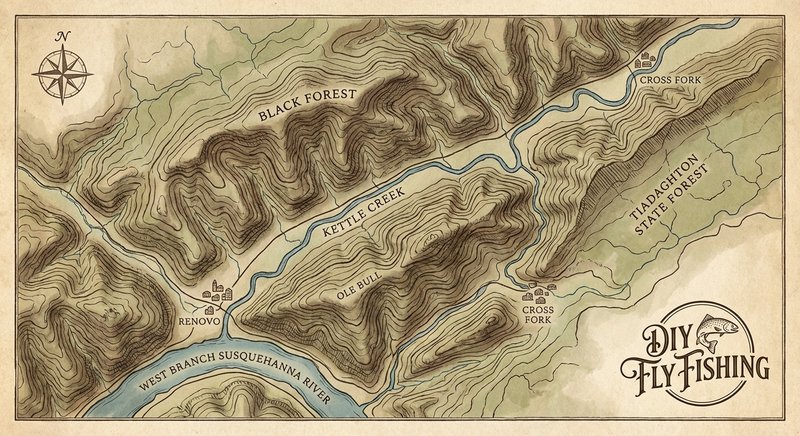
Kettle Creek
Fly fishing in Pennsylvania · Intermediate · Best seasons: Spring, Summer, Fall
Target Species
Brown Trout, Brook Trout
About This Water
Remote freestone stream with wild brown and brook trout. Excellent camping and fishing.
Fishing Recommendations
Tight lines! You’re asking about a true gem of the Pennsylvania Wilds. Kettle Creek is one of the most storied trout streams in the Eastern United States, flowing through the rugged, sparsely populated mountains of Potter and Clinton Counties. It offers a classic "freestone" experience that evokes the golden age of fly fishing.
Here is your comprehensive guide to fishing Kettle Creek.
🎣 Location Overview
Kettle Creek is a massive drainage system characterized by its diversity. It transitions from tiny, brush-choked headwaters in the high plateaus to a broad, powerful valley stream.
What makes it special is the variety of water types. You have the "Upper Kettle" (above the Alvin Bush Dam), which is primarily a wild trout fishery, and the "Lower Kettle" below the dam. The upper section is a classic freestone stream with plunge pools, long riffles, and deep undercut banks. It is surrounded by the Tiadaghton and Susquehannock State Forests, providing a wilderness feel that is rare in the Mid-Atlantic. Anglers love it for its solitude, its prolific insect life, and the sheer beauty of the "God’s Country" landscape.
🐟 Target Species & Behavior
- Brook Trout: These are the native jewels of the system. You will find them primarily in the upper reaches and the numerous small tributaries (like Cross Fork Creek or Hammersley Fork). They are opportunistic but spooky. They hold in the heads of pools and behind small boulders.
- Brown Trout: You’ll find both wild and stocked browns. Wild browns are dominant in the upper main stem and larger tributaries. They are notorious for holding in "skinny" water during hatches but retreating to deep root balls and undercuts during the day.
- Behavior: Because this is a freestone stream (fed by runoff and springs, not a steady limestone flow), fish are very tied to water temperature. In the spring, they are aggressive; in the summer, they become lethargic and seek "thermal refuge" in cold-water feeders.
📅 Best Times to Fish
- Spring (Mid-April – June): This is the Prime Window. The legendary hatches occur now. Water levels are usually high but clear.
- Summer (July – August): Fishing the main stem is generally discouraged during heatwaves as water temperatures can exceed 70°F, which is lethal for trout. During this time, hike into the high-elevation tributaries where the water stays cold.
- Fall (September – October): A fantastic time for "leaf peeping" and chasing aggressive pre-spawn Brown Trout. The crowds are gone, and the fish are hungry.
Best Times of Day:
- Spring: 10:00 AM – 4:00 PM (when the water warms slightly and bugs hatch).
- Summer: Dawn and dusk only (in the colder tributaries).
- Fall: Mid-day as the sun warms the water.
🪰 Recommended Flies & Techniques
Top Fly Patterns
- Dry Flies:
- Hendrickson (April): #12-14.
- Sulphurs (May/June): #14-18. This is the premier hatch.
- Slate Drake (Isonychia): #10-12. Great for the faster riffles.
- Green Drake: Large #8-10. Usually hits in late May.
- Terrestrials (Summer): Dave’s Hopper or Cinnamon Ants.
- Nymphs:
- Pheasant Tail: #14-18 (imitates almost everything).
- Gold-Ribbed Hare’s Ear: #12-14.
- Pat’s Rubber Leg Stonefly: #8-12 (great for high spring water).
- Streamers:
- Woolly Bugger: Olive or Black, #6-10.
- Black Ghost: A local favorite for swinging through deep pools.
Effective Techniques
- Dry-Dropper: This is the most effective way to cover Kettle Creek. Use a buoyant dry fly (like a Stimulator) with a small bead-head nymph 18-24 inches below it.
- Tight-Line Nymphing: In the deeper runs of the "Catch and Release" section, staying in direct contact with your nymph is vital due to the complex currents.
- The "Kettle Creek Swing": Casting a streamer or wet fly 45 degrees downstream and letting it swing through the tail of a pool is a deadly way to find big brown trout.
💡 Pro Tips & Local Knowledge
- The Catch and Release Section: Focus on the 1.7-mile stretch from the bridge at Leidy to the northern boundary of Kettle Creek State Park. This area is managed for quality and holds the best concentration of fish.
- Watch the Thermometer: I cannot stress this enough. If the water is over 68°F, stop fishing the main creek. Head to Cross Fork Creek or Hammersley Fork—these are "Mountain Brookie" havens that stay cooler.
- The "Green Drake" Timing: If you want to hit the Green Drake hatch, it usually starts on the lower sections and moves upstream day by day. Check in with the Kettle Creek Tackle Shop in Cross Fork for the "daily report."
- Stealth is Key: Because the water is often crystal clear, long leaders (9-12 feet) and a stealthy approach (avoiding wading as much as possible) will double your catch rate.
⚠️ Important Information
- Access: Much of the creek parallels Route 144. There are numerous pull-offs with well-worn paths. Most of the land is State Forest, but always respect "Posted" signs on private patches.
- Regulations:
- Pennsylvania requires a valid fishing license and a trout permit.
- Be aware of the Catch and Release Fly-Fishing Only sections vs. the Delayed Harvest Artificial Lures Only (DHALO) sections. Check the current PA Fish & Boat Commission (PFBC) handbook for the exact boundaries, as they can change.
- Cell Service: Expect zero cell service in the valley. Download your maps for offline use before you leave Renovo or Galeton.
- Wildlife: This is black bear and rattlesnake country. Keep your eyes open when walking through tall grass or over rocky ledges.
Guide’s Final Word: Kettle Creek is a place where you can lose yourself in the rhythm of the water. Don't just rush to the big pools; some of the best wild fish live in the "forgotten" pocket water between the famous holes. Tight lines!
Bug Hatches & Matching Flies
| Hatch | Type | Peak months | Time of day | Hook sizes | Matching flies |
|---|---|---|---|---|---|
| Blue-Winged Olive Baetis spp. | mayfly | April, October | Afternoon | #18-22 | BWO Sparkle Dun #18-22, Pheasant Tail #18-20, RS2 #20-22 |
| Quill Gordon Epeorus pleuralis | mayfly | April | Midday | #12-14 | Quill Gordon Dry #12-14, Hare's Ear Nymph #12-14 |
| Hendrickson Ephemerella subvaria | mayfly | April, May | Afternoon | #12-14 | Red Quill #12-14, Hendrickson Emerger #12-14 |
| Grannom Caddis Brachycentrus | caddis | April | Morning/Evening | #14-16 | Elk Hair Caddis (Olive) #14-16, LaFontaine's Deep Sparkle Pupa #14-16 |
| March Brown Maccaffertium vicarium | mayfly | May | Afternoon | #10-12 | March Brown Dry #10-12, Gold Ribbed Hare's Ear #10-12 |
| Eastern Green Drake Ephemera guttulata | mayfly | May, June | Evening/Dusk | #8-10 | Green Drake Parachute #8-10, Coffin Fly #8-10 |
| Slate Drake Isonychia bicolor | mayfly | June, September | Afternoon/Evening | #10-14 | Isolynchia Parachute #12-14, Zug Bug #10-12 |
| Light Cahill Stenacron interpunctatum | mayfly | June, July | Evening | #14-16 | Light Cahill #14-16, Cream Usual #14-16 |
| Terrestrials (Ants/Beetles) Formicidae / Coleoptera | terrestrial | July, August, September | All Day | #12-18 | Cinnamon Ant #14-18, Crowe Beetle #12-16 |