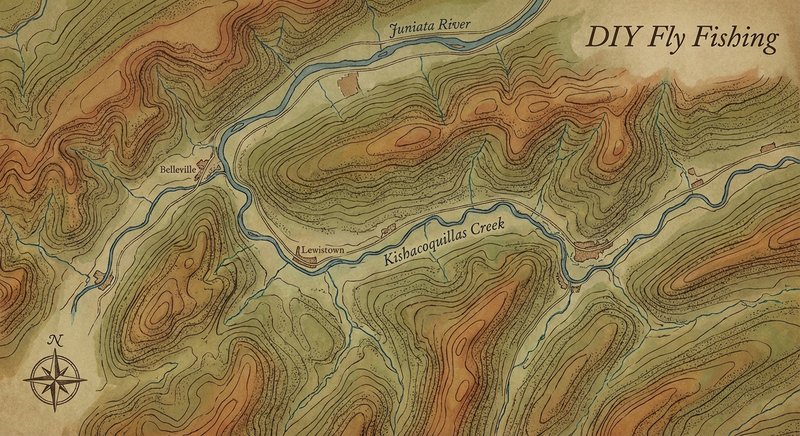
Kishacoquillas Creek
Fly fishing in Pennsylvania · Advanced · Best seasons: Spring, Summer, Fall
Target Species
Brown Trout
About This Water
Mifflin County limestone stream with wild brown trout. Technical fishing in Big Valley.
Fishing Recommendations
Known locally as "The Kish," Kishacoquillas Creek in Mifflin County is one of Central Pennsylvania’s most productive yet underrated limestone-influenced streams. While it doesn't always get the national press of its neighbors like Penns Creek or Spring Creek, the Kish offers a fantastic variety of water—from high-gradient "canyon" stretches to winding meadow runs through the beautiful Big Valley.
As your guide, here is everything you need to know to find success on these waters.
🎣 Location Overview
Kishacoquillas Creek originates in the karst topography of the Big Valley (Kishacoquillas Valley). It is a fertile limestone stream that benefits from cold-water springs, which helps maintain trout-friendly temperatures even during the warmer months.
The creek is a study in contrasts. The upper sections flow through pastoral Amish farmlands with slow, deep bends and undercut banks. As it moves toward Reedsville and the "Narrows," the gradient increases, and the creek takes on a more freestone character with pocket water, riffles, and large boulders. This diversity makes it a favorite for anglers who like to switch between technical dry fly fishing and aggressive nymphing.
🐟 Target Species & Behavior
The primary prize of the Kish is the Brown Trout.
- Wild & Stocked: The creek holds a healthy population of wild brown trout, supplemented by state stockings. The wild fish are notorious for being "PhD fish"—wary, selective, and highly attuned to their environment.
- Holding Patterns: In the meadow sections, look for fish tucked under "overhanging" grass banks or hovering in the shadows of bridge abutments. In the canyon/narrows section, they hold in the classic spots: the soft water behind boulders and at the heads of deep pools.
- Diet: Because of the limestone influence, the Kish is rich in crustaceans. Scuds and sowbugs are a primary year-round food source, along with a robust variety of mayflies and caddis.
📅 Best Times to Fish
Optimal Seasons
- Spring (April – June): This is the "Golden Era" on the Kish. Water levels are usually prime, and the major hatches (Grannoms and Sulfurs) bring the largest fish to the surface.
- Summer (July – August): Focus on the early morning hours for Trico hatches or the "Narrows" where the water stays cooler and oxygenated.
- Fall (September – November): A spectacular time for streamers. As brown trout prepare for the spawn, they become aggressive and territorial.
Best Times of Day
- Morning: Early morning is essential in summer for the Trico spinner falls.
- Evening: The "Magic Hour" just before dark is when the legendary Sulfur hatches occur in late May and June.
🪰 Recommended Flies & Techniques
Top Fly Patterns
- Nymphs: Cress Bugs (size 14-18), Scuds (size 16-18, olive or tan), Zebra Midges (size 18-22), and Pheasant Tails (size 14-18).
- Dry Flies:
- Sulfurs (size 14-18) – The most important hatch.
- Tricos (size 22-26) – Tiny but prolific in summer.
- Tan/Green Caddis (size 14-16).
- Terrestrials: Slumpbusters or Foam Beetles/Ants in late summer.
- Streamers: Black or Olive Wooly Buggers (size 6-10) and small Sculpin patterns.
Effective Techniques
- Tactical Nymphing: Using a European-style nymphing rig (long rod, thin leader) is incredibly effective in the riffles of the Narrows. Keeping your line off the water prevents drag in the complex currents.
- The "Long and Fine" Dry Fly: For the meadow sections, use a 12-foot leader tapering to 6X or 7X tippet. These fish spook easily; a delicate presentation is more important than the fly choice itself.
- Streamer Stripping: In the deeper holes near Lewistown, strip streamers slowly along the bottom during low-light conditions.
💡 Pro Tips & Local Knowledge
- The "Limestone Milk": After a light rain, the Kish may take on a slightly "milky" or cloudy green hue. Do not be discouraged! This is actually the best time to fish. The reduced visibility makes the wild trout less spooky and more willing to chase larger nymphs and streamers.
- Respect the "Big Valley" Culture: Much of the upper Kish flows through Amish farmland. You will likely see horse-drawn buggies and farmers in the fields. Always be exceptionally respectful of property, stay within the high-water marks, and use designated access points.
- Focus on the Narrows: If the sun is high and bright, head to the Narrows (along Route 322). The steep hillsides and heavy tree canopy provide shade that keeps the fish active longer into the day than the open meadows.
⚠️ Important Information
Access Information
- There are several public access points near Reedsville and Burnham.
- A popular spot is the Delayed Harvest Artificial Lures Only (DHALO) section. This area offers great year-round opportunities but check the Pennsylvania Fish & Boat Commission (PFBC) map for specific boundaries.
Regulations & Permits
- A Pennsylvania Fishing License and a Trout Permit are required for all anglers 16 and older.
- Observe all "Private Property" and "No Trespassing" signs. If a section isn't clearly marked as public or open, it is best to ask for permission.
- In the DHALO sections, remember: no bait is allowed, and specific harvest rules apply depending on the time of year (mostly catch-and-release).
Special Considerations
- Wading: The Kish has some very slippery rocks in the faster sections. Felt soles (where legal) or studded boots and a wading staff are highly recommended.
- Temperature Watch: In the heat of August, if water temperatures exceed 68°F, please stop fishing to protect the trout from lethal stress.
Bug Hatches & Matching Flies
| Hatch | Type | Peak months | Time of day | Hook sizes | Matching flies |
|---|---|---|---|---|---|
| Blue-Winged Olive Baetis / Pseudocloeon | mayfly | March, April, September, October | Mid-day/Afternoon | #18-24 | RS2 #20-22, BWO Parachute #18-22, Pheasant Tail Nymph #18-20 |
| Grannom Caddis Brachycentrus | caddis | April | Afternoon | #12-16 | LaFontaine's Deep Sparkle Pupa #14-16, Elk Hair Caddis (Olive/Dark) #14-16, Grannom Pupa #14-16 |
| Hendrickson Ephemerella subvaria | mayfly | April, May | Afternoon | #12-14 | Red Quill #12-14, Hendrickson Nymph #12-14, Hare's Ear #12-14 |
| Sulphur Ephemerella invaria / dorothea | mayfly | May, June | Evening | #14-18 | Sulphur Parachute #14-18, Sulphur Emerger #16-18, Pheasant Tail (Flashback) #16-18 |
| Slate Drake Isonychia bicolor | mayfly | June, September, October | Late Afternoon/Evening | #10-14 | Isonychia Nymph #10-12, Slate Drake Parachute #12-14, Zug Bug #10-14 |
| Trico Tricorythodes | mayfly | July, August, September | Early Morning | #22-26 | Trico Spinner #22-26, Griffith's Gnat #22-24, Trico Nymph #22-24 |
| White Fly Epheron leukon | mayfly | August, September | Dusk/Night | #12-14 | White Wulff #12-14, Snowshoe White Fly #12-14, White Fly Nymph #12-14 |
| Ants and Beetles Formicidae / Coleoptera | terrestrial | June, July, August, September | All Day | #12-20 | Black Foam Ant #16-20, Crowe Beetle #14-16, Cinnamon Ant #16-18 |
| Zebra Midge Chironomidae | midge | January, February, March, December | Late Morning/Mid-day | #18-24 | Zebra Midge (Black/Silver) #18-22, Palomino Midge #20-24, Mercury Midge #18-22 |