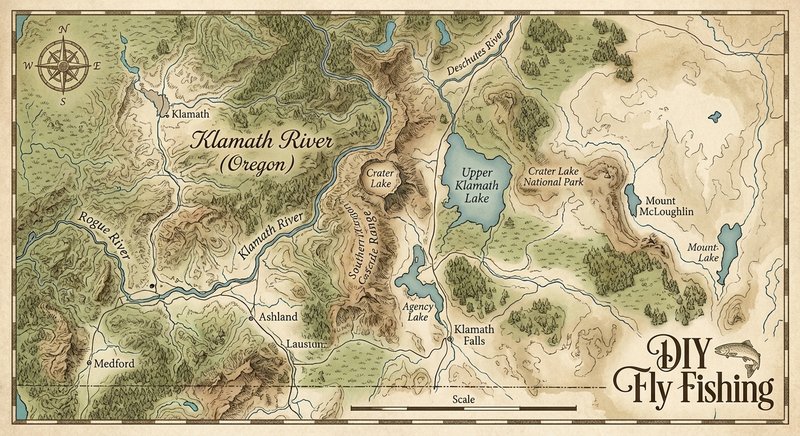
Klamath River (Oregon)
Fly fishing in Oregon · Intermediate · Best seasons: Spring, Fall
Target Species
Rainbow Trout
About This Water
Upper Klamath below the lake. Large rainbow trout migrate from Upper Klamath Lake.
Fishing Recommendations
The Klamath River in Oregon is a rugged, high-desert gem that offers some of the most powerful wild trout fishing in the Pacific Northwest. Specifically, the "Upper Klamath" (the reach from Keno Dam to the California state line) is home to the legendary Interior Redband Trout. These fish are known for their incredible strength, broad shoulders, and ability to thrive in water that would be too warm for most other trout species.
Here is your comprehensive guide to fly fishing the Oregon section of the Klamath River.
🎣 Location Overview
The Oregon stretch of the Klamath flows through a stunning volcanic canyon characterized by massive basalt rimrocks, sagebrush, and oak scrub. This is "big water" fishing. The river is powerful, often slightly turbid (due to the nutrient-rich waters of Upper Klamath Lake), and features heavy pocket water, deep ledge holes, and long, oxygenated riffles.
What makes it special is the wildness. Unlike the manicured spring creeks of Central Oregon, the Klamath is raw. Wading is notoriously difficult due to "greasy" basketball-sized rocks, and the fish are notoriously hard-fighting. It is a destination for the angler who prefers a bit of a "grind" in exchange for hefty, wild fish.
🐟 Target Species & Behavior
The primary target is the Redband Trout. These are a subspecies of Rainbow Trout adapted to the high-desert environment.
- Behavior: Klamath Redbands are extremely aggressive. Because the river is nutrient-rich, these fish grow fast and heavy. They are "blue-collar" fish—they tend to hold in faster, more turbulent water than you might expect, especially in the oxygenated "bubbles" at the head of runs.
- Feeding: They are opportunistic. While they certainly key in on hatches (like the massive Salmonfly hatch), they are primarily subsurface feeders, gorging on large stonefly nymphs, crawfish, and leeches.
📅 Best Times to Fish
Spring (May – June)
This is the "Main Event."
- The Salmonfly Hatch: Usually peaking in late May or early June, giant stoneflies (Pteronarcys californica) crawl out of the rocks. The trout go into a feeding frenzy. This is the best time for dry fly enthusiasts to land a 20+ inch fish on a foam pattern.
Fall (September – October)
As the air cools, the river sees a resurgence in activity.
- October Caddis: Large orange caddis begin to pop. This is also when the "Great Migration" occurs; as water temperatures drop, fish that have been seeking thermal refuge move back into the main river reaches to feed heavily before winter.
Best Times of Day
- Summer/Spring: Low light is your friend. The first two hours of light and the "magic hour" before sunset are most productive.
- Late Fall: Midday becomes better as the water needs a few hours of sun to trigger insect activity.
🪰 Recommended Flies & Techniques
Nymphing (The Bread and Butter)
90% of the fish are caught subsurface. A "High-Stick" or European Nymphing approach is deadly in the pocket water.
- Pat’s Rubber Legs: (Size 4–8) Black, Brown, or Variegated. This is the most important fly on the river.
- Prince Nymphs / Copper Johns: (Size 12–16) The flash helps in the slightly murky water.
- Zebra Midges / Micro-Mayflies: For the technical tailouts.
Dry Fly (The Thrill)
- Chubby Chernobyl: (Size 4–8) In orange, gold, or black. Great for the Salmonfly and Golden Stone hatches.
- Elk Hair Caddis: (Size 12–16) Tan or Olive.
- Morrish October Caddis: (Size 8–10) Essential for the fall months.
Streamers (The "Big Fish" Move)
- Sculpzilla / Woolly Buggers: Black or Olive. Swing these through deep slots or strip them aggressively near the banks.
💡 Pro Tips & Local Knowledge
- Studded Boots are Non-Negotiable: The rocks in the Klamath are covered in a fine, slick silt/algae. Without aluminum bars or studs and a wading staff, you will take a swim.
- Look for the "Bucket": In the heavy rapids, look for small pockets of calm water behind large boulders—we call these "buckets." A heavy stonefly nymph dropped right into that soft water will often produce an explosive strike.
- The "Dirty" Water Myth: Don't be discouraged if the water looks like "pea soup" or has a brownish tint. This is organic matter from the lake above. The fish live in it year-round and can see your fly just fine. In fact, the slight turbidity often makes them less "leader shy."
- The Dam Removal Factor: CRITICAL NOTE: As of 2024, the Klamath River is undergoing the largest dam removal project in US history (including the J.C. Boyle dam in Oregon). This has significantly impacted water clarity and access. Always check current flow and sediment reports before heading out, as conditions are changing monthly.
⚠️ Important Information
- Access: The primary access is via the Keno-Worden Road and the Topsy Grade. Much of the Oregon canyon is accessible via a rugged BLM road that follows the river. High-clearance vehicles are recommended.
- Regulations:
- The Oregon section typically requires Barbless Hooks.
- Check the ODFW Recreation Report for the most current regulations regarding harvest (though Catch & Release is highly encouraged for these wild Redbands).
- Rattlesnakes: The Klamath Canyon is prime rattlesnake habitat. Watch your step when hiking between holes, especially in the tall grass and rimrocks.
- Permits: A standard Oregon Angling License is required. No special "Klamath-specific" permit is needed, but ensure you stay on public BLM land to avoid trespassing on private parcels.
Bug Hatches & Matching Flies
| Hatch | Type | Peak months | Time of day | Hook sizes | Matching flies |
|---|---|---|---|---|---|
| Salmonfly Pteronarcys californica | stonefly | May, June | All Day | #4-8 | Rogue Foam Stone #4-6, Pat's Rubber Legs #4-8, Clark's Stone #6-8 |
| Golden Stonefly Hesperoperla pacifica | stonefly | June, July | Morning/Evening | #8-12 | Chubby Chernobyl (Gold) #8-10, 20 Incher Stone #8-12, Norm Wood Special #10 |
| Blue-Winged Olive Baetis | mayfly | March, April, September, October | Late Morning/Afternoon | #18-22 | Parachute Adams #18-22, RS2 (Olive) #20-22, WD-40 #20-22 |
| Pale Morning Dun Ephemerella | mayfly | June, July | Late Morning/Early Afternoon | #14-18 | PMD Sparkle Dun #16-18, Pheasant Tail #14-18, Quigley Cripple #16 |
| Spotted Sedge Hydropsyche | caddis | June, July, August | Evening | #14-18 | Elk Hair Caddis (Tan) #14-16, LaFontaine's Deep Sparkle Pupa #14-18, Goddard Caddis #14-16 |
| Mother's Day Caddis Brachycentrus | caddis | May | Afternoon | #14-16 | Peeping Caddis #14-16, Dark Elk Hair Caddis #14-16, Holy Grail #14-16 |
| Trico Tricorythodes | mayfly | August, September | Early Morning | #22-26 | Trico Spinner #22-24, Zebra Midge #22, Sunken Trico Spinner #24 |
| Midges Chironomidae | midge | January, February, March, December | All Day | #18-24 | Griffith's Gnat #18-22, Zebra Midge (Red/Black) #18-24, Mysis Shrimp (Tailwater specific) #16-18 |