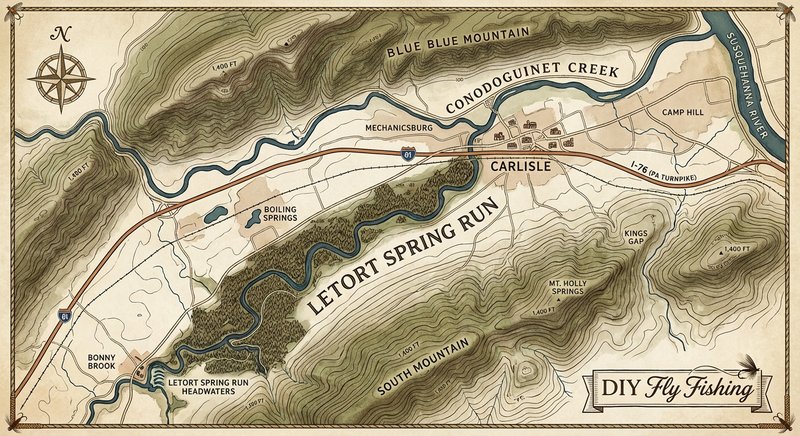
Letort Spring Run
Fly fishing in Pennsylvania · Advanced · Best seasons: Spring, Summer, Fall
Target Species
Brown Trout
About This Water
A legendary limestone spring creek. Technical fishing for educated wild brown trout.
Fishing Recommendations
Welcome to the "Cradle of American Fly Fishing." As your guide, I must start with a disclaimer: The Letort Spring Run is not just a fishing destination; it is a graduate-level course in patience, stealth, and technical precision. Located near Carlisle, Pennsylvania, this limestone spring creek is where legends like Vince Marinaro and Charlie Fox revolutionized the sport.
If you can catch a wild brown on the Letort, you can catch a trout anywhere in the world.
🎣 Location Overview
The Letort is a classic limestone spring creek. Unlike freestone streams that rely on runoff, the Letort is fed by underground aquifers, maintaining a nearly constant temperature (around 52–55°F) year-round.
What makes it special is its physical character. It is narrow, slow-moving, and choked with thick beds of elodea and watercress. The water is gin-clear, and the banks are often boggy and overgrown. Anglers love it because it represents the ultimate challenge. It is "sight fishing" at its most difficult—you aren't just fishing the water; you are hunting specific, highly educated wild trout.
🐟 Target Species & Behavior
The Letort is home to a self-sustaining population of Wild Brown Trout. You will not find stocked fish here.
- Behavior: These fish are notoriously "spooky." The vibration of a heavy footstep on the bank or the shadow of a fly line will send them darting into the weeds.
- Holding Patterns: They rarely sit in the middle of the channel. Instead, they hover in "pockets" or "lanes" between weed beds or tight against the undercut banks.
- Feeding: Because the water is rich in calcium, it is a factory for crustaceans (scuds and sowbugs). However, the Letort is most famous for its terrestrial fishery, where trout look to the overhanging grasses for their next meal.
📅 Best Times to Fish
- Spring (April – June): This is when the stream is most lush. You’ll see hatches of Blue-Winged Olives and some Sulphurs, though the hatches are less dense than they were 40 years ago.
- Summer (July – September): This is the Prime Window. While other streams get too warm to fish, the Letort remains cool. This is the season of the Terrestrial. If you love fishing beetles, ants, and crickets, this is your time.
- Fall (October – November): The Trico hatches (tiny white-winged mayflies) provide excellent morning dry fly action. The fish also become more aggressive as they prepare for the spawn.
- Best Time of Day: Low light is your best friend. Early morning (dawn) and the "magic hour" before dusk are the only times the larger, more cautious browns feel comfortable moving out from under the banks.
🪰 Recommended Flies & Techniques
Top Fly Patterns
- Terrestrials: The Letort Cricket and Letort Hopper (developed here by Ed Shenk). Also, Crowe Beetles (black foam) and Cinnamon Ants (size 16–22).
- Subsurface: Cress Bugs (Sowbugs) in grey or olive (size 16–20) and Scuds (size 18–22). These are the bread and butter of the trout's diet.
- Dries: Tricos (size 22–26) for late summer mornings. Blue-Winged Olives (size 18–22) for overcast days.
- Midges: Zebra Midges in black or olive for when nothing else is moving.
Techniques
- The Upstream Approach: Always fish upstream. If you fish downstream, the trout will see you long before you see them.
- The "Dapping" Technique: Because the banks are so brushy, traditional casting is often impossible. Many guides use a "bow and arrow" cast or simply poke the rod tip through the brush and drop the fly on the water.
- Long Leaders: Use a 12-foot to 15-foot leader tapering down to 6X or 7X fluorocarbon tippet. The water is too clear for anything heavier.
💡 Pro Tips & Local Knowledge
- Stay Off the Skyline: If you stand up tall on the bank, you are a lighthouse to the fish. Experienced Letort anglers often fish from their knees. Wear drab colors (camo, olive, or tan) to blend into the brush.
- The "Wait and Watch": Spend 70% of your time standing still and watching the water. Look for the white wink of a mouth opening or the subtle wave of a tail. Don't cast until you have spotted a specific fish.
- Vince’s Meadow: This is the most famous stretch (located near the park). It is beautiful but heavily pressured. For a better chance at a strike, head further downstream toward the Bonnybrook area or explore the pockets near the Letort Nature Trail.
- Mind the Weeds: When you hook a fish, it will immediately dive into the elodea. You have to keep the rod tip high and "steer" them out of the vegetation instantly.
⚠️ Important Information
- Regulations: Most of the Letort is designated as Heritage Trout Angling. This means Catch and Release Only and Fly Fishing Only (no bait, no spinning gear). Check the PA Fish and Boat Commission (PFBC) signs at access points.
- Access: Much of the Letort flows through private property, but there are excellent public access points via the Letort Nature Trail and Vince's Meadow. Always respect "No Trespassing" signs; local landowners are protective of the stream.
- Wading: Wading is generally discouraged or unnecessary because the stream is narrow and the silt bottom is very soft. Walking in the stream can also crush the delicate cress bugs and scuds that the trout rely on. Fish from the bank whenever possible.
Guide's Final Word: Don't go to the Letort to "catch numbers." Go there to test your soul. If you land one 14-inch wild brown, consider it a highly successful day. Tight lines!
Bug Hatches & Matching Flies
| Hatch | Type | Peak months | Time of day | Hook sizes | Matching flies |
|---|---|---|---|---|---|
| Blue-Winged Olive Baetis spp. | mayfly | April, May, September, October | Late Morning/Afternoon | #18-24 | RS2 #20-22, Blue-Winged Olive No-Hackle #18-22, Pheasant Tail Nymph #18-24 |
| Sulphur Ephemerella invaria/dorothea | mayfly | May, June | Evening | #14-18 | Sulphur Parachute #14-18, Sulphur Spinner #14-18, Hare's Ear Nymph #14-16 |
| Trico Tricorythodes spp. | mayfly | July, August, September | Early Morning | #22-26 | Trico Spinner #22-26, Trico Drown #22-24 |
| Black Ant Formicidae | terrestrial | June, July, August | All Day | #16-22 | Cinnamon Ant #18-20, Black Foam Ant #16-22, Crowe Beetle #16-20 |
| Japanese Beetle Popillia japonica | terrestrial | July, August | Afternoon | #12-16 | Cofey's Sparkle Beetle #12-14, Deer Hair Beetle #14-16 |
| Grasshopper Acrididae | terrestrial | August, September | Midday/Afternoon | #8-14 | Letort Hopper #10-14, Joe's Hopper #12-14 |
| Cricket Gryllidae | terrestrial | August, September | Late Afternoon/Evening | #10-14 | Letort Cricket #10-14, Shenk's Cricket #12-14 |
| Midges Chironomidae | midge | January, February, March, December | Late Morning | #20-28 | Zebra Midge #20-24, Griffith's Gnat #20-24, Black Midge Larva #20-26 |
| Little Blue-Winged Olive Pseudocloeon spp. | mayfly | July, August, September | Morning/Evening | #24-28 | CDC Micro BWO #24-28, Tiny Wingless Nymph #24-26 |