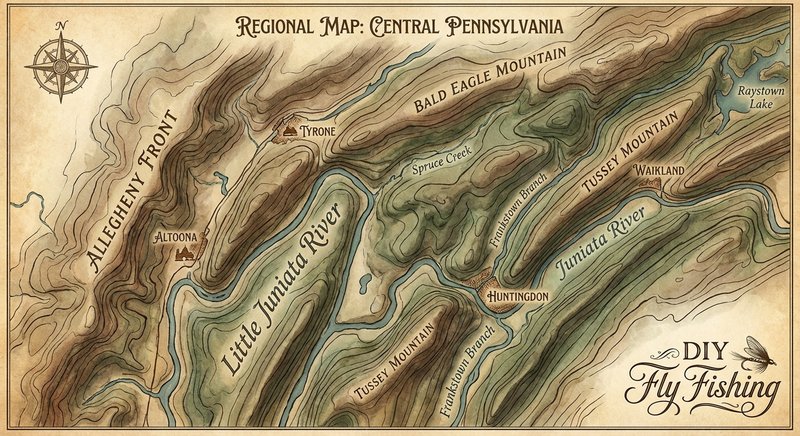
Little Juniata River
Fly fishing in Pennsylvania · Intermediate · Best seasons: Spring, Summer, Fall
Target Species
Brown Trout
About This Water
Excellent freestone fishing in central PA. Good hatches and populations of wild brown trout.
Fishing Recommendations
The "Little J" is often whispered about in the same breath as the legendary limestone creeks of Central Pennsylvania, but it offers a completely different experience. Unlike the narrow, technical spring creeks like Penns Creek or Spruce Creek, the Little Juniata feels like a "big" Western river tucked into the Appalachian mountains.
As your guide, here is everything you need to know to find success on one of the premier wild brown trout fisheries in the Eastern United States.
🎣 Location Overview
The Little Juniata River flows through a dramatic limestone gorge in Blair and Huntingdon Counties. What makes it special is its recovery story; once polluted by industrial runoff, it is now a thriving, Class A wild trout fishery.
The water is "limestone-influenced," meaning it stays cool and nutrient-rich, supporting incredible biomass. The riverbed is primarily freestone-like with large cobble, boulders, and deep ledge pools. It is a large river by Pennsylvania standards—averaging 60–100 feet wide—giving anglers plenty of room to cast but requiring careful wading. The scenery is stunning, with steep forested ridges and frequent sightings of bald eagles and ospreys.
🐟 Target Species & Behavior
The Little J is a wild Brown Trout factory. While there are occasional escapees from stocked tributaries, the vast majority of the fish are wild, buttery-yellow browns with vibrant red spots.
- Behavior: These fish are sophisticated but aggressive. Because the river is rich in food, they don't have to move far for a meal.
- Holding Water: They love the "heavy" water. Look for them in the heads of riffles, tucked behind large boulders (pocket water), and along the deep limestone ledges. In the evenings, they move into the tailouts of pools to sip dry flies.
- Size: Average fish are 12–14 inches, but "The J" is famous for producing fish in the 18–22 inch range for those who know how to hunt them.
📅 Best Times to Fish
Spring (April – June)
This is the "Main Event." The water temperatures are perfect (50–60°F), and the hatches are legendary.
- Prime Window: Mid-May to mid-June.
- Key Hatches: Grannom Caddis (April), Sulphurs (May/June), and the Slate Drake (June).
Summer (July – August)
The river remains fishable due to cold-water springs and the "bubble" effect of the limestone influence, but stealth is key.
- Best Time: Dawn and dusk.
- Key Hatches: Trico (tiny white mayflies) in the early mornings and Terrestrials (ants/beetles) during the day.
Fall (September – November)
A favorite for locals. The crowds disappear, and the brown trout become aggressive as they prepare for the spawn.
- Prime Window: October.
- Key Hatches: Blue Winged Olives (BWO) and Slate Drakes. This is also prime streamer season.
🪰 Recommended Flies & Techniques
Dry Flies
The Little J is a dry-fly angler’s paradise during a hatch.
- Sulphurs (14-18): Parachute or Snowshoe emergers.
- Grannom Caddis (14-16): Apple green body, dark wing.
- Tricos (20-24): For the summer mornings.
- Slate Drakes (12-14): A great "prospecting" dry fly.
Nymphing
This is the most consistent way to catch fish here year-round.
- Patterns: Frenchies, Pheasant Tails, Walt’s Worms, and Zebra Midges.
- Technique: "Euro Nymphing" is incredibly effective here because of the complex currents and ledge holes. If using an indicator, use enough weight to get down through the fast surface bubbles.
Streamers
For the trophy hunters.
- Patterns: Sculpin patterns (black or olive), Wooly Buggers, and Sparkle Minnows.
- Technique: Swing them through deep runs or "strip and pause" near the banks during higher water flows.
💡 Pro Tips & Local Knowledge
- The "Sulphur" Blizzard: The Sulphur hatch on the Little J can be so thick it’s frustrating. When there are thousands of bugs on the water, use a cripple or emerger pattern rather than a high-floating dun. Your fly needs to look like an easy, struggling target to stand out.
- Wading Safety: The rocks on the Little J are notoriously slick and "tippy." Studded wading boots and a wading staff are mandatory. Do not underestimate the current in the gorge sections.
- The Railroad: Much of the river is bordered by active Norfolk Southern tracks. You will hear trains—lots of them. Use the tracks (carefully and legally where permitted) to scout stretches, but always stay well off the ballast.
- Focus on the Gorge: The stretch between Spruce Creek and Barree is the most scenic and often holds the best fish, but it requires a hike.
⚠️ Important Information
- Regulations: The majority of the Little Juniata (from Ironville downstream to the mouth) is managed under Catch and Release Air-Clearance (All-Tackle) regulations. You can use spinning gear or fly gear, but all trout must be returned to the water immediately.
- Access: Key access points include the village of Spruce Creek, the bridge at Barree, and the various pull-offs along Route 453 and Ironville Road.
- Licenses: A valid Pennsylvania Fishing License and a Trout/Salmon Permit are required.
- Flows: Check the USGS gauge at Spruce Creek. Ideal fishing flows are between 250cfs and 500cfs. If it’s over 700cfs, wading becomes dangerous; if it's under 150cfs, the fish become extremely spooky.
Guide’s Final Word: The Little J is a "reward" river. It may beat you up the first time you wade its slippery rocks, but once you time a hatch right and see a 20-inch wild brown rise to your fly, you'll be hooked for life.
Bug Hatches & Matching Flies
| Hatch | Type | Peak months | Time of day | Hook sizes | Matching flies |
|---|---|---|---|---|---|
| Grannom Caddis Brachycentrus | caddis | April | Late Morning/Afternoon | #12-16 | Henryville Special #14-16, LaFontaine's Deep Sparkle Pupa #14-16, Grannom Apple Gum Drop #14-16 |
| Blue Winged Olive Baetis | mayfly | March, April, September, October | Afternoon | #18-22 | RS2 #18-22, BWO CDC Comparadun #18-22, Pheasant Tail Nymph #18-20 |
| Sulphur Ephemerella invaria/dorothea | mayfly | May, June | Evening | #14-18 | Sulphur Snowshoe Emerger #14-18, Sulphur Parachute #14-18, Rusty Spinner #14-18 |
| Slate Drake Isonychia bicolor | mayfly | June, September | Afternoon/Evening | #10-14 | Isonychia Parachute #10-12, Zug Bug #10-14, Iso Wet Fly #12-14 |
| Trico Tricorythodes | mayfly | July, August, September | Morning | #22-26 | Trico Spinner #22-26, Trico Drowned Spinner #22-24 |
| Light Cahill Maccaffertium / Stenonema | mayfly | June, July | Evening | #12-14 | Light Cahill #12-14, Cream Usual #12-14 |
| Blue Quill Paraleptophlebia | mayfly | April | Afternoon | #16-18 | Blue Quill #16-18, Quill Gordon #16-18 |
| Terrestrials Formicidae / Coleoptera | terrestrial | July, August, September | All Day | #12-18 | Cinnamon Flying Ant #14-18, Black Foam Beetle #12-16, Dave's Hopper #10-12 |