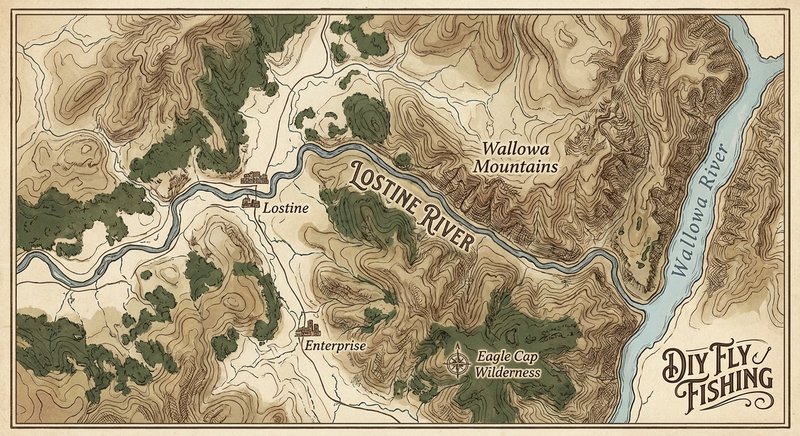
Lostine River
Fly fishing in Oregon · Intermediate · Best seasons: Summer, Fall
Target Species
Rainbow Trout, Bull Trout
About This Water
Wild mountain stream flowing from Eagle Cap Wilderness. Native rainbow and bull trout.
Fishing Recommendations
The Lostine River is one of the crown jewels of the Wallowa Mountains in Northeast Oregon. Flowing out of the Eagle Cap Wilderness, it is a quintessential high-gradient mountain stream characterized by crystalline water, granite boulders, and stunning alpine scenery. For the fly angler, it offers a "classic" trout fishing experience: fast-paced pocket water, eager fish, and a lack of the crowds found on more famous Western rivers.
🎣 Location Overview
The Lostine is a tributary of the Wallowa River, carving a deep glacial valley known as the "Lostine Canyon." What makes this river special is its clarity and the sheer beauty of the surrounding 9,000-foot peaks.
The river transitions from a tumbling alpine torrent in its upper reaches to a more braided, meadow-style stream as it approaches the town of Lostine. The water is cold year-round, which keeps the fish active even in the heat of August. Anglers love it for the "visual" nature of the fishing—you are often sight-casting to shadows in clear pools or watching a dry fly dance through turbulent pocket water.
🐟 Target Species & Behavior
Rainbow Trout
The primary quarry. These are mostly wild, native fish, though you may find some holdover stockers near the developed campgrounds.
- Behavior: They are opportunistic feeders due to the short high-mountain growing season. They hold in "cushions" in front of boulders, in the tail-outs of pools, and along seam lines.
- Size: Expect 8–12 inches on average, with a "big" fish being 14–16 inches.
Bull Trout
The "ghosts" of the Lostine. These are native, migratory fish that move up from the Wallowa River.
- Behavior: They are apex predators. They hold in the deepest, darkest holes or under heavy woody debris. They are rarely interested in small bugs and instead focus on mountain whitefish or smaller trout.
- Note: Bull Trout are a protected species. They must be handled with extreme care and released immediately.
Bonus: Brook Trout
In the highest reaches (above Two Pan Trailhead), you will encounter vibrant Brook Trout in the smaller tributaries and beaver ponds.
📅 Best Times to Fish
Summer (July – August)
This is the prime window.
- Conditions: Runoff usually subsides by early July. Once the water clears and the flow stabilizes, the dry fly fishing becomes world-class.
- Time of Day: Mid-morning until dusk. There is rarely a need to be on the water at dawn here, as the water needs to warm slightly to trigger insect activity.
Fall (September – October)
Perhaps the most beautiful time to be in the canyon.
- Conditions: The huckleberries and aspens turn gold. Water levels are low and technical.
- Time of Day: 11:00 AM to 4:00 PM. The "Blue Winged Olive" (BWO) weather—overcast and cool—can produce incredible hatches.
- Note: This is when Bull Trout are most active as they prepare for their fall spawn.
🪰 Recommended Flies & Techniques
Dry Flies (The Go-To)
The Lostine fish aren't usually "selective," but they want flies that float high in turbulent water.
- Royal Wulff or Royal Coachman: (Size 12-14) A classic for a reason; highly visible.
- Chubby Chernobyl: (Size 10-12) Great as a hopper imitation or a float for a dropper.
- Elk Hair Caddis: (Size 14-16) Tan or olive.
- Parachute Adams: (Size 14-18) For the slower tail-outs and evening rises.
Nymphing
When the fish aren't looking up, a "Dry-Dropper" rig is the most effective way to fish the Lostine.
- Bead-head Prince Nymph: (Size 14-16)
- Pheasant Tail: (Size 16-18)
- Copper John: (Size 14-16) in red or lime.
Streamers (For Bull Trout)
- Dolly Varden Special or White Zonkers: Bull Trout love white or olive patterns that mimic small whitefish.
- Sex Dungeon / Galloup-style Streamers: Big, articulated flies for the deep holes.
💡 Pro Tips & Local Knowledge
- High-Stick Pocket Water: The Lostine is full of "micro-seams." Don't try to make long 40-foot casts. Keep your rod high, your fly line off the water, and fish the "pockets" behind and in front of every boulder.
- The "Two Pan" Reach: Drive to the very end of the Lostine River Road to the Two Pan Trailhead. Hike in just a half-mile to get away from the road-side pressure. The fish here are smaller but incredibly aggressive.
- Shadow Management: Because the canyon is deep and the water is clear, trout are spooky. Fish upstream so you stay behind them, and try to avoid casting your shadow directly over a holding pool.
- The "Bull Trout Hole": Look for where the river makes sharp bends against rock walls. These deep green "slots" are where the 20+ inch Bull Trout hide. If you see a 10-inch rainbow suddenly vanish, a Bull Trout is likely nearby.
⚠️ Important Information
- Access: Follow Lostine River Road (FS Road 8210) from the town of Lostine. The road is paved for the first few miles and then turns to well-maintained gravel. There are numerous campgrounds (Williamson, Pole Bridge, etc.) that offer easy river access.
- Regulations:
- The Lostine is generally open for trout from late May through October (check ODFW Southwest Zone regs for specific dates).
- Barbless hooks are highly recommended and often required for certain sections/species.
- Bull Trout are Catch & Release ONLY. Do not remove them from the water for photos.
- Safety: This is Cougar and Black Bear country. Carry bear spray if you are hiking deep into the wilderness sections. Also, the granite rocks are incredibly slick—felt soles or studs are highly recommended.
- Parking: A Northwest Forest Pass is required at many of the trailheads and developed sites.
Bug Hatches & Matching Flies
| Hatch | Type | Peak months | Time of day | Hook sizes | Matching flies |
|---|---|---|---|---|---|
| Golden Stonefly Hesperoperla pacifica | stonefly | July, August | All Day | #6-10 | Chubby Chernobyl (Gold) #8-12, Pat's Rubber Legs #6-10 |
| Green Drake Drunella doddsii | mayfly | June, July | Afternoon | #10-12 | Hackle Stacker Drake #10-12, Hare's Ear Nymph #10-12 |
| Pale Morning Dun Ephemerella excrucians | mayfly | July, August | Late Morning/Afternoon | #14-18 | Sparkle Dun #14-16, Pheasant Tail #14-18 |
| Yellow Sally Isoperla spp. | stonefly | July, August | Afternoon/Evening | #14-16 | Stimulator (Yellow) #14-16, Little Yellow Sloan #14-16 |
| Blue Winged Olive Baetis spp. | mayfly | April, May, September, October | Midday | #18-22 | Parachute Adams #18-22, RS2 #20-22 |
| Spotted Sedge Hydropsyche spp. | caddis | July, August, September | Evening | #14-16 | Elk Hair Caddis (Tan) #14-16, LaFontaine's Deep Sparkle Pupa #14-16 |
| October Caddis Dicosmoecus atripes | caddis | September, October | Afternoon | #8-10 | Orange Stimulator #8-10, Morrish's October Pupa #8-10 |
| Terrestrials (Grasshoppers) Orthoptera | terrestrial | August, September | Midday | #8-12 | Morrish Hopper #10-12, Dave's Hopper #8-12 |
| Salmonfly Pteronarcys californica | stonefly | June | All Day | #4-8 | Rogue River Stone #4-8, Girdle Bug #4-8 |