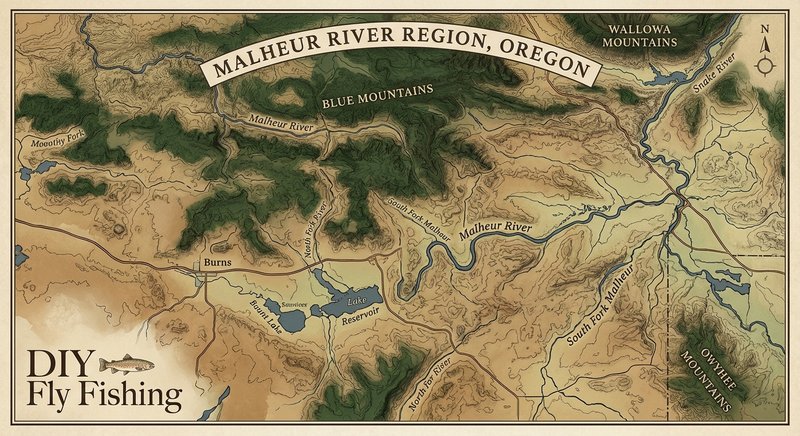
Malheur River
Fly fishing in Oregon · Intermediate · Best seasons: Spring, Fall
Target Species
Redband Trout
About This Water
Eastern Oregon desert river with wild redband trout. Remote canyon fishing.
Fishing Recommendations
The Malheur River in Southeast Oregon is a hidden gem for the adventurous angler. It is a remote, rugged, and high-desert fishery that offers a true "wild west" experience. Unlike the manicured banks of the Deschutes, the Malheur is raw, often lonely, and home to some of the most resilient trout in the Pacific Northwest.
🎣 Location Overview
The Malheur River flows through the high-desert canyons of the Oregon Outback. While it is divided into three forks (North, Middle, and South), the Middle Fork and the main stem below the Warm Springs Reservoir are the primary draws for fly anglers.
What makes this water special is its isolation. You are fishing in deep, basalt-rimmed canyons where cellular service disappears and the silence is broken only by the water and the occasional golden eagle. The river characteristics vary from tight, brushy pocket water to long, slow glides and deep pools. The water can be "thin" and sensitive to drought, making it a technical but rewarding destination.
🐟 Target Species & Behavior
The primary prize here is the Great Basin Redband Trout. These are a unique subspecies of rainbow trout adapted to the harsh, fluctuating temperatures of the high desert.
- Behavior: Redbands are known for their incredible fighting spirit. Because they live in a high-energy environment with limited food, they are opportunistic and aggressive.
- Holding Patterns: Look for them in the "oxygenated water"—the heads of pools, riffles, and behind large basalt boulders. In the heat of the day, they will tuck deep into the undercut banks or under overhanging willows.
- Diet: Their diet consists heavily of stoneflies, caddis, and terrestrial insects (grasshoppers and beetles) during the summer months.
📅 Best Times to Fish
The Malheur is a "shoulder season" river. Extreme summer heat and winter ice make the windows of opportunity narrow.
- Spring (Late April – June): This is prime time. As the desert warms up, the bugs get active. However, you must watch the snowmelt; if the runoff is too heavy, the river becomes unfishable.
- Fall (September – October): This is arguably the best window. Water temperatures drop, the Redbands become aggressive as they prepare for winter, and the "hopper" fishing can be world-class.
- Best Time of Day: In the spring, midday is best as the sun warms the water. In the fall, early mornings and late evenings provide the best dry-fly action.
- Prime Windows: Aim for overcast days in the fall; this often triggers massive BWO (Blue Winged Olive) hatches.
🪰 Recommended Flies & Techniques
Top Fly Patterns
- Dries: Chubby Chernobyl (Size 8-12) in tan or orange; Stimulators (Size 10-14); Parachute Adams (Size 14-18) for technical hatches; Morrish Hopper (Size 10).
- Nymphs: Pat’s Rubber Legs (the "gold standard" here); Bead-head Prince Nymphs; Pheasant Tails (Size 14-16); Zebra Midges in red or black.
- Streamers: Woolly Buggers in olive or black; Sculpzilla (small sizes).
Effective Techniques
- Dry-Dropper: This is the most effective way to cover the Malheur. Use a high-floating Chubby Chernobyl as your indicator and hang a Pat’s Rubber Legs or a Pheasant Tail 18–24 inches below it.
- Tight-Line Nymphing: In the riffles and pocket water, staying in direct contact with your flies is crucial, as the takes from Redbands can be lightning-fast.
- Streamer Stripping: In the deeper pools of the canyons, swinging a small streamer can entice the larger, more territorial Redbands.
💡 Pro Tips & Local Knowledge
- The "Willow Reach": Much of the river is lined with dense willows. You will need to practice your "roll cast" and "bow-and-arrow cast." If you aren't getting your flies under the overhanging brush, you are missing 50% of the fish.
- Focus on the Middle Fork: The reach near Riverside is a great starting point, but the further you hike away from the road access points, the better the fishing gets.
- Watch the Flows: Check the USGS gauges. For the Middle Fork, flows between 100–300 CFS (cubic feet per second) are ideal. If it’s over 500, it’s likely too high to wade safely.
- Stealth Matters: Desert water is often crystal clear. Wear earthy tones (camo or tan) and avoid "lining" the fish by casting from a distance.
⚠️ Important Information
- Access: Much of the river is bordered by BLM (Bureau of Land Management) land, but there are significant patches of private ranch land. Always use a GPS app like OnX or Gaia to ensure you are on public ground.
- Regulations: Oregon Dept. of Fish and Wildlife (ODFW) regulations apply. This is generally a catch-and-release minded fishery for wild Redbands. Barbless hooks are highly recommended to protect the fish.
- Rattlesnakes: This is prime Great Basin Rattlesnake country. Watch your step, especially when climbing over basalt rocks or through tall grass.
- Supplies: The nearest towns (Burns or Ontario) are a long drive away. Bring plenty of water, extra fuel, and a full-size spare tire. The gravel roads in the Malheur basin are notorious for shredding thin-walled tires.
Bug Hatches & Matching Flies
| Hatch | Type | Peak months | Time of day | Hook sizes | Matching flies |
|---|---|---|---|---|---|
| Blue Winged Olive Baetis | mayfly | March, April, September, October | Late Morning/Afternoon | #18-22 | Parachute Adams #18-22, RS2 #20-22, Pheasant Tail #18-20 |
| Pale Morning Dun Ephemerella excrucians | mayfly | June, July | Late Morning/Early Afternoon | #14-18 | PMD Sparkle Dun #16-18, Split Case PMD #16-18, Hare's Ear #14-16 |
| Spotted Sedge Hydropsyche | caddis | May, June, July | Evening | #14-18 | Elk Hair Caddis #14-16, Pupa-tator #16, LaFontaine's Deep Sparkle Pupa #14-18 |
| Midge Chironomidae | midge | January, February, March, December | All Day | #20-26 | Zebra Midge #20-22, Griffith's Gnat #20-24, Top Secret Midge #22-24 |
| Trico Tricorythodes | mayfly | August, September | Early Morning | #20-24 | Trico Spinner #20-24, WD-40 #20-22 |
| Golden Stonefly Hesperoperla pacifica | stonefly | June, July | Morning/Evening | #8-12 | Chubby Chernobyl #8-12, Pat's Rubber Leg #8-12, Golden Stone Nymph #10 |
| Grasshopper Orthoptera | terrestrial | July, August, September | Afternoon | #8-12 | Morrish Hopper #10-12, Parachute Hopper #12, Dave's Hopper #8-10 |
| Yellow Sally Isoperla | stonefly | June, July | Afternoon/Evening | #14-16 | Yellow Sally Dry #14-16, Iron Sally #14-16 |