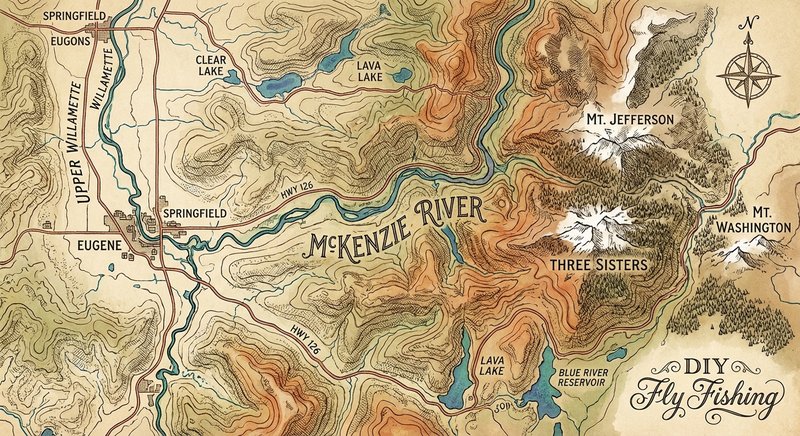
McKenzie River
Fly fishing in Oregon · Intermediate · Best seasons: Spring, Summer, Fall
Target Species
Rainbow Trout, Bull Trout
About This Water
Beautiful Cascade Range river with native rainbow trout. Drift boat fishing popular.
Fishing Recommendations
The McKenzie River is a crown jewel of Oregon fly fishing. Flowing from high in the Cascade Mountains down to the Willamette Valley, it is the birthplace of the iconic high-prow "McKenzie Drift Boat." It is a river of crystal-clear turquoise water, dramatic whitewater, and some of the hardest-fighting rainbow trout in the Pacific Northwest.
🎣 Location Overview
The McKenzie is a classic western freestone river characterized by high-gradient "pocket water," deep emerald pools, and heavy riffles. What makes it special is its volcanic origin; much of the river is fed by underground springs, keeping the water cold, oxygenated, and nutrient-rich year-round.
Anglers love the McKenzie because it offers a "choose your own adventure" experience: you can float through technical rapids in a drift boat or find excellent walk-in access along Highway 126. The scenery is quintessential Oregon—towering Douglas firs, moss-covered basalt, and frequent sightings of osprey and bald eagles.
🐟 Target Species & Behavior
McKenzie "Redside" Rainbow Trout
These are the river's native stars. They are distinguished by a brilliant crimson stripe and heavy spotting.
- Behavior: They are incredibly strong for their size, adapted to living in fast, turbulent water.
- Holdings: Look for them in the "seams" (where fast and slow water meet), behind large basalt boulders, and in the "bubbles" (oxygenated whitewater). They are opportunistic feeders but can become selective during major hatches.
Bull Trout
The McKenzie and its tributaries (like the South Fork) are some of the few places where you can target these apex predators.
- Behavior: Bulls are migratory and piscivorous (fish-eaters). They stay deep during the day, often lurking at the tailouts of large pools or near tributary mouths.
- Feeding: They don't care about dry flies. They want calories—think large streamers mimicking whitefish, sculpin, or juvenile rainbow trout.
📅 Best Times to Fish
- Spring (April – May): This is the season of the March Brown hatch. On cloudy afternoons, the dry fly fishing can be world-class. Water levels are usually high from snowmelt, so fishing from a boat is often more effective than wading.
- Summer (June – August): The "Prime Time." The Green Drake hatch in June is legendary—it brings the largest trout in the river to the surface. As summer progresses, evening caddis hatches provide consistent dry fly action until dark.
- Fall (September – October): My personal favorite. The crowds thin out, and the October Caddis (huge orange insects) begin to emerge. The fish are aggressive, feeding heavily before winter.
🪰 Recommended Flies & Techniques
Dry Flies
- Green Drake (Size 8-10): Hairwing Green Drake or Sparkle Dun (June).
- March Brown (Size 12-14): Western March Brown or Parachute Adams.
- Caddis (Size 14-16): Elk Hair Caddis (Tan/Olive) or the "McKenzie Special" (a local classic).
- October Caddis (Size 8-10): Stimulators or Orange Chubby Chernobyls.
Nymphs
- Possie Bugger (Size 10-14): A local pattern that is arguably the most productive fly on the river.
- Pats Rubber Legs (Size 6-10): For the heavy stoneflies that live in the basalt cracks.
- Perdigons (Size 14-18): To get down fast in the heavy current.
Streamers (For Bull Trout)
- White or Olive/Black Articulated Streamers: Sex Dungeon or Billy's Bunny in 4-6 inch lengths.
Technique Tips
- Pocket Water Fishing: This is the core skill here. Use a "high-stick" technique or Euro-nymphing to keep your line off the complex currents.
- The "McKenzie Hop": When dry fly fishing, don't let your fly drift for 20 feet. Cast into a pocket, let it drift for 3 seconds, and if nothing hits, pick it up and move to the next pocket.
💡 Pro Tips & Local Knowledge
- The "Slickness": The basalt rocks in the McKenzie are notoriously slippery—arguably the slickest in the West. Studded wading boots are mandatory. Do not attempt to wade this river in plain rubber soles.
- Focus on the Upper River: From Olallie Campground down to Paradise is stunning, smaller water with high densities of wild fish. The lower river (below Leaburg) is wider and holds more "stocked" trout, though some very large wild fish live there too.
- The South Fork: If the main stem is running high or dirty, check the South Fork of the McKenzie. It is a tailwater (below Cougar Dam) and often stays clear and cold when the main river is "blown out."
- Evening Rise: In July and August, the river can seem "dead" during the heat of the day. The magic happens in the last 90 minutes of daylight. Be on the water when the sun drops behind the trees.
⚠️ Important Information
- Regulations: The McKenzie has complex regulations. Most of the river is Catch and Release only for wild trout (identified by an intact adipose fin). Hatchery fish (clipped fin) can be kept in certain sections.
- Bull Trout: You must release all Bull Trout immediately. It is illegal to even take them out of the water for a photo in some jurisdictions—keep them wet!
- Access:
- Boat Ramps: There are numerous well-maintained ramps (Finn Rock, Prince Helfrich, Silver Creek).
- Wade Access: Use the McKenzie River Trail for miles of bank access in the upper sections.
- Permits: A standard Oregon Angling License is required. No special McKenzie-specific permit is needed for private anglers.
Guide’s Final Word: The McKenzie rewards the observant angler. Watch the bubble lines, fish the heavy water that other people walk past, and always have a Possie Bugger tied on as your dropper. Tight lines!
Bug Hatches & Matching Flies
| Hatch | Type | Peak months | Time of day | Hook sizes | Matching flies |
|---|---|---|---|---|---|
| Western March Brown Rhithrogena morrisoni | mayfly | March, April, May | Afternoon | #12-14 | March Brown Para-Wulff #12-14, Hare's Ear Nymph #12-14, March Brown Wet Fly #12-14 |
| Salmonfly Pteronarcys californica | stonefly | May, June | All Day | #4-8 | Chubby Chernobyl (Orange) #4-8, Pat's Rubber Legs #4-8, Clark's Stone #6-8 |
| Golden Stonefly Hesperoperla pacifica | stonefly | June, July | Late Afternoon/Evening | #8-12 | Norm Wood Special #8-10, Golden Stone Nymph #8-12, Yellow Stimulator #8-12 |
| Pale Morning Dun (PMD) Ephemerella excrucians | mayfly | June, July, August | Late Morning/Afternoon | #14-18 | Sparkle Dun (PMD) #16-18, Pheasant Tail #14-18, PMD Parachute #14-18 |
| Mother's Day Caddis Brachycentrus occidentalis | caddis | April, May | Afternoon/Evening | #14-16 | Peacock Caddis #14-16, Deep Sparkle Pupa #14-16, Elk Hair Caddis (Dark) #14-16 |
| Blue Winged Olive (BWO) Baetis tricaudatus | mayfly | March, April, September, October | Mid-Day | #18-22 | BWO Parachute #18-20, RS2 #20-22, Baetis Nymph #18-22 |
| Green Drake Drunella doddsii | mayfly | June | Afternoon | #10-12 | Green Drake Cripple #10-12, Hairwing Green Drake #10-12, Green Drake Nymph #10-12 |
| October Caddis Dicosmoecus gilvipes | caddis | September, October | Evening | #8-12 | Orange Stimulator #8-10, October Caddis Pupa #8-10, Morrish October Caddis #8-12 |