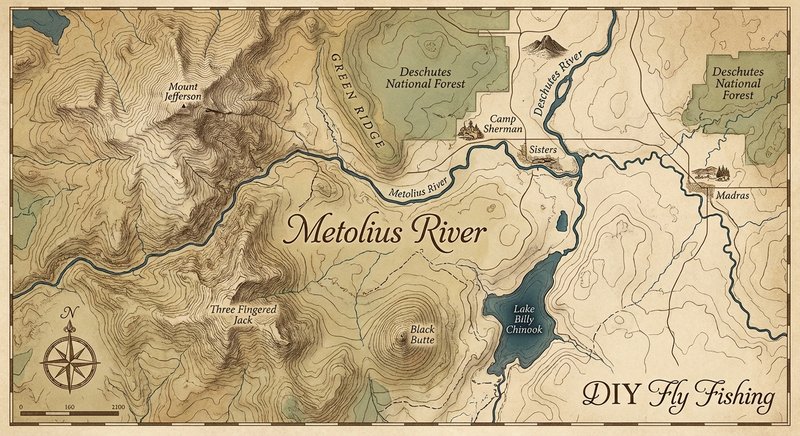
Metolius River
Fly fishing in Oregon · Advanced · Best seasons: Spring, Summer, Fall
Target Species
Rainbow Trout, Bull Trout, Brown Trout
About This Water
Crystal clear spring creek with wild rainbow and bull trout. Technical dry fly fishing in stunning scenery.
Fishing Recommendations
Welcome to the Metolius River, arguably the most beautiful and challenging spring-fed river in the American West. Often referred to as the "PhD of Fly Fishing," the Metolius is a place of breathtaking scenery and humbling technicality.
As your guide, I’m here to tell you: don't come here expecting a high fish count. Come here for the purity of the pursuit, the clarity of the water, and the chance to land a legendary fish in one of the most serene settings on earth.
🎣 Location Overview
Located in Central Oregon near the town of Camp Sherman, the Metolius doesn’t trickle from a mountain peak; it bursts fully formed from the base of Black Butte at Metolius Springs.
The water is a constant 41–48°F year-round, making it incredibly clear, cold, and nutrient-rich. It flows through ancient Ponderosa pine forests with the snow-capped Mt. Jefferson looming in the background. Because it is spring-fed, the river is remarkably stable and rarely "blows out," providing consistent (though difficult) fishing conditions when other rivers are muddy from runoff.
🐟 Target Species & Behavior
Interior Redband (Rainbow) Trout
These are native, wild, and incredibly strong. They are "PhD" fish because they have seen every fly in the catalog.
- Behavior: They hold in incredibly tight seams, often right against the bank or under overhanging brush.
- Feeding: They are highly selective. If your drift has even a micro-millimeter of drag, they will refuse.
Bull Trout
The Metolius is world-famous for its massive, migratory Bull Trout. These apex predators can reach lengths of over 30 inches.
- Behavior: They are opportunistic. They hang out in deep, dark holes or near wood debris.
- Feeding: They eat whitefish, smaller rainbow trout, and kokanee. They require heavy streamers and heavy tackle.
Brown Trout
While less common than the Redbands, you will find wild Browns in the middle and lower stretches. They are nocturnal and secretive, often found in the undercut banks and slower side channels.
📅 Best Times to Fish
- Spring (March – May): Excellent for Blue Winged Olives (BWO) and March Browns. This is the best time for solitude before the summer crowds arrive.
- Summer (June – August): The "Main Event." The Green Drake hatch (typically mid-June to July) is legendary. This is when the largest rainbows in the river look up to the surface. Late summer brings Golden Stoneflies and evening Caddis hatches.
- Fall (September – October): My personal favorite time. The October Caddis (large orange flies) appear, and the Kokanee begin their spawning run from Lake Billy Chinook, which brings the massive Bull Trout out in force to feast on eggs and tired fish.
Best Time of Day: During summer, the best dry fly action is often mid-day (for Drakes) or the "magic hour" just before dusk (for Caddis).
🪰 Recommended Flies & Techniques
Dry Fly Fishing
This is the Metolius's claim to fame. You need long, light leaders (9–12 feet ending in 6X or 7X tippet).
- Patterns:
- Green Drake: Tilt-Wing Drake, Sparkle Dun (Size 10-12).
- BWO: Parachute Adams, RS2 (Size 18-22).
- Caddis: Elk Hair Caddis, Iris Caddis (Size 14-18).
- Stoneflies: Clark’s Stone or Golden Chubby Chernobyl.
Nymphing
Since the water is deep and fast, nymphing is often the most productive way to find fish. European Nymphing (tight-lining) is incredibly effective here due to the complex currents.
- Patterns:
- Jimmy Legs (large weighted stonefly nymphs).
- Perdigons and Zebra Midges (Size 18-22) in olive, black, or red.
- Possie Bugger: A local favorite that mimics everything and nothing.
Streamer Fishing (The Bull Trout Hunt)
If you are targeting Bulls, put away the 5-weight. You need an 8-weight rod with a heavy sink tip.
- Patterns: Large (4-6 inch) articulated streamers in white, olive, or "trash can" (multicolored).
- Technique: Cast into the deepest pools and "strip-pause" or swing the fly deep.
💡 Pro Tips & Local Knowledge
- The "Metolius Drift": Standard mending often isn't enough. You need to master the Reach Cast and the Stack Mend. If your fly moves even slightly faster or slower than the bubbles on the surface, the fish will ignore it.
- Stealth is Mandatory: The water is gin-clear. If you can see the fish, they have likely already seen you. Wear earthy colors (tans/greens), move slowly, and stay low to the bank.
- Spotting Fish: Polarized sunglasses are non-negotiable. Look for the "white wink" of a trout’s mouth opening or the subtle shadow on the gravel rather than the fish itself.
- Key Stretches:
- The Upper River (Camp Sherman to Allingham): Best for classic dry fly water and smaller rainbows.
- The Middle River (Wizard Falls Hatchery area): High fish concentration but high pressure.
- The Lower River (Bridge 99 and below): Rugged, canyon-like, and the best place for Bull Trout.
⚠️ Important Information
- Regulations: The Metolius is strictly Catch and Release. It is Fly Fishing Only from the headwaters down to Bridge 99. Below Bridge 99, lures are allowed, but most anglers stick to flies. Hooks must be barbless.
- Access: Much of the river is bordered by a wonderful trail system. There are numerous forest service campgrounds (Smiling River, Pine Rest, Canyon Creek) that provide easy access.
- Wading Safety: The water is very cold and the rocks are "greased lightning" slippery. Studded wading boots and a wading staff are highly recommended.
- Permits: You will need a standard Oregon Angling License. No special "Metolius" permit is required, but always check the current ODFW (Oregon Department of Fish and Wildlife) regulations for seasonal closures.
Guide’s Parting Advice: Don't get frustrated. Even the best anglers have "zero" days on the Metolius. Take a moment to look at the trees and the mountains—on this river, the "fishing" is world-class, even if the "catching" is a challenge. Tight lines!
Bug Hatches & Matching Flies
| Hatch | Type | Peak months | Time of day | Hook sizes | Matching flies |
|---|---|---|---|---|---|
| Green Drake Drunella doddsii | mayfly | May, June | Mid-day to Afternoon | #10-12 | Hackle Stacker Green Drake #10-12, Green Drake Cripple #10-12, Picket Pin #10-12 |
| Blue-Winged Olive Baetis spp. | mayfly | March, April, September, October, November | Late Morning/Afternoon | #18-22 | RS2 #18-22, Parachute BWO #18-22, Pheasant Tail #18-20 |
| October Caddis Dicosmoecus gilvipes | caddis | September, October | All Day | #8-10 | Morrish October Caddis #8-10, October Caddis Pupa #8-10, Peery's Deep Sparkle Pupa #8-10 |
| Pale Morning Dun Ephemerella excrucians | mayfly | June, July, August | Late Morning/Early Afternoon | #14-18 | Sparkle Dun #16-18, PMD Split Case #16-18, Captive Dun PMD #16-18 |
| Golden Stonefly Hesperoperla pacifica | stonefly | June, July | Morning/Evening | #8-12 | Chubby Chernobyl (Gold) #8-12, Kaufmann's Stone #8-12, Pat's Rubber Legs #8-12 |
| Little Black Stonefly Capniidae | stonefly | February, March | Mid-day | #16-20 | Little Black Sloan #16-18, Zebra Midge (Black) #18-20, Micro Stone #16-18 |
| Cinnamon Caddis Hydropsyche spp. | caddis | July, August | Evening | #14-16 | Elk Hair Caddis (Tan/Cinnamon) #14-16, LaFontaine's Sparkle Pupa #14-16, Soft Hackle Hare's Ear #14-16 |
| Western March Brown Rhithrogena morrisoni | mayfly | March, April | Afternoon | #12-14 | March Brown Western Parachute #12-14, Mercer's Missing Link #14, Hare's Ear Nymph #12-14 |