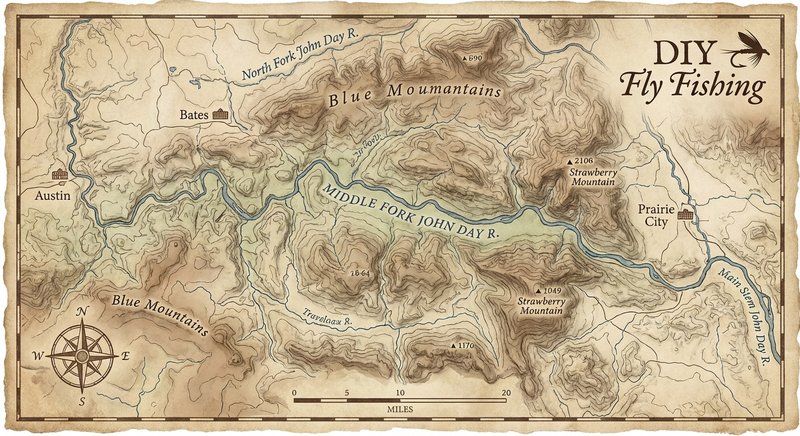
Middle Fork John Day
Fly fishing in Oregon · Intermediate · Best seasons: Spring, Summer, Fall
Target Species
Rainbow Trout, Smallmouth Bass
About This Water
Remote central Oregon river with wild rainbow trout. Less crowded than main John Day.
Fishing Recommendations
The Middle Fork of the John Day River is one of Oregon’s hidden gems. While the Main Stem gets the glory for Smallmouth and the North Fork for its wilderness, the Middle Fork offers a unique, intimate experience that transitions from high-alpine pine forests to rugged high-desert canyons.
As a guide, I view the Middle Fork as a "tale of two rivers." The upper reaches are a cold-water trout sanctuary, while the lower reaches become a world-class Smallmouth Bass factory as the water warms.
🎣 Location Overview
The Middle Fork flows through the Malheur National Forest and private ranchlands in Northeastern Oregon. It is a freestone river, meaning its flow is dictated entirely by snowpack and rainfall, not dams.
What makes it special is its remoteness and diversity. In the upper sections (near Galena and Bates), the river is small, braided, and shaded by ponderosa pines—perfect for "blue-lining" for wild trout. As you move downstream toward the confluence with the North Fork, the valley opens up, the water slows, and the basalt canyon walls take over, creating ideal habitat for aggressive Smallmouth Bass.
🐟 Target Species & Behavior
Wild Rainbow & Cutthroat Trout
The trout here are primarily wild interior Redband Rainbows, often showing characteristics of Westslope Cutthroat.
- Behavior: They are opportunistic and hardy but very wary. Because the river is relatively small, they spook easily.
- Holding Water: Look for "the seams"—where fast water meets slow water. They love undercut banks and the deep "buckets" at the tail-end of riffles.
- Feeding: They rely heavily on aquatic insects (Caddis, Mayflies) and terrestrial "windfalls" like grasshoppers and ants in late summer.
Smallmouth Bass
The John Day system is legendary for Smallmouth, and the Middle Fork is a prime nursery.
- Behavior: These fish are incredibly aggressive. Unlike trout, they aren't as bug-focused; they are predators.
- Holding Water: They hold in the slower, deeper pools, behind large boulders, and in the "slack water" near the banks.
- Feeding: Their diet consists of crayfish, sculpins, and smaller fish. If it moves and looks like a meal, they’ll hit it.
📅 Best Times to Fish
- Spring (Late May – June): This is the window for the "big water." As the runoff subsides, the bass fishing explodes in the lower sections. Trout fishing can be tough if the water is still high and turbid, but once it clears, the dry fly action is electric.
- Summer (July – August):
- Trout: Stick to the upper river (above Galena) where the water stays cool.
- Bass: The lower river is in its prime.
- Note: This is "Hoot Owl" season. If water temps hit 68°F, stop fishing for trout to protect the population.
- Fall (September – October): My favorite time. The "September Swing" brings cooler nights, which drops water temps and triggers a feeding frenzy for both species before winter. The crowds vanish, and the colors in the canyon are spectacular.
🪰 Recommended Flies & Techniques
For Trout (Upper River)
- Dry Flies: Elk Hair Caddis (#14-16), Parachute Adams (#16), and Stimulators (#10-14) in orange or yellow.
- Terrestrials: Dave’s Hopper or any foam grasshopper pattern (#8-12) from July through September.
- Nymphing: A "Hopper-Dropper" rig is the gold standard here. Hang a Beadhead Pheasant Tail or a Copper John (#16-18) about 18-24 inches below a large dry fly.
For Smallmouth Bass (Lower River)
- Streamers: Woolly Buggers (Olive, Black, or Brown) are mandatory. Small Clouser Minnows in chartreuse/white also kill.
- Topwater: Boogle Bugs or small foam poppers. There is nothing more exciting than a Smallmouth smashing a popper in the evening.
- Crayfish Patterns: Near-Nuff Crayfish or any weighted pattern that bounces along the bottom.
💡 Pro Tips & Local Knowledge
- The "Temperature Line": Experienced guides know that the Ritter Bridge area is roughly the transition zone. Above Ritter, focus on trout. Below Ritter, focus on bass.
- Stealth is Key: Because the Middle Fork can get very low and clear in the summer, treat it like a spring creek. Wear drab clothing (camo or tan), stay low, and avoid casting your shadow over the water.
- Wading Safety: The rocks in the John Day system are notoriously "greased" with algae. Felt-soled boots or studs are highly recommended to avoid a dunking.
- The "Twitch": When fishing grasshopper patterns for trout, don't just let them dead drift. Give the rod tip a tiny wiggle to make the fly "kick" on the surface. It often triggers a strike from a fish that was just watching.
⚠️ Important Information
- Access: Much of the Middle Fork flows through private ranchland. Stay below the High Water Mark (ordinary high water line) and use established public access points in the Malheur National Forest or BLM lands.
- Regulations:
- Barbless Hooks: Required for all fishing in the John Day system.
- Catch & Release: While some areas allow harvest, most fly anglers practice 100% C&R for wild trout to preserve the fishery.
- Check ODFW: Always check the Oregon Department of Fish and Wildlife (ODFW) "In-Season Regulations" before heading out, as emergency closures due to water temperature or low flows are common in August.
- Pack it Out: This is a fragile ecosystem. Please follow Leave No Trace principles.
Guide’s Final Word: The Middle Fork isn't about trophy-sized fish; it's about the wildness of the place. Bring a 4-weight rod for the trout and a 6-weight for the bass, and enjoy one of the quietest corners of the Pacific Northwest.
Bug Hatches & Matching Flies
| Hatch | Type | Peak months | Time of day | Hook sizes | Matching flies |
|---|---|---|---|---|---|
| Salmonfly Pteronarcys californica | stonefly | May, June | All Day | #4-8 | Chubby Chernobyl (Orange) #6-8, Pats Rubber Legs #4-8, Rogue Foam Stone #6-8 |
| Golden Stonefly Hesperoperla pacifica | stonefly | June, July | Morning/Evening | #8-12 | Norm Wood Special #8-10, Golden Stone Nymph #8-12, Clark's Stone #10-12 |
| Pale Morning Dun (PMD) Ephemerella excrucians | mayfly | June, July | Late Morning/Afternoon | #14-18 | Sparkle Dun #16-18, Pheasant Tail #14-18, RS2 (PMD color) #16-18 |
| Blue Winged Olive (BWO) Baetis | mayfly | March, April, September, October | Midday | #18-22 | Parachute Adams #18-22, BWO CDC Limp #20-22, JujuBaetis #18-20 |
| Spotted Sedge / Tan Caddis Hydropsyche | caddis | June, July, August | Evening | #14-18 | Elk Hair Caddis (Tan) #14-16, LaFontaine's Deep Sparkle Pupa #14-16, X-Caddis #14-18 |
| Yellow Sally Isoperla | stonefly | June, July | Afternoon/Evening | #14-16 | Little Yellow Sloan #14-16, Iron Lotus (Yellow) #16, Yellow Stimulator #14-16 |
| Grasshoppers Acrididae | terrestrial | July, August, September | Late Morning/Afternoon | #8-12 | Morrish Hopper #10-12, Dave's Hopper #8-12, Thunder Thighs Hopper #10 |
| Trico Tricorythodes | mayfly | August, September | Early Morning | #20-24 | Trico Spinner #20-24, Drowned Trico #22, Trico Parachute #20-22 |