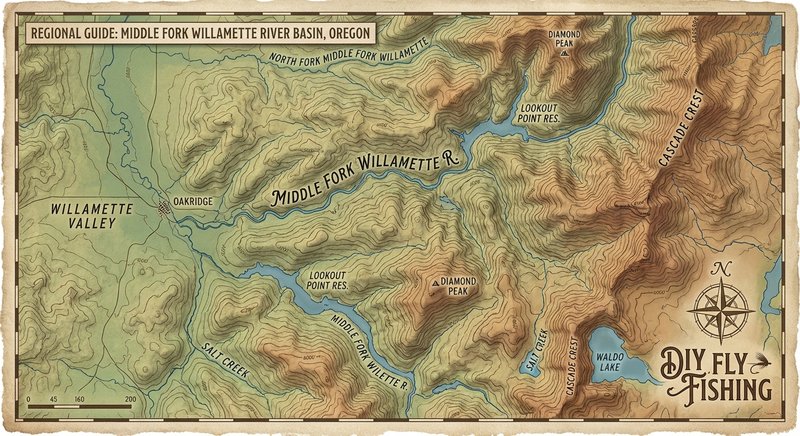
Middle Fork Willamette
Fly fishing in Oregon · Intermediate · Best seasons: Summer, Fall
Target Species
Rainbow Trout, Bull Trout
About This Water
Upper sections offer excellent wild trout fishing in Cascade foothills. Scenic canyon water.
Fishing Recommendations
The Middle Fork of the Willamette River is one of Oregon’s most diverse and scenic trout fisheries. Stretching from the high Cascades near Waldo Lake down to Lookout Point Reservoir, this river offers a "tale of two waters": the rugged, high-gradient upper reaches and the tailwater section below Hills Creek Dam.
For the angler seeking wild fish in a spectacular forest setting without the crowds of the McKenzie or the Deschutes, the Middle Fork is a premier destination.
🎣 Location Overview
The Middle Fork Willamette is a wild, freestone-style river flowing through the heart of the Willamette National Forest. What makes it special is the sheer variety of water. Above Hills Creek Reservoir, the river is characterized by pocket water, riffles, and deep emerald pools. Below the dam (near the town of Oakridge), the river takes on a tailwater character with more consistent temperatures and larger bug life.
Anglers love the Middle Fork for its solitude and diversity. You can spend the morning technical nymphing for hefty Rainbows and the afternoon swinging large streamers for apex predator Bull Trout. The scenery is quintessential Pacific Northwest—towering Douglas firs, mossy boulders, and crystal-clear water.
🐟 Target Species & Behavior
Wild Rainbow Trout
These are the bread and butter of the river. These fish are incredibly athletic, often jumping multiple times once hooked.
- Behavior: In the summer, they hold in highly oxygenated "white water" (riffles and heads of pools). As the water cools in the fall, they move into deeper runs and the tail-outs of pools.
- Feeding: They are opportunistic feeders, keyed into caddis, stoneflies, and various mayflies.
Bull Trout
The "ghosts" of the Middle Fork. These are native, char species that are highly protected.
- Behavior: Bull Trout are piscivorous (fish-eaters). They hold in deep, dark slots or at the confluence of cold-water tributaries. They often shadow schools of spawning mountain whitefish or smaller trout.
- Feeding: They rarely rise for dry flies; they want a "meal." They target sculpins, whitefish, and juvenile trout.
📅 Best Times to Fish
Summer (July - August)
- Conditions: The high-country snowmelt has subsided, and the water is clear.
- Time of Day: Early morning and "last light" are most productive. The evening caddis hatch can be legendary.
- Prime Window: Late July is the sweet spot for dry fly action.
Fall (September - October)
- Conditions: This is arguably the best time to fish. The crowds disappear, and the fish become aggressive before winter.
- Time of Day: Mid-day becomes the "power hour" as the water warms slightly.
- Prime Window: October brings the October Caddis (Dicosmoecus), which triggers some of the most violent surface strikes of the year.
🪰 Recommended Flies & Techniques
Dry Flies (The Surface Game)
- October Caddis (Size 8-10): Orange Stimulators or Chubby Chernobyls in orange/brown.
- Elk Hair Caddis (Size 14-16): Tan or olive for the summer evenings.
- Parachute Adams (Size 14-18): The ultimate "searching" pattern for flat water.
Nymphing (The Numbers Game)
- Possie Bugger (Size 10-14): A local Oregon favorite. It looks like everything and nothing at once.
- Pats Rubber Legs (Size 8-12): Essential for the deeper runs to mimic the large golden stoneflies.
- Perdigons (Size 16): Great for Euro-nymphing the fast riffles.
Streamers (For Bull Trout & Large Rainbows)
- Sculpzilla (Size 4-8): In olive or black.
- Gamechanger: Large white or tan patterns for Bull Trout.
- Wooly Bugger: A beaded black or olive bugger is a staple for swinging through tail-outs.
Presentation Tips
- The "Dry-Dropper": In the summer, run a large foam dry fly with a weighted nymph 2-3 feet below it.
- The Swing: When fishing for Bull Trout, use a sink-tip line and swing your streamer deep, pulsing it slightly as it crosses the current.
💡 Pro Tips & Local Knowledge
- Focus on the "Upper Middle": The stretch between Sand Prairie and the headwaters offers some of the best walk-and-wade access. Look for areas where the river braids; these side channels often hold the most cooperative fish.
- Look for Cold Water: In late summer, focus your efforts near the mouths of tributaries like Salt Creek or the North Fork. The cooler water temperature attracts fish like a magnet.
- The "Bull Trout Shadow": If you hook a 10-inch Rainbow and it suddenly feels like you snagged a log, don't pull! A Bull Trout may have grabbed your fish. They are known for "hitching a ride" on smaller hooked trout.
- Stealth Matters: The water is exceptionally clear. Avoid wading deep into a pool before you've fished the edges. Wear earthy tones (greens/browns) to blend into the forest backdrop.
⚠️ Important Information
Access
- Highway 58: This is your primary artery. Numerous US Forest Service campgrounds (like Sand Prairie or Black Canyon) provide excellent river access.
- Wading: Most of the river is wadeable, but the rocks are incredibly slick. Studded felt boots and a wading staff are highly recommended.
Regulations & Permits
- Catch and Release: All wild trout and Bull Trout must be released unharmed.
- Barbless Hooks: It is highly recommended (and required in some specific stretches) to use barbless hooks to protect the native fish.
- Bull Trout Warning: You cannot intentionally "target" Bull Trout in certain sections unless the regulations specifically allow it for that year. Always check the current ODFW (Oregon Dept. of Fish and Wildlife) Southwest Zone regulations before your trip.
- Parking: A Northwest Forest Pass is required for parking at most developed trailheads and river access points.
Special Considerations
- Fire Season: In late summer and fall, check for forest fire activity and smoke levels, as this area can be prone to seasonal closures.
- Cell Service: It is virtually non-existent once you move east of Oakridge. Download your maps for offline use.
Bug Hatches & Matching Flies
| Hatch | Type | Peak months | Time of day | Hook sizes | Matching flies |
|---|---|---|---|---|---|
| March Brown Rhithrogena morrisoni | mayfly | March, April | Mid-day | #12-14 | Western March Brown #12-14, Hare's Ear Nymph #12-14, March Brown Emerger #14 |
| Blue Winged Olive (BWO) Baetis spp. | mayfly | March, April, September, October | Afternoon | #18-22 | Parachute Adams #18-22, RS2 #20, Pheasant Tail Nymph #18-20 |
| Salmonfly Pteronarcys californica | stonefly | May, June | All Day | #4-8 | Chubby Chernobyl (Orange) #6-8, Pats Rubber Legs #4-8, Clark's Stone #8 |
| Western Green Drake Drunella doddsii | mayfly | June | Afternoon | #10-12 | Green Drake Sparkle Dun #10-12, Hare's Ear Nymph (Olive) #10-12, Doddsii Emerger #12 |
| Golden Stonefly Hesperoperla pacifica | stonefly | June, July | Morning/Evening | #8-12 | Norm Wood Special #8-10, Golden 20-Incher #10-12, Yellow Rogue Foam Stone #10 |
| Pale Morning Dun (PMD) Ephemerella excrucians | mayfly | June, July, August | Late Morning/Afternoon | #16-18 | PMD Sparkle Dun #16-18, Military Mayfly #16-18, PMD Quigley Cripple #16 |
| Mother's Day Caddis Brachycentrus occidentalis | caddis | April, May | Afternoon/Evening | #14-16 | Peacock Caddis #14-16, Deep Sparkle Pupa #14-16, Elk Hair Caddis (Dark) #14 |
| October Caddis Dicosmoecus gilvipes | caddis | September, October | Late Afternoon/Evening | #8-12 | Orange Stimulator #8-10, October Caddis Pupa #10, Morrish's October Caddis #8-12 |
| Spotted Sedge Hydropsyche spp. | caddis | July, August, September | Evening | #14-16 | Elk Hair Caddis (Tan) #14-16, Soft Hackle Hare's Ear #14-16, LaFontaine's Emergent Pupa #16 |