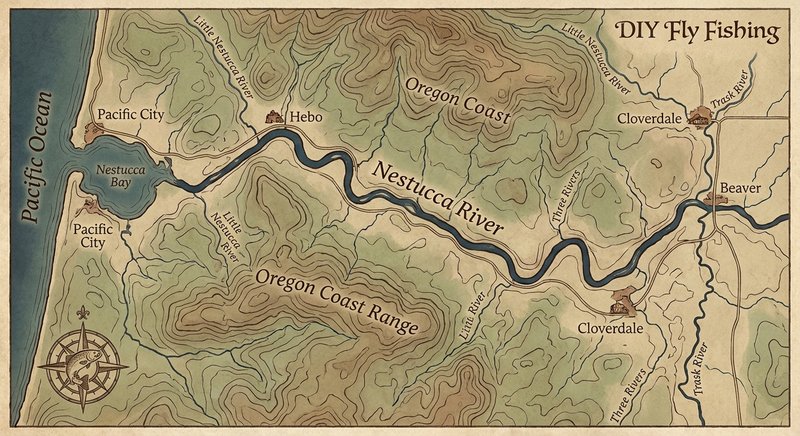
Nestucca River
Fly fishing in Oregon · Intermediate · Best seasons: Fall, Winter
Target Species
Steelhead, Chinook Salmon, Coho Salmon
About This Water
Coastal river with excellent steelhead and salmon. Good fly water in upper sections.
Fishing Recommendations
The Nestucca River is a crown jewel of Oregon’s North Coast. Flowing from the Coast Range and meeting the Pacific at Pacific City, it offers some of the most scenic and productive fly fishing for anadromous salmonids in the Pacific Northwest. Unlike some of its more crowded neighbors, the "Tucca" retains a rugged, intimate feel, characterized by emerald-green water, moss-covered boulders, and classic gravel runs.
🎣 Location Overview
The Nestucca is a medium-sized coastal river that provides a diverse array of water types. The upper river is characterized by tighter canyons and steeper gradients, while the lower river (below the town of Beaver) slows down, meanders through dairy pastures, and opens into wide tide-water reaches.
What makes the Nestucca special is its resiliency. While it is a rain-fed system that can blow out after a heavy storm, it tends to clear faster than the nearby Wilson or Trask rivers. Anglers love it because it offers a "classic" steelheading experience—long, walking-pace glides perfect for swinging a fly, interspersed with technical pocket water for the nymph fisherman.
🐟 Target Species & Behavior
Winter Steelhead
The Nestucca is famous for its large, powerful winter steelhead. These fish are aggressive but temperature-sensitive.
- Behavior: They hold in "walking pace" water, often near the tail-outs of pools or alongside submerged boulders.
- Diet: In freshwater, they don't "feed" traditionally but strike out of aggression or instinct. They are particularly attracted to egg patterns, flashy intruders, and movement.
Chinook Salmon (Fall)
These are the "Kings." The Nestucca sees a strong run of wild and hatchery Fall Chinook.
- Behavior: Chinook are heavy-bodied and prefer deeper "holding" holes and the darker water near the bottom. They are notorious for being stubborn, but they will move for a well-presented large fly in their personal space.
Coho Salmon (Fall)
Coho are the "sporting" salmon of the coast.
- Behavior: They are much more likely to chase a fly than Chinook. They love "froggy" water—slow, deep sloughs or the edges of main current seams. They are highly sensitive to movement and bright colors.
📅 Best Times to Fish
- Fall (September – November): This is the window for Chinook and Coho.
- Chinook: Peak is usually October.
- Coho: Late September through early November. Look for the first "freshet" (significant rainfall) to pull these fish out of the bay and into the river.
- Winter (December – March): This is prime time for Winter Steelhead.
- Early Winter (Dec/Jan): Mostly hatchery-bound fish heading toward the Three Rivers hatchery.
- Late Winter (Feb/March/early April): This is the window for the massive, hard-fighting wild "chrome" steelhead.
- The "Window": The best fishing occurs when the river is dropping and clearing after a rain event. Look for the USGS gauge at Beaver to be between 4.5 and 5.5 feet for optimal fly fishing visibility (3–4 feet of clarity).
🪰 Recommended Flies & Techniques
For Steelhead (Winter)
- Technique: Spey/Swinging. Using a 7 or 8-weight Spey rod with a Skagit head and a T-11 or T-14 sink tip.
- Flies: Blue/Black or Pink/Orange Intruders, Dirty Hoes, or Prom Dress patterns.
- Technique: Nymphing. Using a 9ft 8-wt single-handed rod with an indicator.
- Flies: Soft beads (10mm - 12mm in Mottled Roe or Oregon Cheese), Lifter Brights, or San Juan Worms.
For Chinook (Fall)
- Technique: Deep Swinging or Stripping. You must get the fly down to their eye level.
- Flies: Large, weighted patterns like Comets, Bunny Leeches (Pink/Black), or Clouser Minnows in Chartreuse.
For Coho (Fall)
- Technique: The "Strip-and-Twitch." Use an intermediate sinking line and strip the fly with erratic pauses.
- Flies: Flash Flies, Rolled Muddlers, or Pink Ho-Bos. Coho love flashy, bright pink or chartreuse flies.
💡 Pro Tips & Local Knowledge
- The Three Rivers Factor: The Three Rivers is a major tributary that hosts a hatchery. When the mainstem Nestucca is too high or muddy, the Three Rivers often clears faster. However, it can be very crowded. If you want solitude, stay on the mainstem.
- Focus on the "Shoulders": Most gear anglers fish the "meat" of the hole. As a fly angler, focus on the "shoulders"—the very top where the riffle breaks into the pool, and the very tail where the water accelerates before the next drop. Steelhead often rest here to avoid the pressure of the deep holes.
- The "Nestucca Green": Local guides look for a specific shade of emerald green. If the water looks like "milky jade," it’s go-time. If it’s "tea-colored," it’s too low/clear; go to smaller flies and lighter tippet.
- Cover Water: Steelhead are transient. If you don't get a bump in 20 minutes, move to the next run. Don't fall in love with a beautiful pool that isn't holding fish.
⚠️ Important Information
- Access:
- Bank Access: Excellent along Highway 22 and the Nestucca River Road. Key spots include the Yellow Gate, First Bridge, and the Farmer Creek area.
- Boat Access: Many anglers use drift boats. Common drifts include First Bridge to Cloverdale or Cloverdale to the Big Barn.
- Regulations: Oregon fishing regulations change frequently based on return numbers.
- Check the ODFW "Recreation Report" before you go.
- Barbless Hooks: Generally required for all salmon and steelhead fishing in ODFW Northwest Zone.
- Wild Fish: Wild Steelhead must be released unharmed. Only "Adipose Fin-Clipped" hatchery fish may be retained.
- Safety: The Nestucca has some technical water for rowers (e.g., the "Blossom" area). If you are floating, ensure you have a solid rowing partner. For bank anglers, be wary of "slick-rock" (bedrock); felt soles or studs are highly recommended.
Expert Guide's Parting Words: "The Nestucca is a reward for the patient. Respect the river, watch the weather gauges like a hawk, and when that line goes tight in the middle of a winter drizzle, you'll understand why this river is a legend."
Bug Hatches & Matching Flies
| Hatch | Type | Peak months | Time of day | Hook sizes | Matching flies |
|---|---|---|---|---|---|
| Blue Winged Olive Baetis tricaudatus | mayfly | March, April, October, November | Late Morning/Afternoon | #18-22 | Parachute Adams #18-22, RS2 #20-22, Pheasant Tail #18-20 |
| March Brown Rhithrogena morrisoni | mayfly | March, April | Midday | #12-14 | March Brown Western Deceiver #12-14, Hare's Ear Nymph #12-14, March Brown Wet Fly #12-14 |
| Golden Stonefly Calineuria californica | stonefly | June, July | Morning/Evening | #6-10 | Clark's Stone #8-10, Kaufmann's Stone #6-10, Pat's Rubber Legs #6-10 |
| Little Black Stonefly Capniidae family | stonefly | February, March | Late Morning | #14-18 | Little Black Sloan #16-18, Zebra Midge #16-18, Prince Nymph #14-16 |
| Grannom Caddis Brachycentrus occidentalis | caddis | April, May | Afternoon/Evening | #14-16 | Peacock Caddis #14-16, Deep Sparkle Pupa #14-16, Elk Hair Caddis #14-16 |
| Pale Morning Dun Ephemerella excrucians | mayfly | June, July, August | Morning/Early Afternoon | #16-18 | PMD Sparkle Dun #16-18, Parachute PMD #16-18, Split Case PMD #16-18 |
| October Caddis Dicosmoecus gilvipes | caddis | September, October | Afternoon/Evening | #8-12 | Orange Stimulator #8-12, October Caddis Pupa #8-10, Morrish October Caddis #10-12 |
| Spotted Sedge Hydropsyche | caddis | July, August, September | Evening | #14-18 | Elk Hair Caddis (Tan) #14-18, LaFontaine Sparkle Pupa #14-16, Hydropsyche Larva #14-16 |