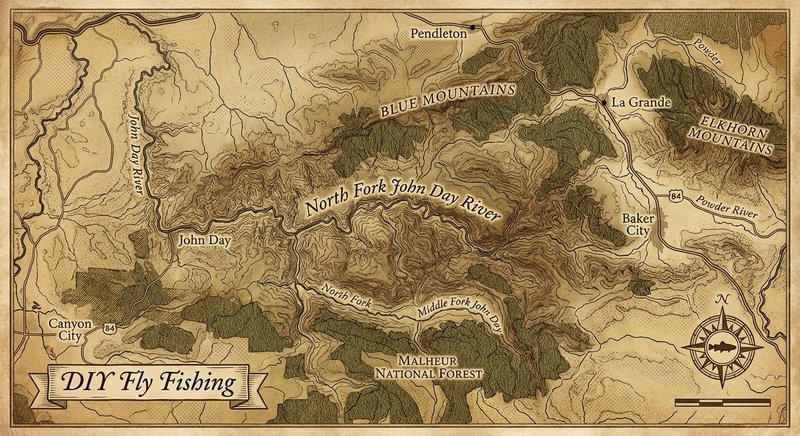
North Fork John Day
Fly fishing in Oregon · Advanced · Best seasons: Fall, Spring
Target Species
Steelhead, Rainbow Trout
About This Water
Wild steelhead and rainbow trout in wilderness setting. Excellent fall fishing.
Fishing Recommendations
The North Fork of the John Day River is one of Oregon’s most pristine and rugged fly fishing destinations. As a "Wild and Scenic" river, it offers a true wilderness experience, flowing through basalt canyons and ancient forests. Unlike the main stem of the John Day, which is famous for Smallmouth Bass, the North Fork is a cold-water sanctuary for native Salmonids.
Here is your comprehensive guide to fly fishing the North Fork John Day.
🎣 Location Overview
The North Fork John Day is the "crown jewel" of the John Day system. It begins in the Blue Mountains and flows west to join the main stem at Kimberly. What makes it special is its undammed, wild character. Because there are no dams, the river's flow is entirely dependent on snowpack and rainfall, creating a dynamic and ever-changing fishery.
The water is characterized by classic "freestone" features: bouldery pocket water, long glassy tailouts, and deep emerald pools. It is significantly colder than the main John Day, making it the primary spawning ground for the basin’s wild summer steelhead and a haven for native Redband trout.
🐟 Target Species & Behavior
Summer Steelhead (A-Run)
- Behavior: These are "A-run" fish, typically ranging from 4 to 8 pounds. They enter the Columbia River in the summer but don't reach the North Fork until late fall. They are known for being aggressive and will often rise to a swung fly.
- Holding Water: Look for "walking pace" water—transitions between riffles and deep pools, and the soft edges of main currents. In the spring, they move toward gravel bars for spawning.
Native Redband Trout (Rainbows)
- Behavior: These are hardy, opportunistic feeders. They are incredibly strong for their size and exhibit brilliant crimson coloration.
- Feeding: They focus heavily on aquatic insects (Stoneflies, Mayflies) but will enthusiastically smash terrestrial patterns (Hoppers) in the late summer and fall.
📅 Best Times to Fish
The Fall Window (September – November)
- Target: Primarily Trout, with the first Steelhead arriving in late October.
- Conditions: Low, clear water. This is "technical" fishing time.
- Time of Day: Mid-day when the water warms slightly and insect activity peaks.
The Spring Window (March – early May)
- Target: Steelhead (Prime Time).
- Conditions: The "sweet spot" occurs after the winter freeze thaws but before the major spring runoff (snowmelt) "blows out" the river.
- Time of Day: Early morning and late evening.
🪰 Recommended Flies & Techniques
Steelhead Techniques
- The Swing: This is a classic Spey or switch rod river. Swinging traditional hair-wing flies or modern Intruders is the preferred method.
- Flies:
- Traditional: Green Butt Skunk, Blue Heron, Max Canyon.
- Modern: Hobo Spey (Black/Blue or Pink/Orange), Egg Leach patterns.
- Surface: In the early fall, try a Steelhead Caddis or a Bomber on a riffling hitch for explosive surface takes.
Trout Techniques
- Nymphing: The most consistent way to catch Redbands. Use a "Hopper-Dropper" rig in the fall.
- Flies: Pat’s Rubber Legs (Size 6-10), Prince Nymphs, Flashback Pheasant Tails.
- Dry Fly:
- Flies: Chubby Chernobyls, Stimulators, and Elk Hair Caddis. During spring, look for March Brown hatches.
💡 Pro Tips & Local Knowledge
- Focus on the "Wilderness Area": The section from Dale down toward Monument offers the best combination of access and high-quality water. For those willing to hike, the North Fork John Day Wilderness section (upstream of Dale) offers incredible solitude for trout.
- The "Monument" Gauge: Before you leave, check the USGS gauge at Monument. For steelhead, you want to see the river stable or dropping. If it’s spiking due to rain or rapid snowmelt, the visibility will drop to zero.
- Stealth is Key: Because the water is often crystal clear, these fish are "spooky." Avoid wading deep if you don't have to. Cast from the bank first to cover the "near" water before venturing in.
- The "Big Stone" Rule: This river is loaded with Golden Stoneflies. If you aren't sure what to tie on, a large, heavy stonefly nymph drifted through deep pockets rarely fails.
⚠️ Important Information
Access & Navigation
- Highway 395: Provides access near the town of Dale.
- NF Road 55: Parallels parts of the upper river, providing numerous pull-outs and campgrounds.
- Rugged Terrain: Cell service is non-existent in the canyons. Carry a satellite communicator (like a Garmin inReach) and a full-sized spare tire.
Regulations & Safety
- Barbless Hooks: Mandatory for all steelhead fishing in Oregon.
- Wild Fish: The John Day is one of the few rivers where all steelhead are wild. There is no hatchery program. Catch and release is mandatory for all steelhead; they must not be removed from the water.
- Check ODFW: Always check the Oregon Department of Fish and Wildlife (ODFW) recreation report before heading out, as emergency closures due to water temperature or low fish counts can occur.
- Rattlesnakes: In the lower sections (near Monument/Kimberly), rattlesnakes are common from spring through fall. Watch your step on the rocky banks.
Bug Hatches & Matching Flies
| Hatch | Type | Peak months | Time of day | Hook sizes | Matching flies |
|---|---|---|---|---|---|
| Salmonfly Pteronarcys californica | stonefly | May, June | All day | #4-8 | Chubby Chernobyl (Orange) #6-8, Pats Rubber Legs #4-8, Rogue River Stone #4-6 |
| Golden Stonefly Hesperoperla pacifica | stonefly | June, July | Morning/Evening | #8-12 | Golden Chubby #8-12, 20 Incher Stone #8-12, Norm Wood Special #8-10 |
| Blue Winged Olive Baetis | mayfly | April, May, September, October | Afternoon | #18-22 | Parachute Adams #18-22, RS2 #20-22, Pheasant Tail #18-20 |
| Pale Morning Dun Ephemerella | mayfly | June, July, August | Late Morning/Afternoon | #14-18 | PMD Sparkle Dun #16-18, Split Case PMD #16-18, Quigley Cripple #14-16 |
| Spotted Sedge Hydropsyche | caddis | June, July, August | Evening | #14-16 | Elk Hair Caddis (Tan) #14-16, Holy Grail Caddis #14-16, Pupa-tator #14-16 |
| Little Yellow Stonefly Isoperla | stonefly | July, August | Evening | #14-16 | Yellow Sally Dry #14-16, Iron Lotus #16, Stimulator (Yellow) #14-16 |
| Grasshoppers Acrididae | terrestrial | July, August, September | Late Afternoon | #8-12 | Morrish Hopper #8-12, Dave's Hopper #10-12, Rainy's Grand Hopper #8-10 |
| October Caddis Dicosmoecus | caddis | September, October | Afternoon/Evening | #8-12 | Orange Stimulator #8-10, October Caddis Pupa #8-12, Pecker Head Caddis #10-12 |