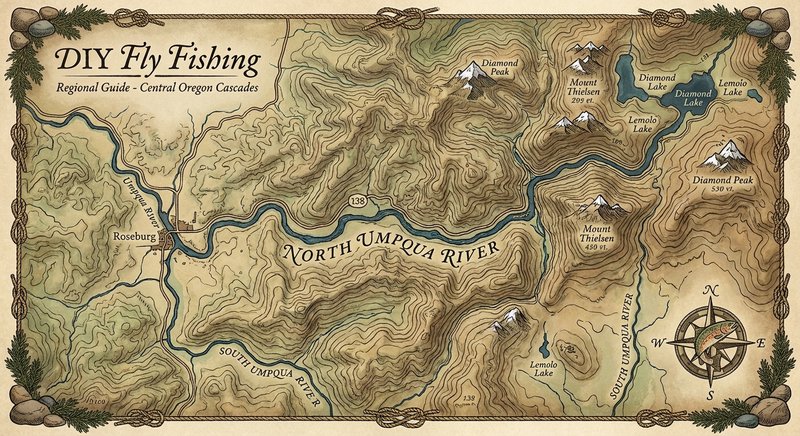
North Umpqua River
Fly fishing in Oregon · Advanced · Best seasons: Summer, Fall
Target Species
Steelhead, Rainbow Trout
About This Water
Premier summer steelhead destination with fly-only water. Beautiful canyon scenery.
Fishing Recommendations
Welcome to the "Graduate School of Fly Fishing." The North Umpqua is a legendary emerald ribbon of water cutting through the basalt canyons of the Cascade Mountains. It is widely considered one of the most beautiful—and challenging—summer steelhead rivers in the world.
As your guide, here is the breakdown of how to approach this hallowed water.
🎣 Location Overview
The North Umpqua is famous for its "Fly Fishing Only" water, a 31-mile stretch extending from Rock Creek upstream to Soda Springs Dam. This section is iconic because of its volcanic geology; the riverbed is comprised of jagged basalt ledges, deep cracks, and slippery chutes that create perfect "buckets" for fish to hold in.
The water is remarkably clear and remains cold even in the heat of summer, thanks to its spring-fed headwaters. Anglers love it for its history (it was a favorite of Zane Grey) and the fact that it is one of the few places on earth where you can consistently raise summer steelhead to a surface-waking fly.
🐟 Target Species & Behavior
Summer Steelhead
The North Umpqua Summer Steelhead are the primary draw. They begin entering the river in May, with numbers peaking in July and August, and remaining through October.
- Behavior: Unlike winter fish, these are aggressive and active. They will move a long way to grab a fly.
- Holding: Look for "tail-outs" (the smooth water at the end of a pool), the edges of deep basalt ledges, and "pocket water" behind large boulders.
Rainbow Trout
While the steelhead get the glory, the river holds a healthy population of wild resident rainbows (often called "McCloud River" strain).
- Behavior: They occupy the swifter pocket water and the seams on the edges of the main current.
- Feeding: They are opportunistic feeders, focusing on caddis, stoneflies, and terrestrial insects falling from the overhanging canopy.
📅 Best Times to Fish
Optimal Seasons
- Summer (July – August): Peak numbers of fish. This is the time for "skating" dry flies.
- Fall (September – November): My personal favorite. The crowds thin out, the maples turn gold, and the fish become aggressive again as water temperatures drop.
Best Times of Day
- First Light & Last Light: On the North Umpqua, "shadow is your friend." Steelhead are notoriously "light-shy." Once the sun hits the water, the bite often shuts down.
- The "Shadow Line": Fish the side of the river that remains in the shade the longest.
🪰 Recommended Flies & Techniques
The "Swing" (Traditional Steelhead)
The North Umpqua is a temple of the "down and across" swing. Use a 7-weight Spey rod or a 9ft 8-weight single-handed rod.
- Wet Flies: Green Butt Skunk, Max Canyon, Blue Heron, and the Signal Light.
- Surface/Waking Flies: The Muddy Buddy or a Bomber. Use a "hitch" to make the fly skate across the surface, creating a "V" wake. There is nothing in fly fishing like seeing a 10lb steelhead explode on a skating dry.
Trout Techniques
- Dry Flies: Stimulators (Size 8-12), Elk Hair Caddis, and Parachute Adams.
- Nymphing: While you cannot use added weight (split shot) in the fly-only water, you can use weighted flies like a gold-ribbed Hare’s Ear or a Copper John.
💡 Pro Tips & Local Knowledge
- The "Umpqua Shuffle": The basalt is incredibly slippery. Cleats or aluminum bars on your wading boots are mandatory. Do not attempt to wade this river in plain rubber soles.
- The Rotation: This is a social river. If someone is fishing a pool, wait your turn. Start upstream of them, and move a few steps down between every cast. This "rotates" the pool so everyone gets a shot at the fish.
- Shorten Your Cast: Many beginners try to cast across the whole river. Most steelhead on the Umpqua are holding in the "near-side" buckets, often only 15–20 feet from the bank.
- Steamboat Inn: This is the spiritual hub of the river. Stop in for a meal or to check the "Fish Board" to see recent counts and conditions.
⚠️ Important Information
Access
- Highway 138 runs parallel to the river, providing excellent access. Look for the marked "Angler Trails." Be prepared for steep, strenuous hikes down to the water.
Regulations & Permits
- Fly Fishing Only Section: From Rock Creek to Soda Springs, you may only use fly fishing gear. No added weights or strike indicators are allowed. You must use a fly line as your casting weight.
- Barbless Hooks: All fishing must be done with single barbless hooks.
- Wild Fish: The North Umpqua is a "catch and release" fishery for all wild (unclipped) steelhead. Keep them in the water at all times.
Safety
- Wading Staff: Bring one. The "ledgy" bottom can drop from 2 feet to 10 feet in a single step.
- Fire Season: In late summer and fall, be aware of forest fire closures. Check the U.S. Forest Service website before heading out.
Tight lines, and remember: The North Umpqua doesn't give up its secrets easily, but the reward is worth the effort.
Bug Hatches & Matching Flies
| Hatch | Type | Peak months | Time of day | Hook sizes | Matching flies |
|---|---|---|---|---|---|
| Salmonfly Pteronarcys californica | stonefly | May, June | All Day | #4-8 | Chubby Chernobyl #6-8, Pat's Rubber Leg Stone #4-8, Clark's Stone #6-10 |
| Golden Stonefly Hesperoperla pacifica | stonefly | June, July | Morning/Evening | #8-12 | Norm Wood Special #8-10, Jimmy Legs #8-12, Golden Rogue Stone #10-12 |
| October Caddis Dicosmoecus gilvipes | caddis | September, October, November | Afternoon/Evening | #8-12 | Orange Stimulator #8-12, Morrish October Caddis #10, Peeking Caddis #10-12 |
| March Brown Rhithrogena morrisoni | mayfly | March, April | Afternoon | #12-14 | March Brown Western Deceiver #12-14, Gold Ribbed Hare's Ear #12-14, March Brown Wet #12-14 |
| Pale Morning Dun (PMD) Ephemerella | mayfly | June, July, August | Late Morning/Early Afternoon | #14-18 | Sparkle Dun #16-18, Pheasant Tail #14-18, PMD Quigley Cripple #16 |
| Green Sedge Rhyacophila | caddis | May, June, July | Evening | #12-16 | Green Weenie #12-16, Elk Hair Caddis (Green) #14-16, LaFontaine's Deep Sparkle Pupa #14-16 |
| Blue Winged Olive (BWO) Baetis | mayfly | March, April, October, November | Mid-day | #18-22 | Parachute Adams #18-22, RS2 #20-22, Baetis Nymph #18-20 |
| Yellow Sally Isoperla | stonefly | June, July | Afternoon/Evening | #14-16 | Yellow Sally Stone #14-16, Little Yellow Sloan #14-16, Yellow Stimulator #14-16 |