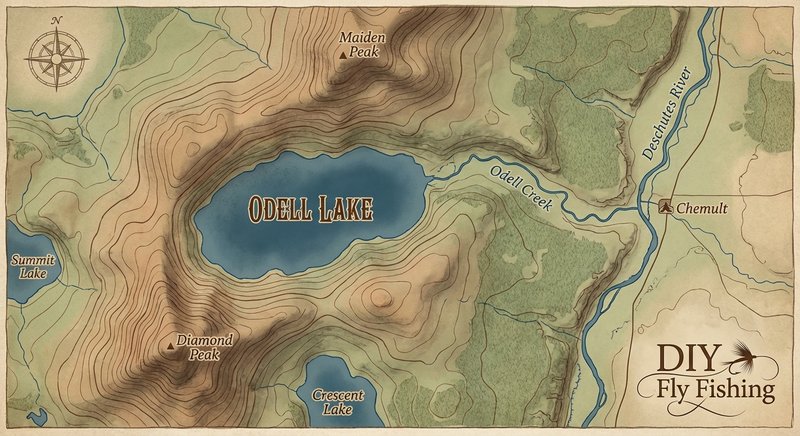
Odell Lake
Fly fishing in Oregon · Intermediate · Best seasons: Spring, Summer, Fall
Target Species
Lake Trout, Kokanee Salmon, Rainbow Trout
About This Water
Deep Cascade lake with lake trout and kokanee. Trolling and jigging popular.
Fishing Recommendations
Greetings, fellow angler. You’ve set your sights on one of the crown jewels of the Oregon Cascades. Odell Lake is a high-elevation (4,788 ft) volcanic gem known for its deep, cold waters and its reputation for producing some of the largest Lake Trout in the lower 48.
While Odell is often dominated by gear anglers in powerboats, the fly fisher who understands depth and timing can find world-class success here. Here is your guide to mastering these waters.
🎣 Location Overview
Odell Lake is a massive, deep bowl carved by glaciers and volcanic activity, reaching depths of over 280 feet. It is approximately 6 miles long and 1.5 miles wide. What makes it special is its nutrient-rich, oxygenated water that supports a massive biomass of Kokanee Salmon, which in turn serves as the primary protein source for trophy Lake Trout (Mackinaw).
The water is incredibly clear, often appearing deep cobalt blue. It is a "big water" experience—the wind (the "Odell Breeze") can kick up whitecaps by noon, so timing and boat safety are paramount. Anglers love it for the sheer size of the fish and the breathtaking backdrop of Diamond Peak.
🐟 Target Species & Behavior
Lake Trout (Mackinaw)
These are the apex predators. They are light-sensitive and prefer water temperatures between 40°F and 52°F.
- Behavior: They follow the Kokanee. In the spring, they can be found in the shallows (20–40 feet). As the lake warms, they drop to 60–150 feet.
- Feeding: Primarily piscivorous. They want big meals—Kokanee or smaller Whitefish.
Kokanee Salmon
Landlocked Sockeye that travel in massive schools.
- Behavior: They are filter feeders (zooplankton) but are highly aggressive and territorial. They move up and down the water column based on light and temperature.
- Fly Fishing Note: Catching these on a fly requires finding the school on electronics and using a vertical "jigging" fly presentation or a deep-sink line.
Rainbow Trout
Though less famous than the Mackinaw, the rainbows here are healthy and hard-fighting.
- Behavior: They frequent the shoreline, weed beds, and the areas around the creek mouths (Trapper Creek). They are more opportunistic, feeding on insects and small minnows.
📅 Best Times to Fish
Spring (Ice-out through June) — The Fly Fisher's Prime Time
This is the only time the Lake Trout are consistently in "fly rod range." As the ice thaws, Mackinaw move into the shallows (10–30 feet) to feed.
Summer (July - August)
Excellent for Kokanee, but you’ll need heavy sinking lines (Type 6 or 7). For Rainbows, the evening "caddis hatch" near the shorelines can be productive.
Fall (September - October)
The Kokanee begin to turn red and stage near Trapper Creek for their spawning run. Lake Trout follow them to feast. This is your best chance at a trophy fish on a streamer.
- Best Time of Day: First light until 10:00 AM. Once the sun hits the water, the fish go deep, and the wind usually picks up.
🪰 Recommended Flies & Techniques
For Lake Trout (Streamer Stripping/Dredging)
You need an 8-weight or 9-weight rod with a fast-sinking integrated thin line (350–500 grains).
- Flies: Massive articulated streamers (6–9 inches).
- Patterns: Game Changers (White/Silver), Sex Dungeon (White), or any Kokanee-imitation (Silver/Blue/Olive).
- Technique: "Dredging." Cast toward drop-offs, let the line sink to the bottom, and use a heavy "strip-strip-pause" retrieve.
For Kokanee (Vertical Fly Jigging)
- Flies: Small, flashy streamers or "Comets."
- Patterns: Pink/Orange Glo-Bugs, Serendipities, or small weighted "Epoxy Minnows" in fluorescent pink or orange.
- Technique: Locate a school on your fish finder. Drop your fly vertically into the school. Use a "twitch" motion rather than a traditional strip.
For Rainbows (Indicator or Dry Fly)
- Flies:
- Dries: Balanced Leeches under an indicator, or Elk Hair Caddis (#12-14) during the evening.
- Nymphs: Zebra Midges (#16-18), Prince Nymphs.
- Technique: Focus on the "west end" near the logs and the mouth of Trapper Creek.
💡 Pro Tips & Local Knowledge
- The "West End" Secret: The west end of the lake (near Shelter Cove) is shallower and features more structure. This is the best area for fly anglers to target Rainbows and Spring Mackinaw without needing 300 feet of line.
- Watch the "Odell Breeze": The wind almost always blows from West to East. If you are in a small boat or float tube, start your morning at the West end. If the wind kicks up, it will push you toward the ramps at the East end/Lodge rather than stranding you in the middle.
- The Kokanee "Wall": Look for the "wall" of fish on your sonar. Kokanee often stack up at specific thermoclines. If you find the Kokanee, the Mackinaw are usually sitting 10 feet below them waiting for scraps.
- Structure is Key: Focus on the steep drop-offs near Princess Creek and the rock slides on the south shore.
⚠️ Important Information
- Access:
- Odell Lake Lodge & Resort (East end): Full Marina and rentals.
- Shelter Cove Resort (West end): Great for fly anglers, closer to the creek mouths.
- Public Ramps: Princess Creek and Sunset Cove.
- Regulations:
- Check the current ODFW (Oregon Department of Fish and Wildlife) Central Zone regulations.
- Note: There are specific bag limits for Kokanee and Lake Trout. No limit on Mackinaw in some years to protect the Kokanee, but always verify.
- Safety: The water is cold enough to cause hypothermia in minutes, even in July. Always wear a PFD. If you are in a float tube, stay close to the shoreline.
- Permits: An Oregon Angling License is required. If you are launching a boat over 10 feet, you need an Oregon Aquatic Invasive Species permit.
Guide’s Final Thought: If you want the fish of a lifetime on a fly rod, come in May. Target the points with a white Game Changer on a 400-grain sink tip. Hold on tight—Odell Mackinaw hit like freight trains.
Tight lines!
Bug Hatches & Matching Flies
| Hatch | Type | Peak months | Time of day | Hook sizes | Matching flies |
|---|---|---|---|---|---|
| Callibaetis (Speckled Duns) Callibaetis ferrugineus | mayfly | June, July, August, September | Late Morning/Afternoon | #12-16 | Parachute Adams #14-16, Callibaetis Nymph #12-14, Quigley Cripple #14-16 |
| Chironomids (Midges) Chironomidae | midge | May, June, September | All Day | #10-22 | Chironobone #12-16, Zebra Midge #16-20, Griffith's Gnat #18-22 |
| Traveling Sedge (Great Blue Sedge) Hesperophylax | caddis | July, August | Late Evening/Twilight | #8-12 | Mikulak Sedge #8-10, Goddard Caddis #10-12, Cased Caddis Nymph #8-12 |
| Blue Damselfly Enallagma | terrestrial | June, July | Late Morning/Afternoon | #10-14 | Braided Butt Damsel #10-12, Marabou Damsel Nymph #12-14, Sheep Creek Special #10-12 |
| Scuds (Freshwater Shrimp) Gammarus | terrestrial | May, June, October | All Day | #12-16 | Ray Charles #14-16, Flashback Scud #12-16 |
| Carpenter Ants Camponotus | terrestrial | July, August | Afternoon | #10-14 | Black Foam Ant #12-14, Chernobyl Ant #10-12 |
| Spotted Sedge Hydropsyche | caddis | June, July, August | Evening | #14-18 | Elk Hair Caddis #14-16, LaFontaine's Deep Sparkle Pupa #14-18 |
| Water Fleas (Daphnia) Daphnia pulex | terrestrial | August, September | All Day | #18-22 | Orange Blobs #12-14, Pink Micro-Jig #18-20 |