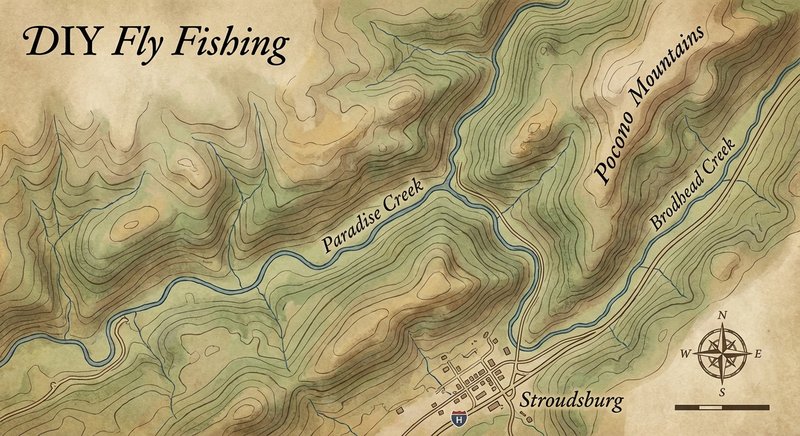
Paradise Creek
Fly fishing in Pennsylvania · Beginner · Best seasons: Spring, Summer, Fall
Target Species
Brown Trout, Brook Trout
About This Water
Monroe County freestone with wild brown and brook trout. Good hatches in spring.
Fishing Recommendations
Paradise Creek, located in the heart of the Pocono Mountains in Monroe County, is hallowed ground. As a guide, I consider this "The Cradle of American Fly Fishing." It is the stream where legends like Theodore Gordon and George LaBranche honed their skills, and it remains one of the most technical and rewarding waters in the Keystone State.
🎣 Location Overview
Paradise Creek is a medium-sized limestone-influenced freestone stream. It flows through lush rhododendron tunnels and over ancient glacial boulders before eventually joining the Brodhead Creek.
What makes Paradise special is its nutrient-rich water. Because of the limestone influence, it stays cooler and more fertile than a standard mountain freestone stream, allowing for incredible insect biomass. The water is crystalline, often glassy in the pools, requiring the utmost stealth. It is a "technical" fishery—it doesn't give up its secrets easily, but for the angler who appreciates history and finesse, it is unmatched.
🐟 Target Species & Behavior
- Wild Brown Trout: The king of Paradise Creek. These fish are descendants of some of the first brown trout stocked in America. They are incredibly wary, highly selective during hatches, and tend to hold in deep undercut banks or under "the sweep" of rhododendron branches.
- Wild Brook Trout: Found primarily in the upper reaches and the colder, tumbling headwaters. They are vibrant, aggressive, and prefer the highly oxygenated pocket water.
- Behavior: During the day, larger browns stay tucked under cover. They move into the tailouts of pools and the "bubble lines" of riffles only when a hatch is heavy or during low-light conditions.
📅 Best Times to Fish
- Spring (Mid-April – June): This is the prime window. The Hendrickson hatch in late April starts the season, followed by the legendary Sulfur hatches in May and June.
- Summer (July – August): Focus on early mornings and late evenings. The creek can get low and clear; this is "Terrestrial Season." Look for fish under overhanging trees waiting for ants or beetles. Note: Monitor water temperatures; if it hits 70°F, stop fishing to protect the trout.
- Fall (September – October): A magical time. The Brookies are in their spawning colors, and the Browns become aggressive as they prepare for the spawn. Blue Winged Olives (BWO) are the staple hatch here on overcast autumn days.
🪰 Recommended Flies & Techniques
Top Fly Patterns
- The Henryville Special: A must-have. Created specifically for this area, it’s a caddis imitation that still kills today. (Sizes 14–18).
- Sulfur Parachute: For the prolific May/June evening hatches. (Sizes 16–20).
- Pheasant Tail Nymph: The gold standard for the "searching" phase. (Sizes 16–22).
- Black/Cinnamon Ants: Essential for summer stealth fishing.
- Zebra Midge: Effective in the winter and early spring under a small indicator.
Techniques
- Dry Fly Finesse: Use long leaders (9–12 feet) tapering down to 6X or 7X tippet. A "reach cast" is essential to prevent drag in the complex currents.
- European Nymphing: In the riffles and faster pockets, tight-line nymphing with small, unweighted or lightly weighted flies is deadly.
- The "Dap": In tight rhododendron tunnels, you may not be able to cast. Dropping a fly vertically (dapping) over a high bank is often the only way to reach the biggest fish.
💡 Pro Tips & Local Knowledge
- The "Glass" Rule: If you are fishing a flat, glassy pool, stay back at least 15 feet from the bank. If you can see the fish clearly, they have already seen you.
- Follow the Bubbles: Look for the foam lines (the "conveyor belt" of food). Even if you don't see a rise, a well-placed nymph in the foam line will often produce a strike.
- The Henryville House Stretch: While much of the history is tied to the old Henryville House, focus on the public stretches near the Brodhead Creek Heritage Center and the Paradise-Price Preserve.
- Stay Low: I often tell my clients to fish from their knees on Paradise Creek. Reducing your profile against the sky is more important than the fly pattern you choose.
⚠️ Important Information
- Access: Much of Paradise Creek is private and owned by historic fishing clubs (like the Henryville Fly Fishers). Respect "Posted" signs. Public access is available at the Paradise-Price Preserve and via Pennsylvania Fish & Boat Commission (PFBC) easements.
- Regulations: Large sections are managed as "Class A Wild Trout" waters. While some areas allow harvest, most dedicated fly anglers practice 100% Catch and Release here to preserve the wild genetics.
- Wading: The rocks are incredibly slippery (typical of PA limestone/freestone mixes). Studded felt boots and a wading staff are highly recommended.
- License: A valid Pennsylvania Fishing License and a Trout Permit are required for all anglers 16 and older.
Fishing Paradise Creek is a journey through fly fishing history. Approach it with patience, light tippets, and a quiet footstep, and you’ll understand why this stream is legendary.
Bug Hatches & Matching Flies
| Hatch | Type | Peak months | Time of day | Hook sizes | Matching flies |
|---|---|---|---|---|---|
| Blue-Winged Olive Baetis | mayfly | April, October, November | Mid-day | #18-22 | RS2 #20-22, BWO Sparkle Dun #18-20 |
| Hendrickson Ephemerella subvaria | mayfly | April, May | Afternoon | #12-14 | Hendrickson Dark #12-14, Pheasant Tail Nymph #12-14 |
| Grannom Caddis Brachycentrus | caddis | April, May | Morning/Afternoon | #14-16 | Grannom Pupa #14-16, Elk Hair Caddis (Olive) #14-16 |
| March Brown Maccaffertium vicarium | mayfly | May | Afternoon | #10-12 | March Brown American #10-12, Hare's Ear Nymph #10-12 |
| Sulphur Ephemerella invaria/dorothea | mayfly | May, June | Evening | #14-18 | Sulphur Parachute #14-18, Sulphur Emerger #16-18 |
| Light Cahill Stenacron interpunctatum | mayfly | June, July | Evening | #12-14 | Light Cahill #12-14, Gold Ribbed Hare's Ear #14 |
| Slate Drake Isonychia bicolor | mayfly | June, September | Afternoon/Evening | #10-12 | Isonychia Parachute #10-12, Zug Bug #10-12 |
| Trico Tricorythodes | mayfly | July, August, September | Morning | #22-26 | Trico Spinner #22-24, Griffith's Gnat #22-24 |
| Terrestrials Formicidae/Coleoptera | terrestrial | July, August, September | All Day | #12-18 | Black Foam Ant #16-18, Crowe Beetle #14-16 |