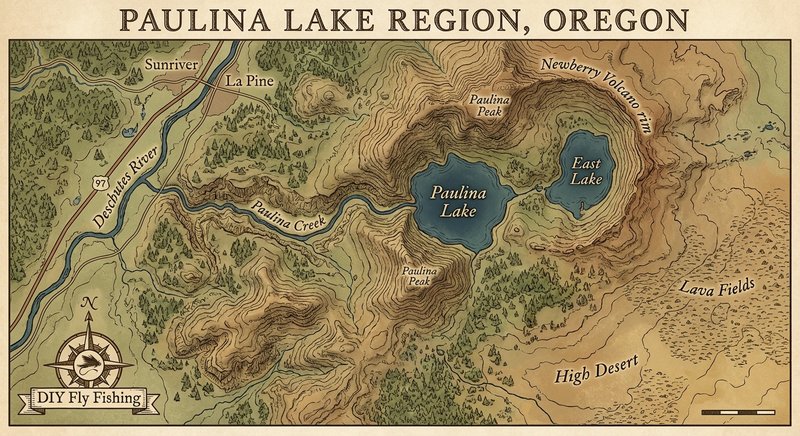
Paulina Lake
Fly fishing in Oregon · Beginner · Best seasons: Spring, Summer, Fall
Target Species
Brown Trout, Rainbow Trout, Kokanee Salmon
About This Water
Sister lake to East Lake in Newberry Crater. Excellent kokanee and brown trout.
Fishing Recommendations
Welcome to one of the crown jewels of Central Oregon. As your guide, I can tell you that Paulina Lake is not just a fishing destination; it is a prehistoric, volcanic experience. Situated at 6,331 feet within the Newberry National Volcanic Monument, this lake sits inside the caldera of an ancient volcano.
Here is your comprehensive guide to fly fishing Paulina Lake.
🎣 Location Overview
Paulina Lake is a high-altitude, nutrient-rich alkaline lake. Unlike many deep mountain lakes that are sterile, the volcanic minerals here create a massive biomass, leading to legendary growth rates for fish.
What makes it special is the water clarity and the structure. You’ll find dramatic drop-offs where the bottom falls from 5 feet to 50 feet in a matter of yards, vast obsidian flow banks, and sunken logs. Because the water is gin-clear, it offers some of the best sight-fishing opportunities in the Pacific Northwest, but it also demands stealth and refined technique.
🐟 Target Species & Behavior
Brown Trout
Paulina is famous for its trophy Browns. These aren't your average trout; they are apex predators.
- Behavior: They are wary and light-sensitive. During the day, big Browns often retreat to the deep shadows of the drop-offs. They move into the shallows to hunt during low-light periods (dawn, dusk, or overcast days).
- Feeding: They focus on crawfish, smaller Tui Chub, and Kokanee.
Rainbow Trout
Mainly stocked but they hold over well and become "wild" in their behavior quickly.
- Behavior: Usually found cruising the weed beds and "flats" looking for insect hatches. They are much more likely to rise to a dry fly than the Browns.
Kokanee Salmon
Landlocked Sockeye that provide a unique fly fishing challenge.
- Behavior: They travel in large schools and are plankton feeders. While most people troll for them with gear, fly anglers can target them using high-density sink tips and small, flashy "comet" style flies or nymphs when they are suspended at 15–30 feet.
📅 Best Times to Fish
Optimal Seasons
- Late Spring (Late May – June): This is "Ice-Out" season. As the ice recedes, the fish are hungry and patrol the shallows. This is your best chance at a double-digit Brown Trout.
- Summer (July – August): Prime time for hatches. The Callibaetis and Damselfly hatches are world-class during these months.
- Fall (September – October): The Browns become aggressive as they prepare for their late-fall spawn. The crowds thin out, and the "Big Dogs" come out to play.
Best Times of Day
- The Golden Hour: For trophy Browns, the hour before sunrise and the hour after sunset are critical.
- Mid-Day: Excellent for sight-fishing with dry flies during a hatch, provided there is a slight "Chop" on the water to hide your profile.
🪰 Recommended Flies & Techniques
The "Paulina Special" Selection
- Dry Flies: Parachute Adams (#14-18), Callibaetis Cripples (#14-16), Foam Ants and Beetles (August), and Adult Damselflies (Blue).
- Nymphs/Emergers: Balanced Leeches (Black/Red or Olive), Pheasant Tails (#16-18), and Zebra Midges.
- Streamers: Sculpzilla (Olive/Black), Peanut Envy, and Bunny Leech patterns. Crawfish imitations are a must for big Browns.
Techniques
- The "Drop-Off" Strip: Using a Type 3 or Type 5 sinking line, cast a streamer from the shallow shelf out into the deep blue water. Let it sink, then strip it back up the "wall" of the drop-off.
- Indicator Nymphing: Set your indicator to 12–15 feet. Hang a Balanced Leech or a Chironomid near the weed edges. This is deadly for Rainbows.
- The Dry-Dropper: During the Callibaetis hatch, use a high-vis dry fly with a small unweighted nymph tied 2 feet behind it.
💡 Pro Tips & Local Knowledge
- Watch the Wind: The "Paulina Chop" is your friend. If the water is glass-calm, the fish will see your leader and your boat. A light ripple on the surface breaks up the light and makes the fish much bolder.
- The Obsidian Flow: Focus on the "Big Obsidian Flow" on the south side of the lake. The underwater rocks there create complex thermal pockets and excellent cover for large fish.
- Stealth Matters: Because the water is so clear, long leaders (12–15 feet) and fluorocarbon tippet (4X or 5X) are essential when nymphing or dry-fly fishing.
- The "Log" Trick: Many of the "logs" you see in 10 feet of water are actually massive Brown Trout. If you see a shadow that looks too big to be a fish, treat it like a fish anyway. Cast well in front of it and strip a streamer past its nose.
⚠️ Important Information
Access
- Boats are best: While there is some shore access near the campgrounds and the lodge, a boat (or float tube/pontoon) is highly recommended to reach the best drop-offs.
- Launch: There are public boat ramps at Paulina Lake Campground and near the Lodge.
Regulations
- Check the ODFW Regulations: Rules can change regarding limits on Brown Trout. Often, there is a "One over 20 inches" rule to protect the trophy genetics.
- Permits: You will need an Oregon Angling License. If you are parking within the National Monument, you will need a Northwest Forest Pass or a day-use permit.
Special Considerations
- Weather: At 6,300 feet, weather changes in minutes. Even in July, a snow squall or a violent thunderstorm can roll over the caldera rim. Bring layers.
- Pace: This is "hunting" more than "fishing." You may go hours without a strike, but when it happens at Paulina, it’s often the fish of a lifetime.
Tight lines, and watch that backcast near the obsidian!
Bug Hatches & Matching Flies
| Hatch | Type | Peak months | Time of day | Hook sizes | Matching flies |
|---|---|---|---|---|---|
| Chironomids Chironomidae | midge | May, June, September | All Day | #10-22 | Chanter's Chironomid #12-16, Ice Bud #14-18, Griffith's Gnat #18-22 |
| Callibaetis (Speckled Duns) Callibaetis ferrugineus | mayfly | June, July, August | Late Morning/Afternoon | #12-16 | Callibaetis Spinner #14-16, Pheasant Tail Nymph #14-16, Quigley Cripple #14-16 |
| Damselfly Enallagma | other | June, July | Morning/Afternoon | #10-12 | Marabou Damsel Nymph #10-12, Adult Damsel #10-12 |
| Traveling Sedge Hesperophylax | caddis | July, August | Evening | #8-12 | Mikulak Sedge #8-10, Goddard Caddis #10-12 |
| Scuds Gammarus | other | April, May, October | All Day | #12-16 | Olive Scud #12-16, Ray Charles #14-16 |
| Terrestrial Beetles/Ants Coleoptera/Formicidae | terrestrial | August, September | Afternoon | #12-18 | Black Foam Beetle #14-16, Cinnamon Ant #16-18 |
| Water Boatmen Corixidae | other | September, October | Afternoon | #14-16 | Boatman Pattern #14-16, Prince Nymph (Small) #16 |
| Cinnamon Caddis Limnephilidae | caddis | August, September | Evening | #14-18 | Elk Hair Caddis (Cinnamon) #14-16, Pupa #16 |