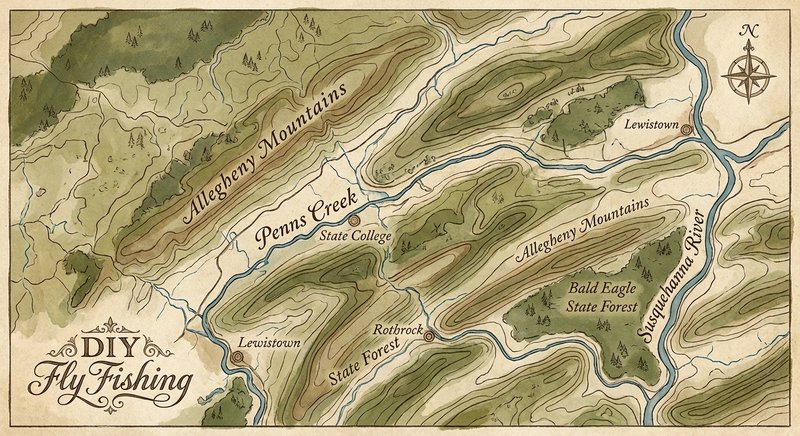
Penns Creek
Fly fishing in Pennsylvania · Advanced · Best seasons: Spring, Summer, Fall
Target Species
Brown Trout
About This Water
One of the top limestone streams in the East. Famous green drake hatch and large wild browns.
Fishing Recommendations
Welcome to one of the most storied trout streams in the Eastern United States. As your guide, I’m excited to walk you through Penns Creek. Located in the limestone-rich heart of Central Pennsylvania, Penns is often referred to as "The Big River" of the state's limestone systems. It is a wild, rugged, and sometimes humbling fishery that rewards technical proficiency and patience.
🎣 Location Overview
Penns Creek is legendary among fly anglers for its prolific insect hatches and its wild, hard-fighting brown trout. Unlike the manicured spring creeks of the Cumberland Valley, Penns feels like a mountain river. It is characterized by its large size (for PA), dark water, jagged limestone ledges, and massive boulders.
What makes it special is its "fertile-freestone" nature. While it originates from a massive limestone spring (Penn’s Cave), it is supplemented by several freestone tributaries. This creates a unique chemistry that supports an incredible biomass of aquatic insects, most notably the famous "Green Drake" hatch. The scenery is spectacular, particularly through the "Poe Paddy" stretch, where the creek winds through a remote, roadless canyon.
🐟 Target Species & Behavior
The primary draw here is the Wild Brown Trout. While there are some stocked fish in the upper reaches, the lower Catch-and-Release sections are a stronghold for wild, buttery-yellow browns.
- Behavior: These fish are products of a high-pressure environment. They are wary and highly attuned to the "hatch cycle."
- Where they hold: Look for fish tucked deep into the crevices of limestone ledges or behind the large boulders that break the heavy current. In the evening, during a hatch, they will move into the shallower tailouts of long pools to sip duns or spinners.
- Feeding: They are opportunistic but can become extremely selective during major hatches. They are known for being "surface-oriented" compared to other PA streams, though they spend 90% of their time feeding on the bottom.
📅 Best Times to Fish
Spring (Mid-April to June) — The Golden Era
This is the peak. The water temperatures are perfect (55–65°F), and the major hatches occur. The Green Drake hatch (late May/early June) is a circus—expect crowds, but also expect the biggest fish in the river to look up.
Summer (July to August) — Technical & Tactical
Penns can get warm in the summer. During heatwaves, fishing should be restricted to early mornings or suspended entirely to protect the fish. However, the Trico hatches and terrestrial fishing (ants and beetles) can be excellent in the cooler morning hours.
Fall (September to November) — The Guide's Favorite
As water temperatures drop, the browns become aggressive ahead of the spawn. The crowds disappear, the foliage is stunning, and the Isonychia and Blue Winged Olive hatches provide excellent dry fly action.
- Best Time of Day: Early morning for tricos/nymphing; late evening (the "magic hour") for the best dry fly activity.
🪰 Recommended Flies & Techniques
Top Fly Patterns
- Dry Flies:
- Green Drake (Size 8-10, Coffin Fly for the spinner fall)
- Sulphur (Size 14-16, Parachute or Sparkle Dun)
- Isonychia (Size 12, Slate Drake)
- Blue Winged Olive (Size 18-22)
- Tan/Grannom Caddis (Size 14-16)
- Nymphs:
- Frenchies/Perdigons (Size 14-18) for the heavy pockets.
- Walts Worm (Size 12-16) – a local staple.
- Golden Stonefly Nymphs (Size 8-12).
- Streamers:
- Sculpin Patterns (Olive/Black) – Penns has a massive sculpin population.
Effective Techniques
- Tight-Line Nymphing: Because of the jagged bottom, traditional indicator nymphing can be frustrating (lots of snags). A Euro-style or tight-line rig allows you to feel the bottom and navigate the ledges more effectively.
- Dry-Drop: In the riffles, a buoyant dry fly with a small nymph dropper is lethal.
- The "Slow Swing": When the caddis or drakes are emerging, swinging emerger patterns or wet flies through the tailouts can trigger explosive strikes.
💡 Pro Tips & Local Knowledge
- The "Poe Paddy" Tunnel: For a true adventure, park at Poe Paddy State Park and hike through the old railroad tunnel. This gives you access to the roadless section of the canyon. It’s some of the most beautiful water in the East.
- Wade With Caution: Penns Creek is notorious for its "slippery bowling balls" and deep ledges. Studded wading boots and a wading staff are mandatory. Do not underestimate the power of this current.
- Watch the Gauge: Use the USGS gauge at Penns Creek, PA. Ideal flows for wading are between 300cfs and 500cfs. Anything over 700cfs becomes dangerous to wade, and over 1,000cfs is generally "blown out" for fly fishing.
- The "Last Light" Rule: On Penns, the best dry fly fishing often happens in the final 20 minutes of legal light. Don't leave early; have your headlamp ready.
⚠️ Important Information
- Regulations: Large sections of Penns Creek (from Coburn downstream to Cherry Run) are designated as Catch and Release Only. Always check the PA Fish & Boat Commission website for updated maps and special regulation zones.
- Permits: You must have a valid Pennsylvania Fishing License and a Trout Stamp.
- Etiquette: Because it’s a popular stream, give fellow anglers plenty of space. If a pool is occupied, hike 200 yards up or downstream—there is plenty of water for everyone.
- Temperature Watch: If the water hits 70°F, stop fishing. Wild trout are fragile in high temps.
Penns Creek isn't an easy river, but it is a rewarding one. Respect the water, watch your step, and keep your fly on the water. Tight lines!
Bug Hatches & Matching Flies
| Hatch | Type | Peak months | Time of day | Hook sizes | Matching flies |
|---|---|---|---|---|---|
| Green Drake Ephemera guttulata | mayfly | May, June | Evening | #8-12 | Coffin Fly #8-10, Green Drake Paradrake #10-12, Green Drake Nymph #8-12 |
| Sulphur Ephemerella invaria/dorothea | mayfly | May, June | Late Afternoon/Evening | #14-18 | Sulphur CDC Comparadun #14-18, Pheasant Tail Nymph #14-18, Sulphur Emerger #14-16 |
| Grannom Caddis Brachycentrus | caddis | April | Morning/Afternoon | #14-16 | Grannom Pupa #14-16, Elk Hair Caddis (Olive/Tan) #14-16, LaFontaine Sparkle Pupa #14-16 |
| March Brown Maccaffertium vicarium | mayfly | May | Afternoon | #10-14 | March Brown Dry #10-12, Gold Ribbed Hare's Ear #10-14, March Brown Wet Fly #12-14 |
| Blue-Winged Olive Baetis / Drunella | mayfly | April, May, September, October | Midday | #18-22 | BWO Sparkle Dun #18-22, RS2 #20-22, Baetis Nymph #18-20 |
| Slate Drake Isonychia bicolor | mayfly | June, September, October | Afternoon | #10-14 | Isonychia Parachute #10-12, Zug Bug #10-14, Isonychia Nymph #10-12 |
| Hendrickson Ephemerella subvaria | mayfly | April, May | Afternoon | #12-14 | Red Quill #12-14, Hendrickson Nymph #12-14, Hendrickson Emerger #12-14 |
| Golden Stonefly Acroneuria lycorias | stonefly | June, July | Evening | #6-10 | Golden Stone Nymph #6-10, Pat's Rubber Legs #8-12, Stimulator (Yellow) #8-12 |