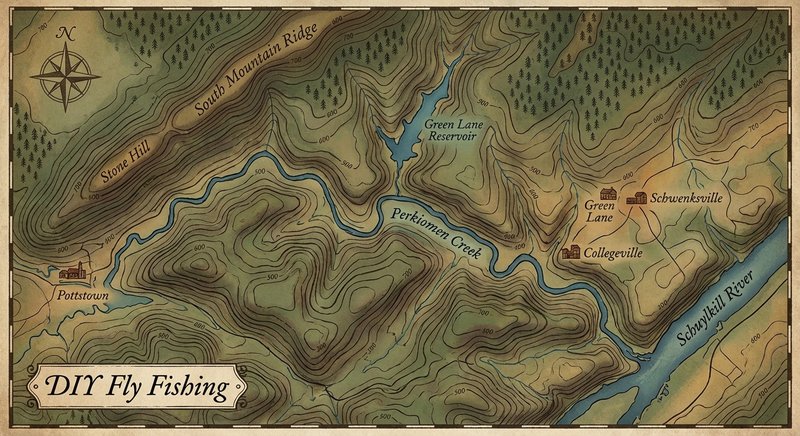
Perkiomen Creek
Fly fishing in Pennsylvania · Beginner · Best seasons: Spring, Summer, Fall
Target Species
Brown Trout, Rainbow Trout
About This Water
Montgomery County stream with stocked and holdover trout. Good fishing near Philly suburbs.
Fishing Recommendations
As an expert guide who has spent years navigating the diverse waters of the Keystone State, I can tell you that Perkiomen Creek (or "The Perk") is one of the most interesting transitional fisheries in Southeastern Pennsylvania.
While many anglers associate the Perk with Smallmouth Bass, the upper reaches and specific tributaries offer fantastic trout opportunities. Here is your professional guide to fly fishing Perkiomen Creek.
🎣 Location Overview
The Perkiomen Creek is a major tributary of the Schuylkill River, winding through Montgomery County. What makes it special is its "dual personality." The upper sections, particularly above Green Lane Reservoir and the East Branch, are classic Pennsylvania freestone environments characterized by shaded canopies, cobblestone bottoms, and cold-water inputs.
The water is generally fertile, with a mix of slow, deep "frog water" and lively riffles. Because it flows through suburban and rural landscapes, it offers surprisingly secluded sections reachable via the Perkiomen Trail, a 20-mile multi-use path that parallels much of the creek, providing unparalleled access for the mobile angler.
🐟 Target Species & Behavior
The primary targets for trout anglers are Stocked Rainbow and Brown Trout.
- Rainbow Trout: These are the primary focus of the Pennsylvania Fish and Boat Commission (PFBC) stockings. They tend to hold in the faster, highly oxygenated water at the heads of riffles. They are opportunistic and will often move for a flashy streamer or a drifted nymph.
- Brown Trout: While most are stocked, the Perk does have some "holdover" browns that survive in the deeper, cooler holes or near spring seeps. These fish are more nocturnal and wary, typically holding under undercut banks or sunken logs during the day.
- Bonus Species: Do not be surprised if you hook into a Smallmouth Bass or a large Fallfish. In the late spring and summer, these species become very active in the same runs where you find trout.
📅 Best Times to Fish
The Perkiomen is highly dependent on water temperature and flow.
- Spring (Mid-April – June): This is the "Golden Window." The PFBC heavily stocks the creek in April. May brings the best insect hatches, and water temperatures remain in the ideal 50°F to 60°F range.
- Summer (July – August): Trout fishing on the main stem becomes difficult as water temperatures often exceed 70°F (which is lethal for trout). During this time, I recommend targeting the East Branch or shifting your focus to Smallmouth Bass using topwater poppers.
- Fall (October – November): As temperatures drop, trout activity picks up again. The state often does a "Fall Stocking" in select areas. This is the best time to hunt for larger holdover Browns looking to bulk up for winter.
- Time of Day: In the spring, midday is productive. As the sun gets higher in late May, focus on first light and the last 90 minutes of the day (the "Magic Hour").
🪰 Recommended Flies & Techniques
Nymphing (The Bread & Butter)
Since the Perk can be slightly turbid (murky) after rain, fly visibility is key.
- Patterns:
- Bead-head Prince Nymph (Size 12-16) – The flash attracts fish in moving water.
- Pheasant Tail (Size 14-18) – To mimic the ubiquitous Mayfly nymphs.
- Squirmy Wormies or Egg Patterns – Deadly immediately following a stocking or after a rain shower.
- Technique: Use a strike indicator and ensure you are bouncing the bottom. If you aren't occasionally snagging a rock, you aren't deep enough.
Dry Fly Fishing (The Hatches)
The Perk has surprisingly good hatches for a suburban stream.
- Patterns:
- Elk Hair Caddis (Tan/Olive) (Size 14-16) – The most consistent hatch.
- Sulphurs (Size 16) – Look for these in late May.
- Adams/Parachute Adams (Size 14-18) – The best generalist searching pattern.
- Technique: Focus on the "bubble line" where the current slows down near the banks.
Streamers (For the Big Ones)
- Patterns: Woolly Buggers (Black or Olive, Size 8-10).
- Technique: Swing the streamer across the current and give it short, erratic strips. This is the best way to cover water and find aggressive fish.
💡 Pro Tips & Local Knowledge
- Follow the Cold Water: Focus your efforts on the sections near Green Lane Park and the stretch below the Green Lane Reservoir dam. The reservoir release helps stabilize temperatures.
- The "Trail" Advantage: Most anglers congregate near the bridges and parking lots. Use the Perkiomen Trail to walk 15–20 minutes away from any road access. You will find unpressured fish that are much more willing to take a fly.
- Check the Gauge: The Perkiomen rises quickly after heavy rain and can become dangerous and unfishable. Check the USGS Gauge at Graterford before heading out. Ideally, you want to see the flow stabilizing or dropping.
- Stealth Matters: Despite being a medium-sized creek, the trout in the Perk can be spooky in the clear, low water of late May. Wear earthy tones and avoid splashing while wading.
⚠️ Important Information
- Regulations: Most of the Perkiomen is managed under General Statewide Regulations. However, always check the PFBC Summary Book for any specific "Delayed Harvest" or "Catch and Release" sections that may be implemented on tributaries like the East Branch.
- Permits: You must have a valid Pennsylvania Fishing License and a Trout/Salmon Stamp.
- Access: Much of the creek runs through private land. However, the stretches within Green Lane Park and those adjacent to the Perkiomen Trail are public. Always respect "Posted" signs to ensure future access for all anglers.
- Wading Safety: The rocks in the Perk can be extremely "greasy" with algae. I highly recommend felt-soled wading boots with studs and a wading staff.
Tight lines, and enjoy your time on the Perk! It’s a gem of Montgomery County.
Bug Hatches & Matching Flies
| Hatch | Type | Peak months | Time of day | Hook sizes | Matching flies |
|---|---|---|---|---|---|
| White Fly Ephoron leukon | mayfly | August, September | Evening | #12-14 | White Wulff #12-14, Ephoron Spinner #12-14, Snowshoe Emerger #14 |
| Blue Winged Olive Baetis | mayfly | April, May, September, October | Late Morning/Afternoon | #18-22 | RS2 #20-22, BWO Sparkle Dun #18-22, Pheasant Tail Nymph #18-20 |
| Tan Caddis Hydropsyche | caddis | May, June | Evening | #14-18 | Elk Hair Caddis #14-16, LaFontaine's Deep Sparkle Pupa #14-16, Holy Grail #16 |
| Trico Tricorythodes | mayfly | July, August, September | Early Morning | #22-26 | Trico Spinner #22-24, Griffith's Gnat #22-24 |
| Sulphur Ephemerella dorothea | mayfly | May, June | Evening | #14-18 | Sulphur Parachute #16-18, Sulphur Emerger #16, Frenchie #14-16 |
| Japanese Beetle Popillia japonica | terrestrial | July, August | All Day | #10-14 | Foam Beetle #12-14, Coffee's Sparkle Beetle #12 |
| Zebra Midge Chironomidae | midge | January, February, March, December | Afternoon | #18-24 | Zebra Midge #18-22, Morgan's Midge #20-22 |
| Crane Fly Tipulidae | stonefly | May, September | Morning/Evening | #10-14 | Daddy Long Legs #10-12, Crane Fly Larva #10-12 |