Pine Creek
Fly fishing in Pennsylvania · Intermediate · Best seasons: Spring, Summer, Fall
Target Species
Brown Trout, Brook Trout
About This Water
The Grand Canyon of PA offers wild brown and brook trout fishing in scenic canyon.
Fishing Recommendations
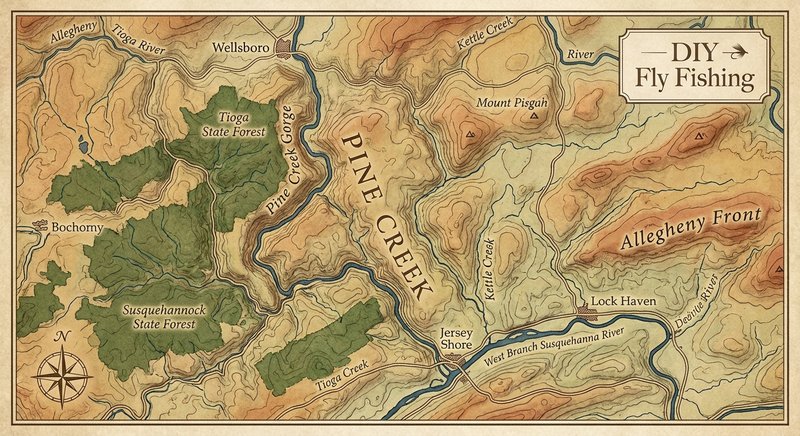
Pine Creek, often referred to as the "Grand Canyon of Pennsylvania," is one of the most iconic and scenic fly fishing destinations in the Eastern United States. Flowing through a massive gorge in Tioga and Lycoming counties, it offers a true wilderness experience combined with legendary hatches.
As your guide, here is the comprehensive breakdown for fishing this majestic freestone water.
🎣 Location Overview
Pine Creek is a massive freestone stream—at times resembling a river—carving through the Tioga State Forest. What makes it special is the scale; it is much larger than your typical Pennsylvania limestone spring creek.
The water is characterized by long, deep pools, massive riffles, and "pocket water" created by glacial boulders. Because it is a freestone system (dependent on snowmelt and rain), its character changes with the seasons. It’s a "big water" experience where you can really stretch out your backcast, surrounded by 1,000-foot canyon walls and soaring bald eagles.
🐟 Target Species & Behavior
- Brown Trout: The primary target in the main stem. These fish can grow quite large (18"+) due to the abundance of biomass. They hold in the deep "guts" of pools during the day and move into the riffles and tailouts to feed during hatch cycles.
- Brook Trout: While found in the main stem during spring, the native Brookies are the kings of the tributaries (like Slate Run and Cedar Run). They are opportunistic, aggressive, and prefer the cold, highly oxygenated headwaters.
- Behavior: Pine Creek trout are "hatch-oriented." When the bugs are off, the fish can seem absent. When a hatch is on, the river "boils." They are wary of shadows and heavy wading due to the clarity of the water in late spring.
📅 Best Times to Fish
- Spring (Late April – June): The Golden Era. This is the prime window. Water temperatures are ideal (55–65°F), and the major hatches (Hendricksons, Quill Gordons, and the famous Green Drake) occur now.
- Summer (July – August): The main stem can get dangerously warm for trout. Guide Tip: During summer, move to the "DH" (Delayed Harvest) sections or head into the colder, high-gradient tributaries like Slate Run. Early morning and late evening (trico/terrestrial time) are the only windows for the main stem.
- Fall (September – October): As water temps drop, Brown trout become aggressive ahead of the spawn. This is the best time for streamers. The foliage in the canyon is also world-class.
- Best Time of Day: During May/June, the "Evening Rise" is legendary, often lasting until total darkness.
🪰 Recommended Flies & Techniques
Top Fly Patterns
- Dry Flies:
- Green Drake (Size 8-10): The king of Pine Creek hatches (late May/early June).
- Slate Drake (Iso) (Size 12-14): Reliable throughout the summer and fall.
- Sulphurs (Size 16-18): Essential for May evenings.
- Blue Winged Olives (BWO) (Size 18-22): For overcast or drizzly days.
- Nymphs:
- Pheonix Tail (Size 14-18): Mimics almost everything.
- Walts Worm: A Pennsylvania staple for the "buggy" bottom of Pine.
- Golden Stonefly Nymphs: Pine has a massive population of stones.
- Streamers:
- Black or Olive Wooly Buggers: Essential for high water.
- Sculpin patterns: For big Browns in the deep canyon pools.
Effective Techniques
- The "Pine Creek Swing": Because the river is wide, swinging wet flies or soft hackles is incredibly effective during a hatch.
- Dry-Dropper: In the riffles, use a high-visibility dry (like a Chubby Chernobyl) with a small nymph 2 feet below.
- Long Leaders: Use 9 to 12-foot leaders tapered to 5X or 6X. The water is clear, and the fish are sophisticated.
💡 Pro Tips & Local Knowledge
- Focus on the Tributaries: If the main stem is high or warm, don't pack it in. Slate Run and Cedar Run are world-famous technical fisheries that flow into Pine. They require a stealthy approach and "mountain goat" wading skills.
- The Pine Creek Rail Trail: Use the 62-mile rail trail to access spots that are miles from the nearest road. A bicycle is a secret weapon for Pine Creek anglers; it allows you to reach "unpressured" water in the heart of the canyon.
- Watch the Gauge: Check the USGS gauge at Cedar Run. If it’s over 3.5 feet, wading can be treacherous. The sweet spot for wading is 2.0 to 3.0 feet.
- Match the Hatch, or Match the Movement: If you don't see rising fish, look for "flashing" underwater—this means trout are taking nymphs. Switch to a weighted nymph immediately.
⚠️ Important Information
- Access: Much of the canyon is accessible via the Pine Creek Rail Trail or Route 414. There are numerous PA Fish & Boat Commission (PFBC) access points.
- Regulations: Pine Creek has various regulations, including "Delayed Harvest Artificial Lures Only" (DHALO) sections. Always check the PFBC Summary Book before casting.
- Permits: A valid Pennsylvania Fishing License and a Trout/Salmon Permit are required for everyone 16 and older.
- Safety: This is a wilderness area. Cell service is non-existent in the canyon. Carry a whistle, let someone know where you are going, and be mindful of rattlesnakes on the rocky banks during summer.
Guide’s Final Word: Pine Creek isn't just a fishing trip; it's a pilgrimage. Take a moment to look up from the water—the scenery is as rewarding as the trout. Tight lines!
Bug Hatches & Matching Flies
| Hatch | Type | Peak months | Time of day | Hook sizes | Matching flies |
|---|---|---|---|---|---|
| Blue Quill Paraleptophlebia | mayfly | April | Mid-day | #16-18 | Blue Quill Dry #16-18, Pheasant Tail #16-18 |
| Hendrickson Ephemerella subvaria | mayfly | April, May | Afternoon | #12-14 | Red Quill #12-14, Hendrickson Emerger #12-14, Hare's Ear #12-14 |
| Grannom Caddis Brachycentrus | caddis | April, May | All Day | #14-16 | Grannom Pupa #14-16, Elk Hair Caddis (Olive/Black) #14-16 |
| March Brown Maccaffertium vicarium | mayfly | May | Afternoon | #10-12 | March Brown Dry #10-12, March Brown Wet Fly #10-12 |
| Sulphur Ephemerella invaria/dorothea | mayfly | May, June | Evening | #14-18 | Sulphur Parachute #14-18, Sulphur Emerger #14-16 |
| Green Drake Ephemera guttulata | mayfly | May, June | Evening/Twilight | #8-10 | Coffin Fly #8-10, Green Drake Nymph #8-10 |
| Slate Drake Isonychia bicolor | mayfly | May, June, September, October | Afternoon | #10-14 | Isonychia Parachute #10-12, Zug Bug #10-14 |
| Light Cahill Stenacron / Stenonema | mayfly | June, July | Evening | #12-16 | Light Cahill #12-16 |
| White Miller Epheron leukon | mayfly | August | Late Evening | #12-14 | White Wulff #12-14, White Miller #12-14 |
| Ants and Beetles Formicidae / Coleoptera | terrestrial | July, August, September | All Day | #12-20 | Black Foam Ant #16-20, Crowe Beetle #12-16 |