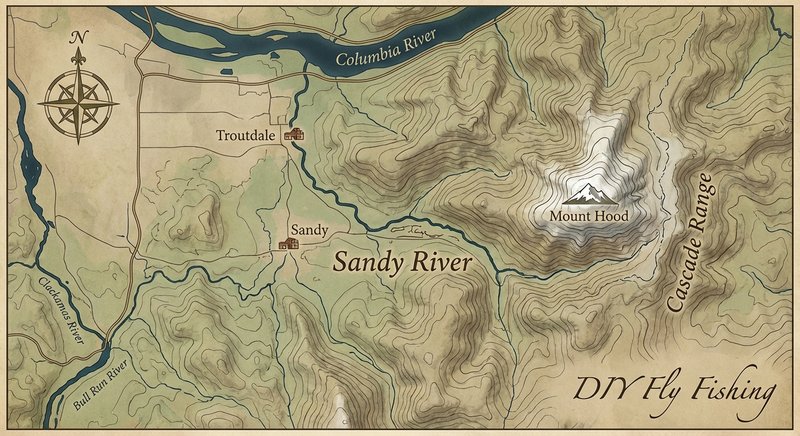
Sandy River
Fly fishing in Oregon · Intermediate · Best seasons: Fall, Winter, Spring
Target Species
Steelhead, Chinook Salmon, Coho Salmon
About This Water
Near Portland with excellent steelhead and salmon runs. Year-round fishing opportunities.
Fishing Recommendations
The Sandy River is a quintessential Pacific Northwest gem. Flowing from the glaciers of Mt. Hood down to the Columbia River, it offers some of the most dramatic scenery and challenging, rewarding fly fishing in Oregon—all within an hour’s drive of downtown Portland.
As your guide, here is the breakdown of how to tackle this technical, glacial-fed river.
🎣 Location Overview
The Sandy River is unique because of its glacial origin. It is a "working" river, meaning its character changes frequently due to sediment load and shifting gravel bars. It’s famous for its deep canyons, towering basalt cliffs, and the classic "swing" water that Spey anglers dream about.
What makes it special is the proximity to the metro area combined with a wild, rugged feel. Unlike the neighboring Deschutes, the Sandy is a coastal-style rain-fed and glacial-melt river. When the "Sandy is out" (too muddy to fish), it's usually due to heavy rain or rapid snowmelt, but when the emerald-green "fishy" water returns, it is world-class.
🐟 Target Species & Behavior
Winter & Summer Steelhead
- Behavior: These are the "ghosts" of the river. Winter runs (the main event) are chrome-bright and aggressive. They tend to hold in "walking pace" water—about 3 to 6 feet deep.
- Holding Water: Look for the "tailouts" of pools and the seams where fast water meets slow water. In winter, they hug the bottom to conserve energy; in summer, they may move into faster, oxygenated riffles.
Chinook Salmon (Spring & Fall)
- Behavior: Spring Chinook ("Springers") are the most prized for their strength and oil content. They are moody and often hold in deep, cold holes. Fall Chinook are larger, darker, and take up residence in deep pools before moving to spawning gravel.
- Feeding: They aren't feeding to survive, but they strike out of aggression or territorial instinct.
Coho Salmon (Fall)
- Behavior: Coho are the "acrobats." They love "froggy" water—slow, slack areas, and woody debris. They are notorious for following a fly and striking at the last second.
📅 Best Times to Fish
- Winter Steelhead (Prime: January – April): This is the peak season for fly anglers. Late February and March are often the "sweet spot" for settled water and fresh fish.
- Spring Chinook (May – June): A difficult but rewarding window. Look for "Springer" runs as the snowmelt begins.
- Fall Salmon (September – November): Coho and Fall Chinook dominate. September is excellent for Coho in the lower river; October sees them moving into the tributaries like Cedar Creek.
- Optimal Conditions: Look for a "dropping and clearing" hydrograph. You want the river visibility to be at least 2–3 feet. If the USGS gauge shows a sharp spike, stay home.
🪰 Recommended Flies & Techniques
The Spey Swing (The Local Favorite)
The Sandy is a premier Spey casting river. Swinging a fly allows you to cover large amounts of water efficiently.
- Flies: Intruder patterns in Pink/Orange (winter), Purple/Black (low light), or Blue/Chartreuse. For Coho, try smaller "Comet" patterns or flashy "Christmas Trees."
- Tip: Use Skagit heads with T-11 or T-14 sink tips to get the fly down into the "bucket" where fish hold in cold water.
Nymphing (Indicator Fishing)
Often more productive when fish are stacked in deep holes or when the water is very cold.
- Flies: Glo-bugs (beads), complex jigs, and "Rubber Legs" (Stonefly imitations).
- Tip: Use a long leader and plenty of weight. If you aren't ticking the bottom occasionally, you aren't deep enough.
The "Twitch" (For Coho)
- Technique: In slow water, cast a weighted marabou fly and "twitch" it back with short, erratic strips.
- Flies: Pink or Purple "Ho-bos" or weighted streamers.
💡 Pro Tips & Local Knowledge
- The "Sandy Green": There is a specific color—a milky, turquoise green—that indicates the glacial silt has settled just enough. This is the magic window. If the water looks like chocolate milk, it’s a "no-go."
- Focus on the Lower River: Most fly anglers focus on Oxbow Regional Park. It has miles of accessible bank and classic swinging runs.
- Cedar Creek Confluence: This is a high-traffic area because it's where many hatchery fish return. It can be "combat fishing" at times. If you want solitude, hike a mile up or downstream from the main access points.
- Short Casts First: Many anglers wade too deep and cast over the fish. Steelhead often hold in the "inside seam" only 10 feet from the bank. Fish the water at your feet before launching a long cast.
⚠️ Important Information
- Access Points:
- Lewis & Clark Park: Lower river, good for early-season Coho.
- Dabney State Recreation Area: Good wading access.
- Oxbow Regional Park: The "Mecca" for fly fishing the Sandy. (Note: Entry fee required, and the gate has strict opening/closing times).
- Revene Park: High-up canyon access.
- Regulations: Always check the ODFW Recreation Report. The Sandy has specific rules regarding wild vs. hatchery fish (clipped fins). Generally, all wild Steelhead and wild Chinook must be released unharmed.
- Safety: The Sandy has "quick-sand" pockets and shifting silt. Use a wading staff and be cautious after a high-water event, as the bottom topography may have completely changed.
- Permit: You need an Oregon Angling License and a Combined Angling Tag (Steelhead/Salmon).
Guide’s Final Word: The Sandy is a "1,000 cast" river. It rewards persistence, clean casting, and an understanding of water temperature. Stay patient, keep your fly in the water, and when that chrome-bright winter fish finally hits, you'll forget all about the rain.
Bug Hatches & Matching Flies
| Hatch | Type | Peak months | Time of day | Hook sizes | Matching flies |
|---|---|---|---|---|---|
| March Brown Rhithrogena morrisoni | mayfly | March, April, May | Afternoon | #12-14 | Western March Brown #12-14, Pheasant Tail #12-14, Hare's Ear Soft Hackle #12-14 |
| Blue Winged Olive Baetis | mayfly | February, March, October, November | Late Morning/Afternoon | #18-22 | Parachute Adams #18-22, RS2 #20-22, Baetis Nymph #18-20 |
| Golden Stonefly Hesperoperla pacifica | stonefly | June, July | All Day | #6-10 | Chubby Chernobyl (Gold) #8-12, Kaufmann's 20-Incher #6-10, Pat's Rubber Legs #6-10 |
| October Caddis Dicosmoecus gilvipes | caddis | September, October | Afternoon/Evening | #8-10 | Orange Stimulator #8-10, Morrish October Caddis #8-10, Peeping Caddis #8-12 |
| Salmonfly Pteronarcys californica | stonefly | May, June | Morning/Afternoon | #4-8 | Rogue Foam Stone #4-8, Jimmy Legs #6-8 |
| Pale Morning Dun Ephemerella | mayfly | June, July, August | Late Morning/Afternoon | #16-18 | PMD Sparkle Dun #16-18, Split Case PMD #16-18 |
| Skwala Stonefly Skwala americana | stonefly | February, March | Afternoon | #8-12 | Skwala Stone #10-12, Olive Girdled Sedge #10-12 |
| Spotted Sedge Hydropsyche | caddis | June, July, August, September | Evening | #14-16 | Elk Hair Caddis (Tan) #14-16, Pupa-tator #14-16, Frenchie #14-16 |