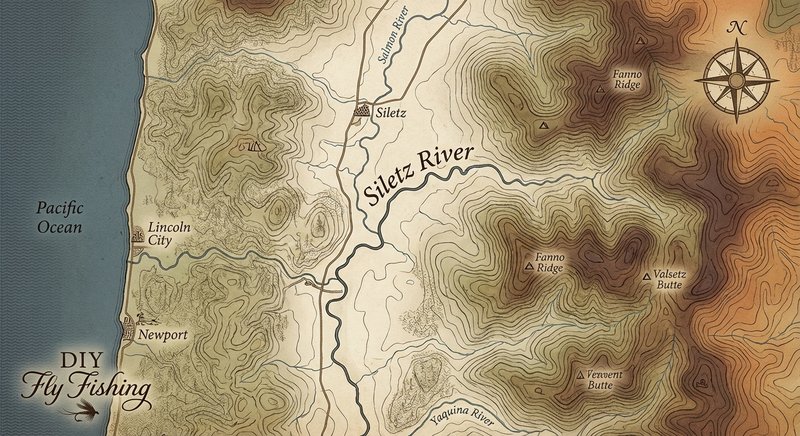
Siletz River
Fly fishing in Oregon · Intermediate · Best seasons: Fall, Winter
Target Species
Steelhead, Chinook Salmon, Cutthroat Trout
About This Water
Central coast river with excellent steelhead. Good fly water and scenic canyon.
Fishing Recommendations
The Siletz River is one of the crown jewels of the Oregon Coast. Stretching from the Coast Range down to the Pacific at Lincoln City, it offers a remarkably diverse range of water—from the steep, boulder-choked gradients of the upper river to the deep, slow-moving tidewater reaches. What makes the Siletz truly legendary is its "Siletz-strain" summer steelhead (the only native summer run in the Oregon Coast Range) and its prolific winter steelhead and fall Chinook runs.
Here is your comprehensive guide to fly fishing the Siletz River.
🎣 Location Overview
The Siletz is a river of two personalities. The Upper Siletz (above the town of Siletz and toward the Gorge) is characterized by classic "step-and-pool" pocket water, large basalt boulders, and tight canyons. The Lower Siletz is a meandering, pastoral river that eventually turns into a massive estuary.
Anglers love the Siletz because it is a "reactive" river; it clears faster than the neighboring Nestucca or Wilson rivers after a storm, often providing the first fishable water on the coast during a rainy winter. It offers world-class swinging water for Spey enthusiasts and technical nymphing for those chasing Coastal Cutthroat.
🐟 Target Species & Behavior
Steelhead (Winter & Summer)
- Behavior: The Siletz is famous for both runs. Winter Steelhead (December–April) are larger, aggressive, and hold in "soft" water (walking pace) to conserve energy in cold temperatures. Summer Steelhead (May–October) are acrobatic and will hold in faster, oxygenated riffles and "heads" of pools.
- Feeding: While they don't "feed" traditionally in freshwater, they strike out of aggression or territorial instinct.
Chinook Salmon (Fall)
- Behavior: These are "King" salmon. They enter the system in late August and peak in October. They tend to hold in deep, dark holes during the day and move through shallow tailouts at first and last light.
- Feeding: They are notorious "snappers" in tidewater but become more territorial as they move upstream toward spawning gravel.
Coastal Cutthroat Trout
- Behavior: Known as "Blue-backs," these fish are aggressive predators. They follow the salmon salmon eggs and fry, but also feed heavily on caddis and mayflies.
- Feeding: They love structure—fallen logs, overhanging branches, and the seams where fast water meets slow water.
📅 Best Times to Fish
- Winter Steelhead: January through March is prime. Look for a "dropping and clearing" hydrograph. When the river gauge at Siletz is between 4.5 and 6.0 feet, conditions are usually "green" and perfect.
- Fall Chinook: September and October. The first heavy rains of September pull the bulk of the fish out of the bay and into the river.
- Cutthroat Trout: July through September. This is the best time for dry fly action in the upper reaches.
- Prime Window: Early morning is essential for Chinook and Summer Steelhead. For Winter Steelhead, midday can actually be better as the water temperature rises a degree or two, making the fish more active.
🪰 Recommended Flies & Techniques
For Steelhead
- Technique: Spey Casting is the preferred method here. Swinging flies allows you to cover the vast runs of the mid-river.
- Flies:
- Winter: Large, weighted Intruders in Pink/Orange, Black/Blue, or "Nightshade" (Purple/Black).
- Summer: Smaller, unweighted flies like the Green Butt Skunk, Max Canyon, or Lady Caroline.
For Chinook Salmon
- Technique: Stripping Streamers in tidewater or Nymphing/Swinging large, heavy flies in the upper river.
- Flies: Comet patterns (Orange or Pink), Bunny Leeches, and the "Flash-n-Grab."
For Cutthroat Trout
- Technique: Light 3-weight or 4-weight rods. Dry-dropper rigs are deadly.
- Flies: Elk Hair Caddis (size 12-14), Royal Wulff, and small gold-ribbed Hare’s Ears.
💡 Pro Tips & Local Knowledge
- The "Siletz Gorge" Advantage: The upper river (Moonshine Park and above) stays cooler in the summer and clears faster in the winter. If the lower river is muddy, head as far upstream as the road allows.
- The Log Springs Road: For those willing to hike, the North Fork Siletz offers incredible solitude and "textbook" fly water, but it requires navigating timber company lands (check for gate closures/permits).
- The Low Light Rule: Chinook and Steelhead on the Siletz are notoriously light-sensitive. If the sun is hitting the water, fish the deep shadows under the heavy timber lining the banks.
- Short Leash the Boulders: When nymphing for Winter Steelhead, don't be afraid to fish "heavy and short" right against the face of the large basalt boulders. Fish often hug the cushion of water right in front of the rock.
⚠️ Important Information
- Access:
- Moonshine Park: A primary launch point for drift boats and excellent bank access.
- Stinger Creek to Ojalla: Classic drift boat water with several public pull-outs.
- Heeluck Barging: Private access points may require small fees or specific knowledge of tide cycles in the lower river.
- Regulations: The Siletz has complex regulations regarding wild vs. hatchery fish.
- Always check the ODFW Recreation Report before heading out.
- Most wild Steelhead must be released unharmed. Barbless hooks are highly recommended (and often required for certain species/seasons).
- Shuttles: Local shuttle services are available in the town of Siletz if you are bringing a drift boat or raft.
- Safety: The Siletz can rise rapidly. If you see logs and "heavy" debris floating by, it's time to get off the water.
Guide’s Final Word: The Siletz is a "moody" river. One day it feels empty; the next, it feels like every slot holds a chrome-bright fish. Persistence and watching the river gauges are the keys to success here. Tight lines!
Bug Hatches & Matching Flies
| Hatch | Type | Peak months | Time of day | Hook sizes | Matching flies |
|---|---|---|---|---|---|
| Blue Winged Olive Baetis tricaudatus | mayfly | March, April, September, October | Late Morning/Afternoon | #16-20 | Parachute Adams #16-20, RS2 #18-20, Pheasant Tail #16-18 |
| March Brown Rhithrogena morrisoni | mayfly | March, April | Mid-day | #12-14 | March Brown Dry #12-14, Hare's Ear #12-14, Soft Hackle March Brown #12-14 |
| Salmonfly Pteronarcys californica | stonefly | May, June | All Day | #4-8 | Chubby Chernobyl #6-10, Pat's Rubber Leg #4-8, Kaufmann's Stone #6-8 |
| October Caddis Dicosmoecus gilvipes | caddis | September, October | Late Afternoon/Evening | #8-12 | Orange Stimulator #8-12, Peeping Caddis #10-12, Morrish's October Caddis #8-10 |
| Golden Stonefly Hesperoperla pacifica | stonefly | June, July | Morning/Evening | #8-12 | Golden Stimulator #8-12, 20 Incher #10-12, Brooks Stone #8-10 |
| Spotted Sedge Hydropsyche | caddis | June, July, August | Evening | #14-16 | Elk Hair Caddis #14-16, LaFontaine's Deep Sparkle Pupa #14-16, Goddard Caddis #14 |
| Little Yellow Sally Isoperla | stonefly | June, July, August | Afternoon/Evening | #14-18 | Yellow Sally Dry #14-16, Iron Lotus #16-18, Little Yellow Sally Nymph #14-16 |
| Pale Morning Dun Ephemerella excrucians | mayfly | June, July | Late Morning/Afternoon | #14-18 | PMD Sparkle Dun #16-18, Pale Morning Dun Dry #14-16, Military Mayfly #16-18 |
| Midges Chironomidae | midge | January, February, December | Mid-day | #18-24 | Zebra Midge #18-22, Griffith's Gnat #20-22, Top Secret Midge #20-22 |