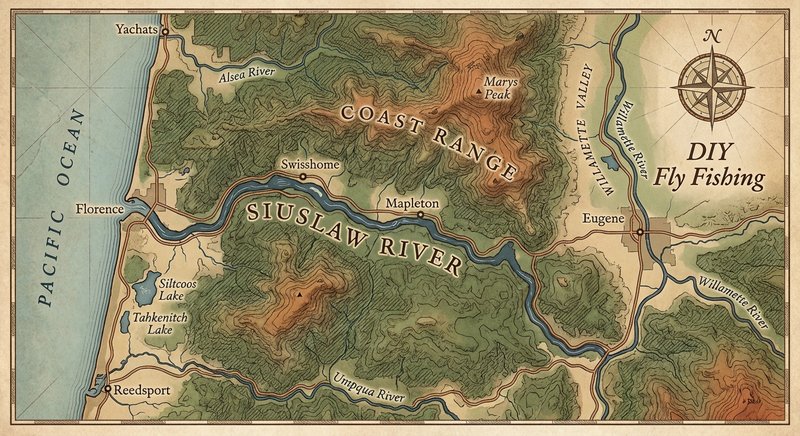
Siuslaw River
Fly fishing in Oregon · Beginner · Best seasons: Fall, Winter
Target Species
Steelhead, Cutthroat Trout, Chinook Salmon
About This Water
Coastal river near Florence with steelhead and cutthroat. Good tidewater fishing.
Fishing Recommendations
The Siuslaw River, winding through the lush Coast Range and emptying into the Pacific at Florence, Oregon, is a quintessential coastal river. Unlike the glacial-fed rivers of the Cascades, the Siuslaw is a "rain-fed" system. This means its character is defined by the rhythm of the Pacific storms. It is a moody, dark-water river that offers some of the best opportunities in the state for "bright" fish fresh off the tide.
🎣 Location Overview
The Siuslaw is beloved for its classic coastal aesthetics—overhanging vine maples, moss-covered logs, and deep, "root beer" colored water stained by tannins. It is a low-gradient river, meaning it doesn't have the roaring whitewater of the Rogue or Deschutes; instead, it features long, slow pools and walking-speed riffles.
What makes the Siuslaw special is its proximity to the ocean. Many of the best fishing holes are just a few miles from the salt, meaning the Steelhead and Salmon you hook are often "sea-bright" with sea lice still attached. It is also home to one of the most robust runs of wild Coastal Cutthroat Trout in the Pacific Northwest.
🐟 Target Species & Behavior
Winter Steelhead
The Siuslaw hosts both wild and hatchery winter-run Steelhead. These fish are known for being aggressive. Because the water is often tinted, they tend to hold in shallower water (3–6 feet) than you might expect, often hugging the "seams" where fast and slow water meet.
Chinook Salmon
The Siuslaw produces massive Fall Chinook. These are "tule" and "bright" stocks that enter the system with one goal. In the lower tidewater, they are aggressive; as they move upstream to the spawning beds, they become territorial.
Coastal Cutthroat Trout (Sea-run)
Locally known as "Bluebacks," these fish migrate to the estuary and ocean in spring and return to the river in late summer and fall. They are voracious predators, following the salmon upstream to feast on loose eggs and stirred-up nymphs.
📅 Best Times to Fish
- Fall (September – November): This is the peak for Chinook Salmon and Sea-run Cutthroat. Look for the first "freshet" (significant rain) in September to pull the fish out of the estuary and into the river.
- Winter (December – March): The prime window for Winter Steelhead. January and February are the "heart of the run."
- The "Golden Window": On the Siuslaw, the best fishing occurs when the river is dropping and clearing after a heavy rain. When the river gauge shows a downward trend and the water turns from "chocolate milk" to a "steel-green" or "root beer" clarity, drop everything and go.
🪰 Recommended Flies & Techniques
For Steelhead (The Swing & The Nymph)
- Swing: Use large, weighted Intruders or String Leeches in bright colors (Cerise/Orange or Blue/Black). The tannic water demands high-contrast flies.
- Nymphing: A 10mm or 12mm soft bead (mottled orange or "dead egg" white) under an indicator is incredibly effective here.
For Chinook (The Big Stuff)
- Fly Patterns: Comets (orange or pink), Bunyan Bugs, and large Flashy Buggers.
- Technique: Use a heavy sink-tip (T-11 or T-14) to get the fly down into the deep holes where Chinook rest during their journey.
For Cutthroat (The Opportunists)
- Fly Patterns: Borden Specials, Muddler Minnows, and Egg Patterns.
- Technique: Focus on the tailouts of pools and around submerged woody debris. A 4-weight or 5-weight rod is perfect for these feisty fish.
💡 Pro Tips & Local Knowledge
- Focus on Lake Creek: The Siuslaw has a major tributary called Lake Creek. Most of the hatchery Steelhead return here. If you are looking to take a fish home for the smoker, focus your efforts around the confluence and upstream on Lake Creek.
- Color Matters: In the dark, tannic water of the Siuslaw, Chartreuse and Pink are the "magic" colors. If the water is particularly murky, black silhouettes show up best from below.
- The "Tidewater" Secret: Early in the Fall season, don't be afraid to fly fish the tidewater reaches near Florence. Stripping large streamers on intermediate sinking lines can produce explosive strikes from fresh Chinook.
- Stay Mobile: The Siuslaw has limited bank access compared to some rivers. If a hole isn't producing, move. Many of the best spots are small "pockets" rather than long runs.
⚠️ Important Information
- Regulations: The Siuslaw has very specific regulations regarding wild vs. hatchery fish. Always check the current ODFW (Oregon Department of Fish and Wildlife) Southwest Zone regulations before heading out. Wild Steelhead must be released unharmed.
- Access: Key access points include the Whitaker Creek Recreation Site and various pull-outs along Highway 126 and Siuslaw River Road.
- Wading Safety: The Siuslaw has a "slick" bottom. The rocks are covered in a fine silt and algae. Felt soles (where legal) or studs are highly recommended. Watch out for "quick-sand" silt pockets in the lower river.
- Permits: You will need an Oregon Angling License and a Combined Angling Tag (Salmon/Steelhead). If you are fishing for Steelhead, ensure you have the required validation.
Guide’s Final Word: The Siuslaw isn't a river that gives up its secrets easily. It requires patience and an eye on the weather report. But when the rain stops and the river settles into that perfect emerald-tannin hue, there is no place in Oregon more beautiful to hook a silver fish.
Bug Hatches & Matching Flies
| Hatch | Type | Peak months | Time of day | Hook sizes | Matching flies |
|---|---|---|---|---|---|
| Blue-Winged Olive (BWO) Baetis tricaudatus | mayfly | March, April, September, October | Late Morning/Afternoon | #16-20 | Parachute Adams #16-20, RS2 #18-20, Pheasant Tail Nymph #16-20 |
| March Brown Rhithrogena morrisoni | mayfly | March, April, May | Afternoon | #12-14 | March Brown Western Deceiver #12-14, Gold Ribbed Hare's Ear #12-14, March Brown Wet Fly #12-14 |
| Grannom Caddis Brachycentrus | caddis | April, May | Morning/Afternoon | #14-16 | Peacock Caddis #14-16, Deep Sparkle Pupa #14-16, Elk Hair Caddis (Olive) #14-16 |
| Pale Morning Dun (PMD) Ephemerella invaria | mayfly | June, July, August | Late Morning/Early Afternoon | #14-18 | Sparkle Dun #16-18, PMD Parachute #14-18, Split Case PMD #16-18 |
| Golden Stonefly Hesperoperla pacifica | stonefly | June, July | Evening | #8-12 | Clark's Stone #8-10, Pat's Rubber Leg (Gold/Brown) #8-12, Rogue Foam Stone #10-12 |
| Cinnamon Caddis Hydropsyche | caddis | July, August, September | Evening | #14-16 | Elk Hair Caddis (Tan) #14-16, Caddis Larva (Green) #14-16, X-Caddis #14-16 |
| Yellow Sally Isoperla | stonefly | June, July | Afternoon/Evening | #14-16 | Little Yellow Sloan #14-16, Yellow Sally Nymph #14-16 |
| Midges Chironomidae | midge | January, February, December | All Day | #18-24 | Zebra Midge #18-22, Griffith's Gnat #20-22, Morgan's Midge #20-24 |
| Terrestrials Formicidae/Coleoptera | terrestrial | July, August, September | Afternoon | #12-16 | Cinnamon Ant #14-16, Black Foam Beetle #12-14 |