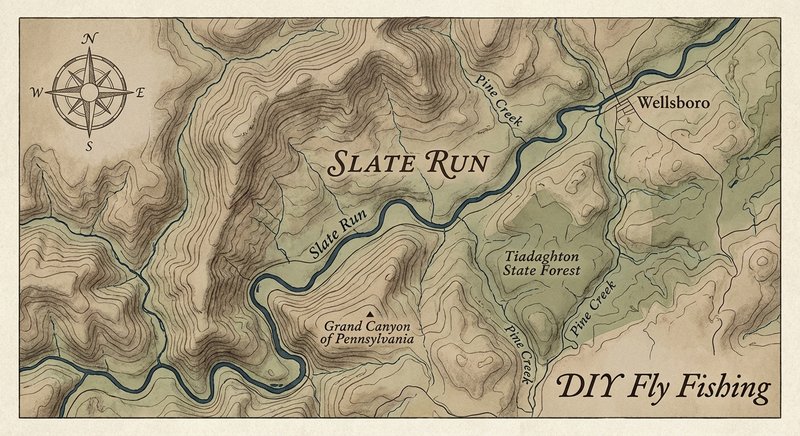
Slate Run
Fly fishing in Pennsylvania · Intermediate · Best seasons: Spring, Summer, Fall
Target Species
Brown Trout, Brook Trout
About This Water
Trophy trout water in Pine Creek valley. Wild brown trout with excellent public access.
Fishing Recommendations
Slate Run is widely considered one of the "crown jewels" of Pennsylvania fly fishing. Tucked away in the rugged Tiadaghton State Forest in Lycoming County, it is a quintessential freestone stream that offers some of the most technical and rewarding wild trout fishing in the Eastern United States.
Here is your comprehensive guide to fishing the legendary waters of Slate Run.
🎣 Location Overview
Slate Run is a classic Appalachian freestone stream that carves a deep, dramatic gorge through the Allegheny Plateau before emptying into Pine Creek. It is famous for its "big water in a small package" feel—featuring plunging waterfalls, deep crystalline pools, and complex pocket water.
What makes Slate Run special is its wildness. Unlike many stocked PA streams, Slate Run is managed for wild trout. It is a sterile, low-alkalinity environment, meaning the fish grow slowly and are incredibly savvy. Anglers love it because it demands high-level woodcraft, stealth, and precise presentation. When you land a 15-inch wild brown here, you’ve earned it.
🐟 Target Species & Behavior
- Wild Brown Trout: These are the primary residents of the lower and middle stretches. They are notoriously "spooky." They favor deep ledges, the dark shadows under overhanging rocks, and the turbulent "bubble lines" at the heads of pools.
- Native Brook Trout: Found predominantly in the upper reaches and the two main tributaries (Francis Branch and Cushman Branch). They are opportunistic but fragile, favoring the cold, highly oxygenated water of the headpins.
Behavior: Because the water is exceptionally clear, these fish have high visibility. They will bolt for cover at the slightest shadow or heavy footstep. During the day, larger browns stay deep; they move into the shallows to feed primarily during hatch events or low-light conditions.
📅 Best Times to Fish
- Spring (Mid-April to June): This is the "Prime Time." The water levels are usually perfect, and the major hatches (Hendricksons, March Browns, Sulphurs) occur.
- Summer (July to August): This is technical "terrestrial" season. The water gets low and clear. Pro Warning: Keep a thermometer on you. If the water temperature exceeds 68°F, stop fishing to protect the wild trout from lethal stress.
- Fall (September to October): A magical time. The crowds thin, the Brook Trout are in their vibrant spawning colors, and the Brown Trout become aggressive before their late-autumn spawn. The Isonychia (Slate Drake) hatch is the highlight here.
- Best Time of Day: During Spring, mid-day is best. In the heat of Summer, focus on the "Magic Hour"—the 60 minutes before dark—and the crack of dawn.
🪰 Recommended Flies & Techniques
Top Fly Patterns
- Dry Flies:
- Slate Drake (Isonychia): Sizes 10-12. The namesake fly of the run.
- Blue Winged Olive: Sizes 18-22 (Essential for overcast days).
- Elk Hair Caddis: Sizes 14-16 (Tan or Olive).
- Terrestrials: Black foam ants, beetles, and Dave’s Hoppers (Summer).
- Nymphs:
- Pheasant Tail: Sizes 16-20.
- Hare’s Ear: Sizes 14-18.
- Zebra Midge: Size 20 (For low water).
- Streamers:
- Black or Olive Wooly Buggers: Size 10-12 (Used during higher flows or "stained" water after rain).
Techniques & Presentation
- The Stealth Approach: This is more important than the fly. Wear drab clothing (camo or olive), stay low, and move slowly. Avoid "lining" the fish by using long, 9-to-12-foot leaders tapered to 6X or 7X.
- Upstream Dry Fly: Most fishing here is done casting upstream to rising fish. You must manage your slack perfectly to avoid "drag," which will instantly spook a Slate Run brown.
- High-Sticking Nymphing: In the plunge pools, use a tight-line or "Euro" style approach to keep your nymphs deep in the fast current without your fly line being caught in conflicting surface flows.
💡 Pro Tips & Local Knowledge
- The "Gorge" Section: The lower 7 miles are designated as Catch and Release / Artificial Lures Only. This area is rugged. Be prepared to hike and scramble over boulders.
- The Forks: Where the Francis Branch and Cushman Branch meet to form the main stem is a legendary spot. Explore the Francis Branch for more consistent brook trout action.
- The "Wolfe" Influence: Stop at Wolfe’s General Store (Slate Run Tackle Shop). It is the heartbeat of the valley. The staff knows exactly what is hatching that morning.
- Look for "The Bubble Line": In the deep pools, trout wait where the foam and bubbles gather. If you place your dry fly exactly in that foam line, your chances of a strike triple.
⚠️ Important Information
- Regulations: Slate Run is under Catch and Release - All Tackle and Catch and Release - Artificial Lures Only regulations depending on the specific stretch. Check the PA Fish & Boat Commission (PFBC) signs at access points.
- Permits: A valid Pennsylvania Fishing License and a Trout Permit are required for all anglers 16 and older.
- Safety:
- Rattlesnakes: Timber Rattlesnakes are common in the Slate Run gorge during summer. Watch where you step and where you place your hands when climbing rocks.
- Cell Service: Virtually non-existent. Download your maps for offline use and let someone know when you expect to be back.
- Wading: The rocks are incredibly slippery. Felt soles or studs are highly recommended.
Slate Run is not a place for "numbers"; it is a place for the purist. Respect the water, handle the fish with wet hands, and enjoy the silence of one of Pennsylvania's last truly wild places.
Bug Hatches & Matching Flies
| Hatch | Type | Peak months | Time of day | Hook sizes | Matching flies |
|---|---|---|---|---|---|
| Quill Gordon Epeorus pleuralis | mayfly | April | Afternoon | #12-14 | Quill Gordon Dry #12-14, Gordon Quill Nymph #12-14 |
| Hendrickson Ephemerella subvaria | mayfly | April, May | Afternoon | #12-14 | Red Quill #12-14, Hendrickson Emerger #12-14 |
| March Brown Maccaffertium vicarium | mayfly | May, June | Afternoon | #10-12 | March Brown Dry #10-12, Hare's Ear Nymph #10-14 |
| Sulphur Ephemerella invaria/dorothea | mayfly | May, June | Evening | #14-18 | Sulphur Parachute #14-18, Sulphur CDC Emerger #14-18 |
| Slate Drake Isonychia bicolor | mayfly | June, September | Afternoon/Evening | #10-12 | Iso Parachute #10-12, Zug Bug #10-12 |
| Eastern Green Drake Ephemera guttulata | mayfly | May, June | Evening | #8-10 | Green Drake Coffin Fly #8-10, Green Drake Nymph #8-10 |
| Grannom Caddis Brachycentrus | caddis | April, May | Morning/Afternoon | #14-16 | Elk Hair Caddis (Dark) #14-16, Pupa-can-do #14-16 |
| Tan Caddis Hydropsyche | caddis | June, July | Evening | #14-18 | Tan Elk Hair Caddis #14-18, LaFontaine's Deep Sparkle Pupa #14-16 |
| Giant Stonefly Pteronarcys dorsata | stonefly | May, June | Evening | #4-8 | Pat's Rubber Legs #4-8, Stimulator (Orange) #6-10 |
| Terrestrials Formicidae / Coleoptera | terrestrial | July, August, September | All Day | #12-20 | Flying Ant #16-20, Crowe Beetle #14-16 |