South Fork McKenzie
Fly fishing in Oregon · Intermediate · Best seasons: Summer, Fall
Target Species
Rainbow Trout, Bull Trout
About This Water
Wild trout tributary to the McKenzie. Less pressured than main river.
Fishing Recommendations
The South Fork of the McKenzie River is one of Oregon’s most enchanting and biologically diverse fisheries. Tucked into the Willamette National Forest, it offers a distinct experience compared to the larger mainstem McKenzie. It is a place of rugged beauty, characterized by old-growth forests, massive basalt boulders, and some of the most innovative river restoration work in the country.
🎣 Location Overview
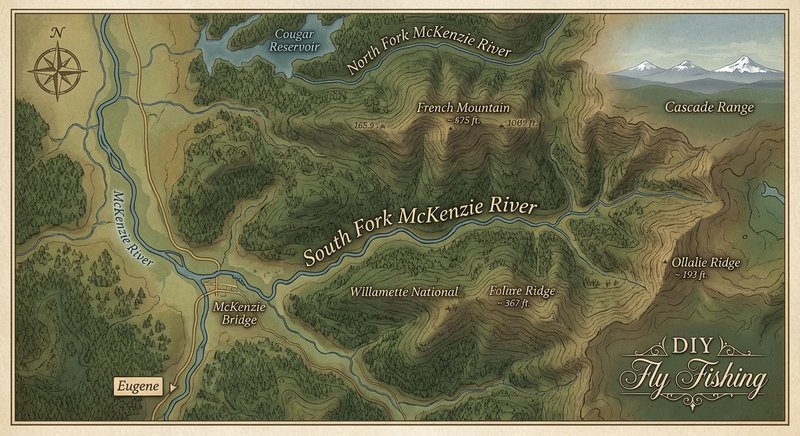
The South Fork McKenzie is a classic Cascadian freestone stream that feeds into the mainstem McKenzie near the town of Blue River. It is divided into two primary sections by Cougar Reservoir.
- The Upper South Fork (Above the Reservoir): This is high-country fishing. It feels intimate, with tight canopies and pocket water.
- The Lower South Fork (Below the Dam): This section has undergone massive "Stage 0" restoration. Instead of a single channel, the river now spreads into a complex web of braided side channels, log jams, and wetlands.
What makes it special is the water quality. It is exceptionally cold and clear, providing a refuge for wild trout even during the heat of mid-summer. Anglers love it for its solitude and the technical challenge of fishing around heavy woody debris.
🐟 Target Species & Behavior
Rainbow Trout (and Coastal Cutthroat)
The "Redband" Rainbows here are wild, vibrant, and incredibly strong for their size.
- Behavior: They are opportunistic feeders but wary. In the fast water, they hold in the "cushion" in front of boulders or in the soft seams along the banks.
- Feeding: They key in on heavy aquatic insect hatches (Caddis and Mayflies) but will move several feet for a well-presented terrestrial in late summer.
Bull Trout
The South Fork is a stronghold for the ESA-listed Bull Trout. These are the apex predators of the river.
- Behavior: They are "ghosts." You’ll find them in the deepest, darkest pools or hovering near the inlets of the reservoir. They are highly territorial and piscivorous (fish-eaters).
- Feeding: They primarily target Mountain Whitefish and smaller trout. They are rarely caught on dries; you have to go deep with large profiles to get their attention.
📅 Best Times to Fish
Summer (July – August)
This is the "Golden Age" for the South Fork. As other Oregon rivers warm up, the South Fork stays chilly.
- Conditions: Low, clear water.
- Prime Window: Early morning for nymphing; late evening (the last 90 minutes of light) for explosive dry fly action.
Fall (September – October)
My personal favorite time to be on the water. The vine maples turn brilliant red, and the fish sense winter coming.
- Conditions: The arrival of the October Caddis (Dicosmoecus).
- Prime Window: Mid-day becomes more productive as the water takes longer to warm up. Fall is also the best time to find large Bull Trout moving through the system.
🪰 Recommended Flies & Techniques
Dry Flies (The Stars of the Show)
- October Caddis (Size 8-10): Large, orange-bodied patterns. Great for "skating" across the surface.
- Elk Hair Caddis (Size 14-16): Tan or Olive. A staple for the South Fork.
- Parachute Adams (Size 14-18): The ultimate searcher pattern for the slower glides.
- Purple Haze: For some reason, the rainbows here have a penchant for purple.
Nymphs & Streamers
- Possie Bugger (Size 10-14): A local favorite developed on the McKenzie. It mimics everything and nothing at the same time.
- Perdigons (Size 16): Essential for getting down fast in the heavy pocket water.
- Dolly Llama (White/Olive): The go-to for Bull Trout. It has massive movement and triggers an aggressive predatory response.
Techniques
- The "Dry-Dropper": In the summer, run a size 12 Stimulator with a small Pheasant Tail nymph 24 inches below it. This covers both bases in the riffles.
- Short-Line Nymphing: Because the water is so clear, long casts can often spook fish. Get close, keep your rod tip high, and "tuck" your nymphs into the pockets behind logs.
💡 Pro Tips & Local Knowledge
- Focus on the Wood: In the newly restored sections below Cougar Dam, don't be intimidated by the downed trees. The largest trout hide directly under the root balls. If you aren't losing a few flies to the timber, you aren't fishing where the big ones live.
- The "Hatch" is Constant: Even if you don't see rising fish, the South Fork is oxygen-rich. Fish are almost always looking up. Don't be afraid to fish a dry fly through a "bubbly" riffle where you think a fish couldn't possibly see it.
- Wading Safety: The South Fork is notorious for "slick-snot" rocks. Felt soles (where legal) or studs are non-negotiable here. A wading staff is a very wise investment for the braided sections.
⚠️ Important Information
Regulations
- Bull Trout: Catch and Release ONLY. It is illegal to even remove them from the water for a photo in some jurisdictions. Handle with extreme care.
- Barbless Hooks: Highly recommended (and required in many sections) to protect the wild population.
- Check ODFW: Always check the current Oregon Sport Fishing Regulations for the "Willamette Zone" as rules regarding bait and harvest can change seasonally.
Access
- FS Road 19 (Aufderheide Drive): This is your main artery. It parallels much of the river. There are numerous pullouts and USFS campgrounds (like French Pete or Roaring River) that offer easy river access.
- Fire Impact: Be aware that the area has been impacted by wildfires in recent years. Watch for "widow-makers" (standing dead trees) on windy days.
Permits
- You will need a standard Oregon Angling License. If you are parking at USFS trailheads, a Northwest Forest Pass is often required.
The South Fork McKenzie is a gem that rewards the observant angler. Move slowly, stay stealthy, and enjoy the emerald waters of the Cascades. Tight lines!
Bug Hatches & Matching Flies
| Hatch | Type | Peak months | Time of day | Hook sizes | Matching flies |
|---|---|---|---|---|---|
| March Brown Rhithrogena morrisoni | mayfly | March, April, May | Afternoon | #12-14 | March Brown Western Deceiver #12-14, Hares Ear Nymph #12-14, March Brown Emerger #14 |
| Blue Winged Olive Baetis spp. | mayfly | March, April, September, October | Mid-day to Afternoon | #18-22 | Parachute BWO #18-20, RS2 #20-22, Pheasant Tail Nymph #18-20 |
| Salmonfly Pteronarcys californica | stonefly | May, June | All Day | #4-8 | Chubby Chernobyl (Orange) #6-10, Pats Rubber Legs (Black/Orange) #4-8, Clark's Stone #8 |
| Golden Stonefly Hesperoperla pacifica | stonefly | June, July | Morning/Evening | #8-12 | Norm Wood Special #8-10, Golden Stone Nymph #10-12, Yoshi's Golden Stone #10 |
| Pale Morning Dun Ephemerella spp. | mayfly | June, July, August | Late Morning to Afternoon | #14-18 | Sparkle Dun #16-18, PMD Parachute #14-16, Frenchie #16-18 |
| Mother's Day Caddis Brachycentrus occidentalis | caddis | April, May | Afternoon/Evening | #14-16 | Elk Hair Caddis (Dark) #14-16, Peacock Caddis #16, Deep Sparkle Pupa #14-16 |
| October Caddis Dicosmoecus gilvipes | caddis | September, October | Late Afternoon/Evening | #8-12 | October Caddis Orange Stimulator #8-10, Morrish October Caddis Adult #10, Peeping Caddis #10-12 |
| Yellow Sally Isoperla spp. | stonefly | June, July, August | Evening | #14-16 | Yellow Sally Stimulator #14-16, Little Yellow Stone Nymph #14-16, Yellow Sally Parachute #16 |
| Green Drake Drunella doddsii | mayfly | May, June | Mid-day | #10-12 | Green Drake Hairwing #10-12, Klinkhammer (Olive) #12, 20 Incher Stone #10 |
| Terrestrials (Ants/Beetles) Formicidae / Coleoptera | terrestrial | July, August, September | All Day | #12-18 | Cinnamon Ant #14-16, Black Foam Beetle #12-14, Fat Albert #12 |