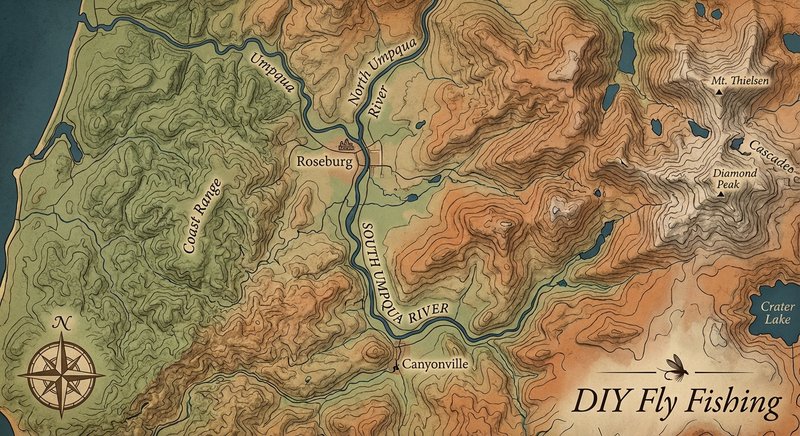
South Umpqua River
Fly fishing in Oregon · Beginner · Best seasons: Summer, Fall
Target Species
Smallmouth Bass, Steelhead
About This Water
Tributary with excellent smallmouth bass fishing. Warm summer water temperatures.
Fishing Recommendations
Welcome to the South Umpqua River, a hidden gem of Southern Oregon. While its sister to the north, the North Umpqua, gets the international glory for its legendary steelhead runs, the South Umpqua offers a rugged, intimate, and incredibly productive experience for fly anglers—especially those looking for world-class Smallmouth Bass action and tenacious Steelhead.
🎣 Location Overview
The South Umpqua flows through the heart of Douglas County, characterized by its dramatic bedrock formations, deep turquoise pools, and wide gravel bars. Unlike the North Umpqua’s volcanic, constant-flow nature, the South is a "freestone-style" river that is heavily influenced by seasonal rainfall.
What makes it special is the variety of water. You’ll find everything from slow, glass-calm flats to turbulent chutes and classic "greasy" tailouts. In the summer and fall, the water warms significantly, transforming the river into one of the most prolific Smallmouth Bass fisheries in the Pacific Northwest, while still hosting runs of Winter Steelhead that begin to arrive as the fall rains cool the system.
🐟 Target Species & Behavior
Smallmouth Bass
The South Umpqua is arguably one of the best Smallmouth rivers in the West.
- Behavior: They are aggressive and highly competitive. During summer, they hold in the swifter water at the heads of pools to oxygenate and intercept food. As the sun gets high, they move toward the shade of bedrock ledges or the deepest parts of the pools.
- Diet: Their primary diet consists of crayfish, sculpins, and various terrestrial insects (grasshoppers/crickets) that fall from the overhanging riparian brush.
Steelhead (Winter/Fall)
- Behavior: While the South is famous for its Winter Steelhead (returning Dec–April), the late fall brings the "Early Birds." These fish are fresh, silver, and often rest in the lower river waiting for the first big rain event to push upstream.
- Holding Water: Look for "walking pace" water—about 3–5 feet deep with a broken surface. They love resting near large boulders that break the current.
📅 Best Times to Fish
Summer (July – September)
- Target: Smallmouth Bass (Peak Season).
- Conditions: Low, clear, and warm water.
- Time of Day: First Light & Last Light. The "Golden Hour" on the South Umpqua is magical for topwater bass action. During the heat of the day (12 PM – 4 PM), fish deeper with weighted flies.
Fall (October – November)
- Target: Transition period. Smallmouth remain active but begin moving to deeper wintering holes. The first pulses of Steelhead begin to enter the system after the first significant autumn rains.
- Conditions: Cooling water temperatures.
- Time of Day: Mid-morning to late afternoon as the water warms slightly.
🪰 Recommended Flies & Techniques
For Smallmouth Bass
- Topwater: Umpqua’s Swimming Frog, BoogleBug Poppers (Chartreuse or White), and Murdoch’s Minnow.
- Technique: Cast toward the bank or overhanging trees. Let the rings dissipate, then give it two sharp "chugs."
- Subsurface: Rubber-Legged Woolly Buggers (Olive/Black), Clouser Minnows (Chartreuse/White), and Crayfish Patterns (Orange/Brown).
- Technique: Use a sink-tip line in deeper pools. Strip with a "twitch-twitch-pause" cadence to mimic a fleeing crawdad.
For Steelhead
- Traditional Swung Fly: Green Butt Skunk, Max Canyon, or Purple Peril.
- Technique: The "Down and Across" swing is king here. Cast at a 45-degree angle, mend upstream, and let the fly swing through the tension.
- Nymphing: Egg patterns, Prince Nymphs, and beaded Stoneflies.
- Technique: Use a strike indicator and ensure your fly is ticking the bottom.
💡 Pro Tips & Local Knowledge
- The Bedrock Secret: Smallmouth on the South Umpqua love the vertical cracks in the bedrock. If you see a shelf that drops from 2 feet to 8 feet instantly, that vertical wall is a "fish highway." Run a weighted streamer parallel to that wall.
- Wet Wading: In the summer, forget the waders. The water is warm and the rocks can be slippery. A good pair of felt-soled wading boots with neoprene socks is the way to go.
- The "Half-Pounder" Surprise: In the fall, you may hook into smaller, 12–16 inch Steelhead known as "half-pounders." They fight pound-for-pound harder than almost any other fish in the river. Use a 6-weight rod to make these encounters exhilarating.
- Strategic Sections:
- Low Water: Focus on the stretches near Canyonville and Myrtle Creek.
- Higher Water: Move down toward the "Forks" (where the North and South meet) near Roseburg.
⚠️ Important Information
- Access: Much of the South Umpqua follows Highway 99 and I-5. There are numerous public access points, boat ramps (Stanton Park, Douglas County Fairgrounds), and bridge crossings. Always respect "No Trespassing" signs on private ranch land.
- Regulations: The South Umpqua has specific regulations regarding bait and barbless hooks, which can change seasonally. Always check the current ODFW Recreation Report before heading out.
- Note: Wild Steelhead must be released unharmed. Only hatchery fish (clipped adipose fin) may be retained.
- Safety: The bedrock can be incredibly slick. Even in summer, a wading staff is highly recommended. Keep an eye on water levels; the South can rise rapidly after a heavy fall rain.
Guide’s Final Thought: If you want high-volume catching and aggressive strikes, hit the South Umpqua in August for the Bass. If you want the "Fish of a Thousand Casts" in a stunning, quiet setting, wait for the first cold rains of November. Tight lines!
Bug Hatches & Matching Flies
| Hatch | Type | Peak months | Time of day | Hook sizes | Matching flies |
|---|---|---|---|---|---|
| March Brown Rhithrogena morrisoni | mayfly | March, April | Afternoon | #12-14 | Western March Brown #12-14, Hare's Ear Nymph #12-14, March Brown Emerger #12-14 |
| Blue Winged Olive (BWO) Baetis | mayfly | February, March, October, November | Late Morning/Afternoon | #18-22 | Parachute Adams #18-22, RS2 #20-22, Pheasant Tail Nymph #18-20 |
| Golden Stonefly Hesperoperla pacifica | stonefly | May, June | Morning/Evening | #6-10 | Rogue Foam Stone #6-10, 20 Incher Stone #8-10, Pat's Rubber Legs #6-10 |
| Spotted Sedge Hydropsyche | caddis | May, June, July, August | Evening | #14-16 | Elk Hair Caddis #14-16, Pupa Sparkle Caddis #14-16, Hydropsyche Larva #14-16 |
| Pale Morning Dun (PMD) Ephemerella excrucians | mayfly | June, July | Late Morning/Early Afternoon | #16-18 | PMD Sparkle Dun #16-18, Split Case PMD #16-18 |
| Yellow Sally Isoperla | stonefly | June, July | Evening | #14-16 | Yellow Stimulator #14-16, Iron Sally #14-16 |
| October Caddis Dicosmoecus | caddis | September, October | Afternoon/Evening | #8-12 | Orange Stimulator #8-10, October Caddis Pupa #10-12, Peeking Caddis #10-12 |
| Terrestrials (Grasshoppers) Orthoptera | terrestrial | July, August, September | Mid-day/Afternoon | #8-12 | Dave's Hopper #8-12, Morrish Hopper #10-12 |
| Midges Chironomidae | midge | January, February, December | All Day | #18-24 | Zebra Midge #18-22, Griffith's Gnat #18-20 |