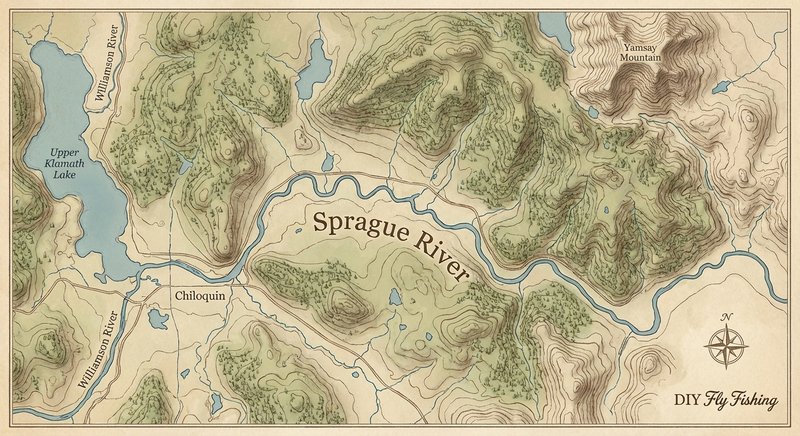
Sprague River
Fly fishing in Oregon · Intermediate · Best seasons: Spring, Fall
Target Species
Rainbow Trout, Brown Trout
About This Water
Klamath Basin river with excellent rainbow trout. Spring spawning runs from the lake.
Fishing Recommendations
The Sprague River in South-Central Oregon is one of the most enigmatic and rewarding "trophy" rivers in the Pacific Northwest. Flowing through the high-desert meadows of the Klamath Basin, it is a primary tributary to the legendary Williamson River. While it may look like a sleepy, meandering meadow stream, it hides some of the largest wild Rainbow Trout in the lower 48 states.
Here is your comprehensive guide to fly fishing the Sprague River.
🎣 Location Overview
The Sprague is a low-gradient, high-desert river characterized by deep, silty oxbows, willow-lined banks, and extensive meadow stretches. It is divided into the Main Stem, the North Fork, and the South Fork.
What makes the Sprague special is its role in the Klamath Basin ecosystem. It serves as a thermal refuge and spawning ground for the massive "Great Basin Redband Trout" that migrate up from Upper Klamath and Agency Lakes. This isn't a numbers river; it’s a "quality over quantity" fishery where a single hookup could result in a 10-pound rainbow of a lifetime.
🐟 Target Species & Behavior
Redband (Rainbow) Trout
These are the stars of the show. These fish are migratory, moving out of the warming lakes and into the Sprague starting in late spring.
- Behavior: They are notoriously shy. They hold in deep holes, under thick willow overhangs, and along undercut banks.
- Feeding: They are opportunistic but lean heavily toward high-protein meals: leeches, crawfish, and smaller tui chub/minnows.
Brown Trout
Predominantly found in the upper reaches and the North/South Forks.
- Behavior: Highly predatory. They lurk in the darkest shadows of the undercut banks.
- Feeding: In the fall, they become aggressive as they prepare to spawn. They respond well to large streamer patterns.
📅 Best Times to Fish
Spring (Late May – June)
As the snow melts in the Gearhart Mountain Wilderness and the river settles, the first push of lake-run fish arrives.
- Condition: Water is usually higher and slightly off-color, which is actually an advantage as it hides the angler.
Fall (September – October) — PRIME TIME
This is the most famous window. As the lakes cool, a second major migration occurs.
- Condition: Crystal clear water and cool mornings. The fish are at their strongest and heaviest.
Best Times of Day
- Low Light: The Sprague is shallow in many places. The best fishing occurs during the "golden hours"—the first two hours of light and the last two hours of light. On bright, sunny days, the big fish often shut down or retreat deep into the willows.
🪰 Recommended Flies & Techniques
Streamer Stripping (Most Effective)
Because the fish are often migratory and aggressive, swinging or stripping streamers is the preferred method.
- Flies: Black or Olive Woolly Buggers (size 4-8), Sculpzillas, Bunny Leeches, and Seal Buggers.
- Technique: Cast tight to the opposite bank—literally inches from the grass—and use a "strip-strip-pause" retrieve.
Nymphing
When the fish are holding deep in the oxbow bends.
- Flies: Girdle Bugs (Pat’s Rubber Legs) in tan/black, Prince Nymphs (size 10-12), and bead-head Pheasant Tails.
- Technique: Use a strike indicator and plenty of split shot to get the fly down into the "buckets" at the bottom of deep bends.
Dry Fly (Seasonal)
- Flies: PMDs in June; Grasshoppers and Chernobyl Ants in August/September.
- Technique: "Splat" a hopper near an undercut bank and give it a slight twitch.
💡 Pro Tips & Local Knowledge
- The "Willow Reach": Much of the Sprague is lined with thick willows. Stealth is more important than casting distance. Wear earthy tones and keep a low profile.
- Mind the Temperature: By July and August, the Main Stem can get quite warm (over 68°F). During this time, focus on the North Fork or areas with cold-water springs to avoid stressing the fish.
- Heavy Tackle: Do not bring a 4-weight rod here. You are fishing for fish that can exceed 25 inches in a river full of submerged logs and roots. A 9-foot 6-weight or 7-weight is the standard tool to move large fish away from cover.
- The "Slow Swing": If stripping isn't working, try a slow swing with a sink-tip line through the deeper runs, letting the fly flutter just above the bottom.
⚠️ Important Information
- Access: Much of the Sprague River Valley is private ranch land. Public access is limited primarily to bridge crossings (e.g., Beatty, Bly, and Chiloquin) and small parcels of BLM land. Always respect "No Trespassing" signs.
- Regulations: The Sprague is generally open from late May through October, but regulations can change. Catch and release is highly encouraged for all wild Redbands to preserve the genetics of these unique fish. Always check the current ODFW Central Zone Regulations.
- Wading Safety: The bottom of the Sprague can be "sticky" mud or silt. Be careful when wading, as you can easily sink past your knees in certain oxbows. A wading staff is highly recommended.
- Permits: A valid Oregon Angling License is required. No special Klamath tribal permits are needed for the river itself unless you are on specific tribal lands (check local maps).
The Sprague is a "thinking angler's" river. It rewards patience, stealth, and a willingness to hunt for one big fish rather than many small ones. Tight lines!
Bug Hatches & Matching Flies
| Hatch | Type | Peak months | Time of day | Hook sizes | Matching flies |
|---|---|---|---|---|---|
| Salmonfly Pteronarcys californica | stonefly | May, June | All Day | #4-8 | Chubby Chernobyl (Orange) #6-8, Kaufmann's Stone #4-8, Pat's Rubber Leg #6-10 |
| Golden Stonefly Hesperoperla pacifica | stonefly | June, July | Morning/Evening | #8-12 | Rogue River Stone #8-10, Golden 20-Incher #10-12 |
| Pale Morning Dun (PMD) Ephemerella excrucians | mayfly | June, July, August | Late Morning/Afternoon | #14-18 | Sparkle Dun #16-18, Pheasant Tail #14-18, PMD Emerger #16-18 |
| Blue Winged Olive (BWO) Baetis | mayfly | March, April, September, October | Midday | #18-22 | Parachute Adams #18-22, RS2 #20-22, Baetis Nymph #18-20 |
| Spotted Sedge Hydropsyche | caddis | June, July, August | Evening | #14-16 | Elk Hair Caddis #14-16, LaFontaine's Deep Sparkle Pupa #14-16, Peacock Caddis #16 |
| Trico Tricorythodes | mayfly | August, September | Early Morning | #20-24 | Trico Spinner #22-24, Trico Dun #22 |
| Grasshopper Melanoplus | terrestrial | July, August, September | Afternoon | #8-12 | Morrish Hopper #10-12, Dave's Hopper #8-12 |
| Black Midge Chironomidae | midge | January, February, March, November | Midday | #18-24 | Zebra Midge #18-22, Griffith's Gnat #20-22 |