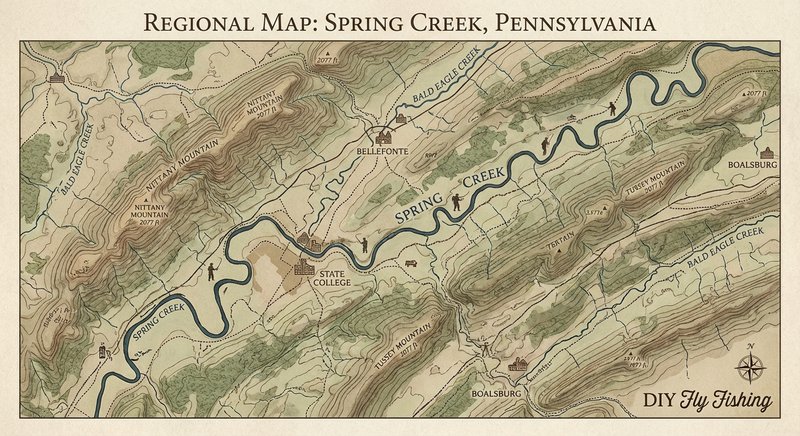
Spring Creek
Fly fishing in Pennsylvania · Intermediate · Best seasons: Spring, Summer, Fall
Target Species
Brown Trout, Rainbow Trout
About This Water
State College area limestone stream. Trophy trout program with large fish possible.
Fishing Recommendations
As an expert guide with decades spent on the limestone waters of the Mid-Atlantic, it is a pleasure to breakdown one of the crown jewels of American fly fishing: Spring Creek in Centre County, Pennsylvania.
🎣 Location Overview
Spring Creek is a legendary limestone spring creek flowing through the heart of State College and Bellefonte. What makes it special is its remarkable biomass and thermal stability. Fed by massive limestone aquifers, the water remains roughly 50–55°F year-round.
Unlike freestone rivers that suffer from seasonal temperature swings, Spring Creek is a "fish factory." It boasts one of the highest densities of wild brown trout in the Eastern United States. The water is rich in calcium carbonate, which fosters an explosion of aquatic life—scuds, sowbugs, and a massive variety of mayflies. It is a technical, beautiful, and highly rewarding fishery that requires a delicate touch and a "match the hatch" mentality.
🐟 Target Species & Behavior
- Wild Brown Trout: The undisputed kings of the creek. These are 100% wild, stream-born fish. They are wary, sophisticated, and have "PhD" levels of education regarding fly patterns.
- Rainbow Trout: While not as numerous as the browns, there are pockets of wild rainbows and some escapees from the local hatcheries (though the creek is no longer stocked).
Behavior: These fish are highly efficient. Because the current is generally moderate, they won't move far for a fly. They hold in "cushions" in front of rocks, in deep undercut banks, and in the "shelves" where shallow riffles drop into deeper pools. During hatches, they move into the tailouts and skinny water to sip emergers.
📅 Best Times to Fish
Spring Creek is a true 365-day fishery, but here is the seasonal breakdown:
- Spring (April – June): The Prime Window. This is when the major hatches occur. The Grannom Sedge (April) and the Sulphurs (May/June) are the most famous. The "Sulphur Blizzard" on Spring Creek is a bucket-list event for dry fly enthusiasts.
- Summer (July – August): While other PA streams get too hot, Spring Creek stays cool. Focus on early mornings and late evenings. This is prime Tersitial Season (Ants and Beetles).
- Fall (September – November): The Brown Trout become aggressive as they prepare to spawn. The Blue-Winged Olives (BWO) are consistent on overcast days.
- Best Time of Day: In Spring/Summer, the "magic hour" is the last 90 minutes of daylight. In Winter, midday (11 AM – 2 PM) is best when the sun warms the water slightly.
🪰 Recommended Flies & Techniques
Top Fly Patterns
- Nymphs:
- The Walt’s Worm (and Sexy Walt's): Developed nearby, this mimics the ubiquitous crane fly larvae and scuds.
- Zebra Midge: (Size 18-22) Essential for year-round success.
- Pheasant Tail: (Size 16-20) To mimic the Baetis and Sulphur nymphs.
- Scuds & Sowbugs: (Grey or Tan, Size 14-18) These are the "bread and butter" of a Spring Creek trout's diet.
- Dry Flies:
- Sulphur Parachute/Snowshoe: (Size 14-18).
- Blue-Winged Olive: (Size 18-22).
- CDC Ant: (Size 16-20) Vital for summer stealth fishing.
- Streamers:
- Black or Olive Wooly Buggers: (Size 8-10) Fished on a dead-drift or with slight twitches.
Techniques & Presentation
- European Nymphing: This is arguably the most effective way to fish Spring Creek. Because the fish hold in tight seams, a tight-line approach with thin leaders reduces drag and gets small flies down to the "zone" quickly.
- Dry-Dropper: Excellent for the riffles. Use a high-vis hopper or klinkhammer and hang a small pheasant tail 18 inches below.
- The "Reach Cast": Crucial for dry fly fishing to counteract the complex micro-currents that cause immediate fly drag.
💡 Pro Tips & Local Knowledge
- The "Fisherman's Paradise" Stretch: Located near Bellefonte, this is a historic catch-and-release area. It is heavily pressured but holds massive fish. To succeed here, you must drop your tippet size to 6X or 7X and use very small flies.
- The Canyon (Shiloh Road to Benner Spring): This is the soul of the creek. It requires some hiking, which thins out the crowds. Focus on the deep bends and the woody debris.
- Match the Speed, Not Just the Hatch: Drag is your number one enemy. If your fly moves even a fraction faster than the bubbles on the surface, a wild Spring Creek brown will refuse it.
- Stay Out of the Water: The creek is narrow. Whenever possible, fish from the bank. Wading often spook fish before you even make a cast.
⚠️ Important Information
- Regulations: Spring Creek is managed under Catch and Release All Tackle regulations. You can use flies, lures, or bait (though almost everyone here fly fishes), but you cannot possess any fish. It is a year-round open season.
- Access: Access is excellent. The "Benner Spring" area, "Fisherman's Paradise," and the "Canyon" all have well-maintained parking lots and trails.
- Mud Snails: CRITICAL. Spring Creek is infested with New Zealand Mud Snails. You must clean and dry your wading gear thoroughly before moving to another watershed (like Penns Creek) to prevent spreading this invasive species.
- License: A valid Pennsylvania Fishing License and a Trout/Salmon permit are required for all anglers 16 and older.
Spring Creek is a place of rhythm and patience. Take a moment to watch the water before you cast—the fish will tell you exactly where they are and what they are eating. Tight lines!
Bug Hatches & Matching Flies
| Hatch | Type | Peak months | Time of day | Hook sizes | Matching flies |
|---|---|---|---|---|---|
| Blue Winged Olive Baetis / Acerpenna | mayfly | March, April, September, October | Midday | #18-24 | RS2 #20-22, BWO Sparkle Dun #18-22, Pheasant Tail Nymph #18-24 |
| Sulphur Ephemerella invaria / dorothea | mayfly | May, June | Evening | #14-18 | Sulphur Snowshoe Emerger #14-18, CDC Sulphur Dun #16-18, Sulphur Spinner #14-18 |
| Trico Tricorythodes | mayfly | July, August, September | Early Morning | #22-26 | Trico Spinner #22-26, Drowned Trico #22-24 |
| Tan Caddis Hydropsyche | caddis | April, May, June | Evening | #14-18 | LaFontaine's Deep Sparkle Pupa #14-16, Elk Hair Caddis #14-18 |
| Grannom Brachycentrus | caddis | April | Midday/Afternoon | #12-16 | Peacock Caddis #14-16, Green Weenie #12-14 |
| Scud Gammarus | crustacean | January, April, July, October | All Day | #12-18 | Ray Charles #14-18, Pink Scud #12-16 |
| Crane Fly Tipulidae | midge | August, September | Afternoon/Evening | #8-12 | Daddy Long Legs #10-12, Crane Fly Larva #8-10 |
| White Curler (Terrestrial) Coleoptera (Ants/Beetles) | terrestrial | July, August | Midday | #12-20 | Black Foam Ant #16-20, Crowe Beetle #14-18 |
| Light Cahill Stenacron / Stenonema | mayfly | June, July | Evening | #12-14 | Light Cahill Dry #12-14 |